Saturday, May 22, 2021

Francisco Perea 1830–1913


 Francisco Perea of New Mexico, who fought to keep his territory loyal to the Union and served a term as a Delegate to the U.S. House of Representatives during the Civil War, was born on this date in Los Padillas, New Mexico. Perea attended private schools in New Mexico, and studied at colleges in St. Louis and New York City. Two of Perea’s schoolmates from New Mexico, Jose Francisco Chaves and Miguel Antonio Otero, later served as Delegates to Congress. After college, Perea returned to New Mexico and built a successful distribution and ranching business. From the summer of 1861 to the summer of 1862, Union forces attempted to dislodge Confederate occupiers of the New Mexico Territory. Over a four-month period, Perea rallied prominent New Mexicans, then under pressure to support the Confederacy, to remain with the Union. He raised a battalion at his own expense and served as lieutenant colonel of a regiment, seeing action against insurgents and Native Americans in the decisive battle of Apache Canyon that broke the back of the Confederate offensive in New Mexico. During the summer of 1863, Perea challenged José Manuel Gallegos for a seat in Congress. Narrowly elected as a Delegate to the 38th Congress (1863–1865), Perea submitted bills for war damage compensation and disputed land claims for his constituents. A close friend of Abraham Lincoln, Perea was seated near Lincoln’s box at Ford’s Theatre when the President was assassinated. Defeated for re-election to the 39th Congress (1865–1867) by Chaves, Perea returned to his business activities in New Mexico. He died in Albuquerque, on May 21, 1913.

Republican Delegate Francisco Perea of New Mexico
rallied New Mexicans to side with the Union in the Civil War. He was a Republican Congressman from 1863 - 1865

Francisco Perea capitalized on his family’s prominence and his military service to propel his career in territorial and national politics. The first Republican Hispanic-American Member of Congress, he dedicated his single term as Territorial Delegate to serving his constituents and containing the Indian threat to settlers by championing a controversial reservation system.

Perea was born in Los Padillas, New Mexico, on January 9, 1830, to Juan Perea and Josefa Chaves de Perea. Perea’s maternal grandfather, Francisco Xavier Chaves, was Mexico’s governor of the New Mexico province in the 1820s, and two of Perea’s maternal uncles eventually succeeded his grandfather. Perea’s father served in the Fourth Departmental Congress in 1846 and in the New Mexico Legislative Assembly in 1852 and 1857. After the U.S. war with Mexico, José Leandro, Perea’s paternal uncle, represented Bernalillo County in the First Legislative Assembly. Years later, his cousins Pedro Perea and José Francisco Chaves would serve as New Mexico’s Legislative Delegates to the U.S. Congress. Francisco studied at a local Bernalillo school in 1836 and 1837. He and his cousin José Chaves attended a Santa Fe school in 1837 and 1838, and Francisco transferred to a school in Albuquerque the following academic year. From 1839 to 1843, Perea tutored his younger siblings. Like many elite New Mexicans, he received a college education in Missouri, mastering English (again, with his cousin José F. Chaves) at Jesuit College in St. Louis from 1843 to 1845. While the Mexican-American War raged on, Perea traveled to New York City’s Bank Street Academy in 1847, completing his studies in 1849. During this sojourn, Perea and a colleague visited East Coast cities including Philadelphia, Baltimore, and Washington, D.C.; they also traveled to northern New York and Chicago.

Perea returned to New Mexico in 1850 to pursue a career in business that included ranching, trade, and commerce. He served as a distributor of manufactured goods to New Mexicans by importing products from cities such as St. Louis, and Independence, Missouri, at the head of the Santa Fe Trail. He also herded sheep to California for sale in the markets. After making a fortune selling sheep, Perea invested in the Atlantic and Pacific Railroad. Perea married twice. He had 18 children with his first wife, Dolores Otero (a niece of Territorial Delegate Miguel Antonio Otero’s), whom he wed in 1851, but many of them died in infancy. Dolores died in 1866. In 1875 Perea married Gabriela Montoya, with whom he had 18 more children, but only 10 were living at the time of his death.1

Perea entered politics when he was elected to New Mexico’s Eighth Legislative Assembly in 1858 for a two-year term representing Bernalillo County.2 Aside from his pedigree, his motivation to run for political office is unclear. A staunch Republican, Perea considered Abraham Lincoln’s election to the presidency in 1860 to be fortuitous for the Union. The news of Lincoln’s election, Perea recalled, “was celebrated by immense processions of men and boys marching through the principal streets to the music of many brass bands, the firing of cannon, and the discharging of anvils.”3 Nevertheless, New Mexican loyalties were split between pro-Confederate Democrats and pro-Union Republicans; the territory became a flashpoint for conflict during 1861 and 1862.

In the summer and fall of 1861, Perea advocated for New Mexico to remain in the Union by appealing to “every prominent man in the … territory.” In light of New Mexico’s precarious condition, Lincoln authorized Governor Henry Connelly to raise two full regiments and four battalions of four companies each. Perea organized a volunteer battalion at his own expense and was commissioned as a regimental lieutenant colonel.4 Dubbed “Perea’s Battalion,” the unit was stationed near Albuquerque, where its namesake commander led various campaigns against Apaches and Navajos in 1861 and 1862. The battalion also saw action in the Apache Canyon at the Battle of Glorieta Pass, a pivotal engagement that forced the Confederates out of New Mexico in March 1862. Shortly thereafter, Perea resigned his commission and returned to civilian life.5

In January 1863, Perea ran for the position of Territorial Delegate to the U.S. House in the 38th Congress (1863–1865), winning the Republican nomination that June. He outlined his proposed legislative priorities in a public letter that was printed in New Mexico newspapers. Perea’s experience fighting Indians convinced him that the two cultures could not coexist. He condemned past treaties as “worse than useless,” suggesting that American Indians were liable “to do wrong in accordance with the instincts of the savage nature.” Justifying his solution—to remove Indians to reservations—he argued, “It will be acting the part of wisdom in our own behalf and the part of philanthropy on behalf of the savages … [there] they may be compelled to earn their subsistence by the labor of their own hands, and have the opportunity given them to cultivate the habits and enjoy the blessings of civilization and Christianity.”6

The economic leg of his platform was closely associated with suppressing American Indians, particularly the Apaches, because their removal would open more land to settlers and allow the exploitation of New Mexico’s mineral resources. Perea believed mining would determine the territory’s financial fortunes. “Nothing can give our Territory as much prominence in the eyes of the people throughout the United States as the fact of the existence of rich gold producing mines in our midst,” he wrote. To remove the Indians, Perea promised that as Delegate, he would make “every exertion I can put forth … to strengthen the hands of our [military] Department commander and give him sufficient force to expel the savages from the bounteous fields which should now be furnishing profitable employment to thousands of our people.”7

Perea advised against implementing statehood in the midst of war, noting that the issue might be exploited by “men ambitious of place and power” and arguing that public sentiment did not support it.8 Nevertheless, he urged continued support for the Lincoln administration, asserting, “It is the duty of all citizens to occupy themselves with the stern realities with which we are confronted and do all in their power to maintain the integrity of the government.” He left no doubt that as Delegate, he would exert “the whole of my influence … in favor of the reestablishment of the Union as it was and the enforcement of the constitution as it is.”9

Perea’s opponents were José Manuel Gallegos and Judge Joab Houghton, a former chief justice of the superior court under New Mexico’s military government and an associate of Miguel Otero’s brother Antonio José.10 Houghton dropped out of the race in July 1863 and threw his support to Perea.11 Gallegos, a prominent but controversial priest-turned-politician, served as a Territorial Delegate in the 33rd and 34th Congresses (1853–1857), but was unseated in his second term after Miguel Otero contested his election. However, Gallegos remained a power in territorial politics, serving as speaker in the Tenth, Eleventh, and Twelfth Legislative Assemblies (1860–1862).12 Although Gallegos ran as a Democrat, he was pro-Union and was imprisoned during the Confederate occupation of Santa Fe, but his party designation left him open to charges of collaborating with secessionists.

Perea’s supporters resurrected tactics other territorial politicians had used against Gallegos, advertising his suspension from the Catholic priesthood and his affiliation with a cadre of activist priests before the American occupation. A seamy campaign poem entitled El Padrecillo (“The Father”), circulated by Perea’s backers, mocked Gallegos’s connections to administrative corruption and his obliviousness to such ethical lapses. The poem also publicized Gallegos’s controversial relationship with Candelaria Montoya, a widow.13 According to one account, Perea visited nearly every part of the territory and frequently spoke to crowds.14 The initial results showed that Perea won the election, with 7,231 votes to Gallegos’s 6,425.15 However, a variety of seeming irregularities in various counties persuaded Republican governor Henry Connelly to have “the vote reconstructed from the tallies kept by election officials in the precincts, and these were tabulated in place of the actual ballots.” The recount confirmed Perea’s majority.16 Gallegos and his supporters contested the results, arguing that Connelly had exceeded his authority, but when Gallegos was denied an extension to obtain more testimony from voters, his case fell apart, and the House Committee on Elections awarded the seat to Perea.17

Like the other Delegates of the era, Perea was not permitted to sit on a standing committee when he was sworn in to the 38th Congress (1863–1865). Nevertheless, he submitted bills regarding a range of constituent services and personal legislative interests; but because Republicans controlled the chamber and tended to support the development of national infrastructure, Perea’s initiatives enjoyed only modest success.18 In early 1864, Perea requested funds to construct a military road between Taos, New Mexico, and the territorial capital of Santa Fe. Another measure requested financial aid for communities in the New Mexico Territory and the newly created Arizona Territory, and a third measure asked for the implementation of boundaries between the New Mexico, Colorado, and Arizona Territories. Perea responded to the needs of military veterans by submitting private relief bills and requesting payments for volunteer companies that served against hostile Indian tribes and in the Mexican-American War. All the bills were read and submitted to the appropriate committees, but no action was taken.19 Perea tried to secure money for surveying land in New Mexico in H.R. 786, a miscellaneous appropriations bill, but he was unsuccessful.20 True to his campaign promise, he took particular interest in a Senate bill that requested “aid in the settlement, subsistence, and support of the Navajo Indian captives upon a reservation in the Territory of New Mexico.” The bill mustered enough votes to pass, but Senator William Windom of Minnesota killed it using a parliamentary tactic.21

During his tenure, Perea became close friends with President Lincoln, to whom he was introduced by former New Mexico Territorial Delegate John S. Watts in 1864. “I met the President in the White House, in company with a number of senators, representatives, and others,” Perea recalled. Perea went to see Lincoln “time after time on business connected with complaints against [territorial] officials and other difficulties.” Perea reported that he “occupied the seat in the pit of the theater directly under the Lincoln box” on the evening of April 14, 1865. “I heard the shot fired by [John Wilkes] Booth,” he said.22 Also, Perea served as one of three delegates to the Republican National Convention in Baltimore, Maryland, in 1864.23 According to a contemporary account, Perea “bore aloft the Star Spangled banner, over which streamed a pure white penant bearing … the motto: ‘New Mexico–the Union and the Monroe Doctrine forever.’ The flag and its motto attracted great attention and elicited loud applause.”24

Perea used his influence as a Territorial Delegate to persuade federal officials in Washington, D.C., to attack political opponents and promote the careers of his allies back home. During the contested election case, Perea wrote a number of letters to Secretary of State William H. Seward about the professional conduct of William F. M. Arny, the territorial secretary and a committed ally of José Manuel Gallegos. In one letter, Perea enclosed documents alleging that Arny’s performance had alienated constituents. Perea also noted that Arny had “undertaken to come to Washington with(out) leave” from territorial superiors to hire lawyers to represent Gallegos in February 1864.25 A month later, Perea informed Seward about Arny’s support of Gallegos, neglecting to tell him about Governor Connelly’s relationship with the Perea family. Perea wrote, “It becomes obvious beyond question, that he has been not only instrumental in exciting a contest for my seat in Congrefs, but that the principal object … is to act as an agent in behalf of the contestant.” Perea considered Arny’s conduct “reprehensible, in disturbing the political quietude of the Territory by agitating this contest, after the voice of the people had spoken and their decision had been announced in the form of law” and asked that he be removed.26

Early in 1865, Perea became involved in a dispute between the New Mexico and Colorado Territories concerning The Conejos, a large tract of land on New Mexico’s northern border that was ceded to Colorado upon its incorporation in 1861. In a published letter to James Ashley of Ohio, Chairman of the House Committee on Territories, Perea alleged that “the sole purpose of such a severance was to give evenness and symmetry to the southern boundary of Colorado … at the serious expense of New Mexico.” Perea noted that the “population of Los Conejos … are almost entirely Mexicans. They are foreign in language … from the great body of the people of Colorado. The laws of that Territory are enacted and published only in the English language, which they do not understand and the legislative discussions and deliberations are conducted in the same language.” Perea emphasized the Conejans’ foreignness, their affinity for Spanish institutions, and their incompatibility with Colorado Anglos and American jurisprudence. He deemed the situation “utterly repugnant to the true principles of liberty” and requested its immediate amelioration.27

Perea insisted that New Mexican citizenship would satisfy the cultural aspirations of the Conejans. He noted that one of the earliest acts of the New Mexico territorial government was to declare “that the principles of the civil law should prevail in all civil causes that might arise before their courts; and the Congress of the United States, in approving that legislation … manifested its appreciation of their desire to preserve and perpetuate their ancient and venerated system of jurisprudence.”28 New Mexicans, Perea maintained, were uniquely suited to managing this still-foreign people. Although “they have formed a patriotic fondness for this government, and are now earned and true in their allegiance to their new sovereign, the change was not a matter of their own choice. The acquisition of their country was the fruit of war waged by the United States against their native land, and by every consideration of justice and humanity they are entitled to the enjoyment of their native language, and their system of law and domestic usages, so long … as they do not conflict with the principles of the general government.” Perea submitted the bill in the waning weeks of the session, and the Committee on Territories did not act on it. After acquiring the region, Colorado retained it through its territorial period (1861–1876); today Los Conejos remains part of that state.29

Perea began running for re-election in January 1865. In a glowing editorial, the Santa Fe Weekly Gazette noted that he had been a highly effective legislator and had stood firm in his support of the Lincoln administration. While admitting Perea’s “efforts have secured but very meager appropriations—sums far below the amounts obtained by his predecessors,” the editors blamed the war for siphoning off federal funds. Alluding to the tempestuous tenures of earlier Territorial Delegates, they appealed to constituents to keep Perea in office because he was experienced. In an effort to defuse potential contenders’ use of a native-son platform, the editors suggested that replacing Perea would be “unfair to the Mexican people as a race” because it would deprive New Mexicans of an incumbent with seniority. Other Members of Congress “are possessed of advantages which the New Mexican people are unwilling to give to their own sons,” they wrote. If Perea “is successfully opposed by a native, that native will be no further advanced than his predecessor.… Thus always we shall have inexperienced Representatives, and so always be subjected to the same imputation and disadvantages.”30 To Perea, the editors wrote, “[You are] worthy of our confidence; you have done your work well and are entitled to the reward of re-election to the place which for two years you have so worthily filled.”31 Perea responded that he was “grateful to the public for past favors” [and] would “endeavor to continue to merit their approbation” upon being re-elected.32

Perea’s acceptance letter for the Republican nomination in July 1865 outlined his successes and his plans for another term. Adopting the party platform, he acknowledged that much of his energy was focused on containing “our deadly enemies” the Navajo Indians. As part of that platform, he embraced a developing military-led effort to forcibly remove Navajos to a reservation known as the Bosque Redondo in eastern New Mexico. Perea noted, “I have steadfastly, in Congress, before the Committees on Indian Affairs in both Houses and before the Interior and War Departments of the Government, advocated the policy which is now observed of keeping that tribe on the Reservation at the Bosque Redondo.” After vigorously defending the policy, he added, “Those who oppose the Government in its efforts to thus relieve us of our despoilers are the worst enemies the Territory can have.” If he was re-elected for another term, Perea promised, “I shall continue to use all the influence I possess to have the reservation system made permanent and in this way, secure lasting peace with the Indians.”33

Perea’s principal election opponent was his cousin, José Francisco Chaves. Although both men were Republicans, they represented distinct territorial factions. Perea was nominated to lead the Union Party ticket. Unionists, explains historian Howard Lamar, “supported the Indian reservation policy … praised General [James H.] Carleton and the troops participating in the Indian campaigns, recognized the supremacy of the United States Government, and condemned Abraham Lincoln’s assassination.” Chaves was an Administration Party candidate. The Administration faction’s loyalties were identical to those of Unionists, but they opposed Carleton’s policy of forcing the Navajos onto the Bosque Redondo Reservation.34

Perea noted that although he and Chaves were “connected by the most endearing ties of consanguinity,” his cousin had “allowed himself to pass into the hands of my enemies, the enemies of my political friends and, as I hold, the enemies of the Territory.”35 The campaign hinged on the Bosque Redondo Reservation experiment. Perea fully supported its expansion, whereas Chaves opposed it. Chaves also criticized Perea’s efforts to regain Los Conejos. Throughout the summer of 1865, Perea’s political standing suffered from his association with the controversial General Carleton, who was eventually removed from his post.36 Chaves prevailed, with a 58 to 42 percent victory.37

Afterward, Perea returned to his business activities in New Mexico and, according to his eulogist W. H. H. Allison, retained a large amount of political influence by controlling federal appointments to the territory under President Andrew Johnson’s administration. Later, Perea was elected to the territory’s Sixteenth and Twenty-Sixth Legislative Assemblies (1866–1867 and 1886–1887, respectively) as a representative of Bernalillo County. In 1881 Perea owned and operated a resort hotel in Jemez Springs, New Mexico, where he also served as postmaster from 1894 to 1905. Perea died in Albuquerque at age 83 on May 21, 1913.38

Biographical Directory of the American Congress, 1774-1971. The Continental Congress (September 5, 1774 to October 21, 1788) and the Congress of the United States (from the first through the ninety- first Congress March 4, 1789, to January 3, 1971, inclusive). Washington, DC: U.S. Government Printing Office, 1971. Biographies begin on page 487. (BiDrAC) Biographical Directory of the United States Congress, 1774-1989. The Continental Congress, September 5, 1774 to October 21, 1788 and the Congress of the United States from the first through the one hundredth Congresses, March 4, 1789, to January 3, 1989, inclusive. Bicentennial Edition. Washington, DC: U.S. Government Printing Office, 1989. Biographies begin on page 507. (BiDrUSC) Biography Index. A cumulative index to biographical material in books and magazines. Volume 16: September, 1988-August, 1990. New York: H.W. Wilson Co., 1990. (BioIn 16) The Hispanic American Almanac. A reference work on Hispanics in the United States. By Nicolas Kanellos. Detroit: Gale Research, 1993. Use the Index to locate biographies. (HispAmA 1) The Hispanic American Almanac. A reference work on Hispanics in the United States. Third edition. Detroit: Gale Group, 2003. Use the Index to locate biographies. (HispAmA 3) Mexican American Biographies. A historical dictionary, 1836-1987. By Matt S. Meier. New York: Greenwood Press, 1988. (MexAmB) Who Was Who in American Politics. A biographical dictionary of over 4,000 men and women who contributed to the United States political scene from colonial days up to and including the immediate past. By Dan and Inez Morris. New York: Hawthorn Books, 1974. (WhAmP)

Sunday, January 10, 2021

The Parallels of Family History and Current Events

When I was young, my mother would sometimes proudly talk about her uncles and great uncles who were politicians in New Mexico. When she spoke the surnames of her family, she did so with such pride. Unfortunately, I didn't know enough about New Mexico history to show interest in the conversation or to ask important questions. I didn't have a clue that my family, on both sides were the founding families of New Mexico. Throughout the four centuries that my family had lived in New Mexico, each generation had experienced a very different New Mexico. 

It wasn't until after my parents had passes away that I feverishly became interested in my family history. In a very small way, I've seen a similar interest from my son and grandson for the events I experienced in the early 70's in Austin when Willie Nelson moved to Austin from Nashville and the hippies and the cowboys collectively created the cosmic cowboy scene at the Armadillo World Headquarters. Ecstatically, I offer up as much information as possible when they ask about a particular song or artist because I realize my missed opportunity of gathering information from my parents. I've had to rely on what has been written about my family in books, newspapers and on the internet. 


I've mentioned in past blogs that I started doing ancestry research partially because I felt there was a lack of information about women in our history books. I wish to change that, at least for my family. I then started to realize that even though there's a lot of history written even documentaries filmed, the stories are told with a slant that I'm not in the least bit satisfied with. Therefore, I have made an effort to enlighten myself and those who care about the truth that isn't often mentioned in whitewashed history books.


Over the past 10 years of research, I have found the Padilla and the Labadie families to be the most interesting in my direct lineage. It's not surprising that both surnames are deeply embedded on both my mother and my father's side of the family, which is a common phenomenon in the founding families of New Mexico. In my 10 plus years of research I always circle back around to the Padilla and the Labadie lineage. My mother's maiden name is Padilla and my father's mother was a Labadie.


This week it became a bit surreal as I was digging around into my family history. Unpleasant current day events mirrored events that I was reading about in my family's history. What were the chances that I would decide to reread the book "Juan Patron: A Fallen Star in the Days of Billy the Kid" just the day before the attempted coup at the United States Capitol by the white supremacists Trump supporters? Seriously! The night before I had been reading a parallel story about my Great-Uncle Juan Patron. In April of 1884 Juan Parton was the Speaker of the House in New Mexico. He was assassinated in cold blood by a white supremacist.


January 6, 2021 should have been a great day in American history. The Democrats in Georgia had won the runoff for the US Senate. Instead that day turned into one of the darkest days of the Unites States history. It marked the first time the US Capitol building had been breached since the early 1800's. It wasn't a demonstration, it was a desecration of our democracy incited by the president.


I watched in disbelief as our Capitol was being vandalized. I was shocked when I saw a photo of a man sitting at the desk of Nancy Pelosi, Speaker of the House, taking selfies of himself with his feet on her desk. Again, it was so very surreal that the night before I had been reading a parallel story about my Great-Uncle Juan Patron. In April of 1884 Juan Parton was the Speaker of the House in New Mexico. He was assassinated in cold blood by a white supremacist, Mike Maney. Eleven years prior, Juan's father had been murdered at Juan's younger sister's wedding reception. Much like our present day Capitol being broken into, the white supremacists of the 1800's knew the Patron family would be gathered for a wedding in Lincoln, New Mexico and they broke in and started randomly shooting. Juan Patron's father looked like his son in the dark so he was murdered. Patron had been targeted because he had been fighting for democracy against the Santa Fe Ring. If you are remotely familiar with New Mexico history, you know New Mexico held unadulterated opportunity. The land-grant legacy in New Mexico made the region attractive for the members of the Santa Fe Ring.They were politicians, lawyers, military officers, ranchers and retailers who had power, money and few scruples. They were infamous for public corruption, with varied skills and their goal was to take land from the Hispanic land owners. Illegally. Needless to say, my Great-Uncle Juan Patron, was standing in their way. 


It's no surprise that you won't find much about this horrific shadow government in history books any more than you will read about the shadow government of today. It infuriates me that justice was never served for the assassination of my Great-Uncle Juan Patron. Mike Maney went to trial yet he was acquitted because the prosecutor, Thomas B. Carton was one of the most active members of the Santa Fe Ring. He had stolen more land from the Hispanic population than anyone, acquiring title to more than 3 million acres, making him the largest land owner in New Mexico.


Juan Patron isn't just a New Mexico hero. He stood for everything I stand for. He was a blood relative on both sides of my family. His mother and my mother were Padillas. He was married to Beatriz Labadie, daughter of my Great Great Grandfather Lieutenant Colonel Lorenzo Labadie on my dad's side of the family. The Labadies and Padillas were well respected families who owned thousands of acres of land and cattle in New Mexico. Juan was born and raised in Santa Fe. He was in the first graduating class at St Michael's Catholic School in Santa Fe. He graduated with honors. He became a school teacher, he owned a store and he became a politician. Always working for the better of his community with his main goal was to tame a frontier plagued with greed and violence. 


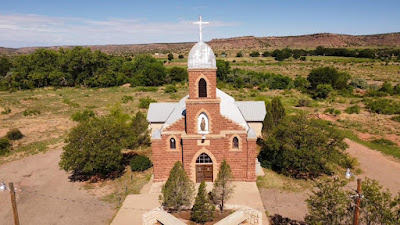
The Patron family had moved from Santa Fe to Lincoln, New Mexico and opened a store, built a school and a church. In 1878, when his father was killed in Lincoln, the president called the one mile main street in Lincoln "the deadliest street in America." Juan decided to move his family to his wife, Beatriz's home town of Puerto de Luna. This was my mom and dad's hometown too. Upon their arrival, Juan Patron and his father-in-law, Lorenzo Labadie raised money to have the church, Nuestra Senora del Refugio (Our Lady of Refuge) built in 1882. 


Nuestra Senora del Refugio

I've mentioned many times in past blogs how important this church is to me. My parents were baptized and married there. I used to attend Spanish Mass there as a child. It absolutely breaks my heart that the first church service at Nuestra Senora del Refugio was my Great-Uncle Juan Patron's funeral service. I didn't learn until recent years that he's buried under the nave of the church. He could have very well become the governor of New Mexico but instead he was needlessly assassinated before the age of 30.


Beatriz Labadie Patron
and Juan Patron


This week, feeling the ongoing grief of the year long, worldwide pandemic and the events at our Capitol, I was reading Juan's story from a different perspective. I wondered what happened to Juan's widow, Beatriz after her husband was assassinated in cold blood in Puerto de Luna. He had merely gone to Moore's Saloon for a single beer to never return home. 
I discovered that Beatriz married again and then after her second husband died she owned a house in Santa Rosa and lived with her younger siblings Roman, Lorenzo Jr. and Josefita. One thought lead to another and I started thinking about some of the women in the Labadie family that had never been written about. Just as the male names repeat in families, generation after generation, so do the female names. My sister is going to hate this part of my blog but I think it is kind of special so I am just going with it. My sister, Nita's given name at birth was Josie Ann. She was named after our grandmother Josefita Labadie. We never met our paternal grandmother because she died during the last pandemic at the age of 24 when our father was only 3 years of age. He had a younger sister named Anita. For whatever reason, in the second grade, my sister started going by the name Anita and then dropped the A and started going by Nita. Here's the cool part. Josefita is an old family name and I never put it all together because again men are named "Senior" and "Junior" or I, II, III and so on. Women are not and the lineage gets lost in the shuffle because they also have to change their last name when they get married. So below is the the lineage of the Josefita Labadies in our family.


Our 4th Great-Grandparents Dr Dominique Labadie and Maria Micaela Padilla had a daughter named:

Josefa Labadie    Born 1783 Died 1810

She is our Great-Great-Great-Aunt


Our Great-Great Grandfather Lieutenant Colonel Lorenzo Labadie and his wife Maria Rayitos Giddings Gutierrez Labadie had a daughter named:

Josefita Labadie    Born 1864 Died 1941

She is our 1st Cousin 3 generations ago


Our Great-Grandparents Captain Juan Labadie y Sanchez and Dorotea Maria Chavez had a daughter named: 

Josefita Labadie Born 1894 Died 1918 

She is our Paternal Grandmother


My sister: Josie Ann Fajardo AKA Nita Fajardo  Born 1951


Recap: Dr Dominique Labadie born in 1738 Gascony, France first settled in St Louis, MO and the arrived in New Mexico in 1775, He married Maria Micaela Padilla, the daughter of one of the founding families of Albuquerque. They had 15 children, among them was a daughter named Josefa, One of their grandsons was Lieutenant Colonel Lorenzo Labadie. Not only was Lorenzo a Lieutenant Colonel, he was a sheriff in 3 New Mexico counties, he served as an Indian Agent for 8 years and then in his old age, he became a census taker. When I first started doing ancestry research, most of my important information came from the census he recorded in Puerto de Luna and surrounding areas in the late 1800’s and in 1900. He too had a daughter named Josefa Labadie born in 1864. She was the sister-in-law of Juan Patron who was the first speaker of the house in New Mexico. Then there was our grandmother Josefita Labadie. This is the sad part of the story. She died at the age of 24 during the last pandemic of 1918. My dad was only 3 years old and he had a younger sister. My heart has always ached for my dad because it was so obvious that he missed having his mother. I have an adorable portrait of my him when he was a baby and I am sure there would have been many more photos and stories about his life had his mother not died at such a young age. The current pandemic has made that pain much more real to me.


My grandmother Josefita Labadie Fajardo


To my sister Josie Ann, AKA Nita, I hope you know deep in your heart that you come from a very long line of beautiful souls who walk with you daily and give you strength.


Thank you Kimberly Harris, who now owns the Juan and Beatriz Labadie Patron's ranch for sharing with me stories and photos. I will forever send you, your horses and rescued animals love and light.

Juan and Beatriz Labadie Patron's
Ranch House in Puerto de Luna, New Mexico

Juan and Beatriz Labadie Patron's Bedroom
at their Ranch in Puerto de Luna, New Mexico


Thursday, August 20, 2020

In Honor of My Father


Today has been 19 years since my dad passed away at the age of 86. His mother died in the last pandemic of 1918, when he was only 3 yrs old. It wasn't until this world pandemic of 2020 that I had a clue what it must have been like for my father. His 24 year old mother died in the second wave of the pandemic of 1918. Some say my mother's uncle, Francisco Padilla brought the Spanish flu back to the small community of Puerto de Luna, NM. when he returned from Kansas City, Missouri after he had gone there to sell his livestock at market. Everyone in the community was celebrating the end of WWI. So many people contracted the virus and died in the harsh winter of 1918 that they couldn't have funerals and had to bury families in unmarked group graves.

Thinking of you and your mom today Daddy.


AMERICAN BADASS
Written by my nephew Derek Hatley

Native son who fought for his country
Left no one behind as the bullets were strafing
Standing up to the Nazi’s and the communists armies
Better men, were born back then
What have we become since the days back when
We’re now all shitty and thin
Sucking up to things we don’t believe in
Corruption sucks, yet we are licking it’s boots thin
In a way I can’t describe now
Better men, were born back then
My grandpa would rather be
Buried alive
Than to see what has become
that came after his life
Radical fists punching up to the sky
Break the silence left behind
Let’s shout it out now
And leave it loose at the ends, because...
Better men, were born back then
Yeah better men were born back then. 
Better men were born back then
Yeah better men were born back.
In your time then. You were the better man!

Love you grandpa!
Derek


Saturday, July 4, 2020

Happy 4th of July to My Extended Family


I created this timely blog on the 4th of July as a gift to my extended family including my children Adriane Ethridge and Christian Ethridge, my grandchildren, Dylan Ethridge, Andrew Ethridge and Jacqueline Ethridge. My step-daughter Sarah Ethridge and her daughter Emerson Ethridge. Also to my nephew Derek Hatley and his two daughters Bianca Hatley and Ava Hatley. And to my ex-husband, Davis Ethridge and my sister's ex-husband, Jack Hatley.

Happy 4th of July!

You are related to Thomas Jefferson!


In case you have forgotten the reason we celebrate the 4th of July, the Americans were fighting for their rights as subjects of the British crown in 1775. By the following summer, with the Revolutionary War in full swing, the movement for independence from Britain had grown and delegates of the Continental Congress were faced with a vote on the issue. In mid-June 1776, a five-man committee including Thomas Jefferson drew up a formal statement of the colonies’ intentions. The Congress formally adopted the Declaration of Independence, written mostly by Thomas Jefferson in Philadelphia on July 4, 1776.

I made the primary discovery last week that my ex-husband, Davis and Nita's ex-husband, Jack are coincidentally cousins. They grew up on opposites ends of Texas and met one time at my wedding in 1977. It is uncanny that Nita and I would marry cousins, wouldn't you say?

As I was leisurely having my morning coffee and reading Facebook posts, I found a photo of my nephew, Derek and his two daughters and decided to download it and place it on Ancestry. com. The ancestry website notified me that there was some updated info in the Hatley lineage. I've spent a considerable amount of time in the past ten years researching my side of the family yet I've not done much research into the Ethridge family because I didn't have any leads. But this little hit on the Hatley lineage lead me to an unexpected discovery and/or gold mine. After several hours of research, I discovered that Jack Hatley and Davis Ethridge are 5th cousins. My first clue was finding a woman named Sarah Elizabeth Ethridge born on June 15, 1841 in the Hatley lineage. After about eight hours of research I traced both the Ethridge and the Hatley lineages back to Thomas William Etheridge I born in England in 1564.


This information opened another can of worms. I discovered that Captain William Ethridge was married to Judith Marmaduke and then I noticed that her mother was Judith Randolph. The Randolph family is a prominent Virginia political family.The first Randolph to come to America was Henry Randolph in 1643. His nephew, William Randolph later came to Virginia as an orphan in 1669. Because of their numerous progeny, William Randolph and his wife, Mary Isham Randolph, have been referred to as "the Adam and Eve of Virginia ." The Randolph family was the wealthiest and most powerful family in 18th-century Virginia.


President Thomas Jefferson was the great-grandson of William Randolph and is the second cousin seven generations back of both my ex-husband Davis and Nita's ex-husband, Jack.

Yeah.... the 3rd President of the United States who oversaw the Louisiana Purchase leading the United States to double in size during his presidency.


I'll go into Robert E Lee being the great-great-great grandson of William Randolph at a later date. Today isn't the day to talk about the commander of the Confederate Army of North Virginia in the Civil War.


Tuesday, June 16, 2020

What A Long Strange Trip It's Been - Sad News From New Mexico


Just when I thought our country couldn't feel any more divided, ugly and violent, there was a shooting yesterday outside of the Albuquerque Museum. A petition to remove the statue of Juan de Oñate in front of the museum had been circulating and then a protest followed with protesters trying to remove the Spanish conquistador statue. 

There's no doubt in my mind that the multitude of protests due to wide spread social injustice in our country caused this issue to resurface. History repeats itself and the upheaval of current day America mirrors what was going on in the 1600's in New Mexico. The common denominator always goes hand in hand with having a demagogue leader. I never dreamed I would live to see the division and protests in my country and it is touching each of us on a very deep level and bringing up the hurt and betrayal each of us have felt to the core. Whether or not each of us are aware of it, we all have the memories of our ancestors stored in our DNA. 

La Jornada Sculpture
Women and Children
Click on photo to enlarge
La Jornada Sculpture
Women and Children
Click on photo to enlarge
La Jornada Sculpture
Click on photo to enlarge
La Jornada Sculpture
Front Center -  Juan de Oñate
Click on photo to enlarge

La Jornada Sculpture
Click on photo to enlarge
National news doesn't often cover the issues of the southwest. Issues I felt that Beto O'Rourke was very familiar with and was trying to take to a national level. Nobody on the east coast wanted to listen. It isn't their personal story. The story of their journey began at Ellis Island in 1892. Our journey was long before that, with the Oñate expedition of 1598. He has been seen as a heroic figure who lead the colonization of New Mexico and others view him as a killer who repressed and enslaved Native Americans. So here it is, bubbling over again. People still in cages at the border and now the raging Oñate controversy on national news. 

I am torn. The issues in New Mexico are very personal and complicated for me. I am 71% Spanish/European descent and 29% Native American. My ancestors were both the oppressors and the oppressed. I wouldn't be here if it weren't for the Oñate expeditions yet I find his tactics disturbing. He was operating in the name of Christianity, outlawing the rituals of the Native Americans that had been practiced for centuries. He was eventually banished from New Mexico and convicted by the Spanish government of using "excessive force" against the Native Americans.

Juan Oñate leading the way at the La Jornada Sculpture
Click on photo to enlarge
You know those members of your family that you would just as soon not claim? Juan Oñate is one of them, but I have a list of them. Oñate was married to my 3rd cousin 9 generations ago, Isabel de Tolosa Cortés de Moctezuma. She was the granddaughter of my 1st cousin 10 generations back, Hernando Cortes. You know, the Spanish conquistador who led an expedition that caused the fall of the Aztec Empire. And her mother, Isabel Tecuichpo de Moctezuma was the daughter of the Aztec Emperor Moctezuma. It seems that raping and pillaging was a widespread practice to gain power.

So when you look at the whole art installation, it is very symbolic of what was truly going on. Oñate marching forward acting as a conquistador while the women and children were simply living in involuntary servitude to the powers who were in charge. If you think that protesting and voting doesn't work, think again. We have come a long way.

Juan de Oñate
La Jornada Sculpture
Click on photo to enlarge
Oñate colonized New Mexico in 1598 then in 1599 he wrote to the viceroy of New Spain (present day Mexico) and requested additional soldiers and families to help strengthen the colony that had been established.  In the year 1600, sixty-five Spaniards and twenty-five servants were recruited, including women and children. The families from this second wave of colonization were my ancestors and the ancestors of most people with Hispanic roots in New Mexico.

Here is an example of some of my ancestors that came on the expedition:

My 9th great-grandparents, the progenitors of the Baca family of New Mexico. Capitan Cristóbal Baca III and his wife Ana Maria Ortiz Pacheco y Coronado. They had three daughters and two sons.

There are an estimated five million descendants from Cristobal Baca and Ana Ortiz. Almost anyone who has a lineage of seven or more generations in New Mexico are descendants of one of the many Baca lines, if not several times over.

My 7th great-grandparents, the progenitors of the Chavez family of New Mexico. Pedro Gomez Duran y Chaves, and his wife Isabel de Bohorguez Baca. She was the daughter of Cristobal Baca and Ana Ortiz. They had one daughter and two sons.

My 8th great-grandparents the progenitors of the Montoya family of New Mexico. Bartolome de Montoya and his wife Maria de Zamora  They had three sons and two daughters. 

Plaques with names of my ancestors
La Jornada Sculpture
Click on photo to enlarge
I could go on and on, but you get the gist. Yes, the multi-figure art installation titled “La Jornada.” (The Journey)  pays homage to a man that committed atrocities in the name of Christianity. But it also pays homage to other men, women and children. My ancestors. Most of whom I assume were innocent. I am very sad. It's the only place I've ever been where I saw rows and rows of plaques with the names of my ancestors who were the founding fathers of New Mexico. It stood prominently in front of the Albuquerque Museum. It's sad to negate the contributions that the expeditions made to New Mexico's history. Oñate himself was an ugly demagogue but there's a positive side. They brought horses, cattle, sheep, goats, pigs, irrigation, wine and mining.

Woman, child and pig
La Jornada
Click on photo to enlarge
I took the above photos of “La Jornada” on my last trip to Albuquerque. I never dreamed it would be the last time I saw it. I choose to see the beauty in these photos of women, children and animals who I am sure were doing their best just to survive. I honor those who made the long journey. I pray that we learn to live together in peace.