Showing posts with label Cortes. Show all posts

Tuesday, April 18, 2023

The Arrival of the Montoya Family in New Mexico Part 1

I've been told many times that I should write a book about my ancestry research. This task would be next to impossible. I would have to settle on one ancestor and there are too many ancestors and too many intertwining stories to fit into one book. I've watched "Finding Your Roots" many times and Henry Louis Gates is usually hard pressed to find one ancestor in the famous person's past who is a historic figure. It's mind boggling to look into my family's past and find Hernando Cortes, Juan Onate, Kit Carson, Billy the Kid, just to name a few.

I started this journey to answer a few questions, then quickly realized the more I learn, the more questions I had. I discovered an extremely complex history filled with thousands of people and just as many challenges. There are so many perspectives from which to tell each story. Fortunately, my family has hundreds of years of recorded history, thanks to the Catholic church. I never expected to be able to look up so many of my ancestors in Wikipedia. There are hundreds of stories filled with exciting, romantic stories of my family immigrating from Spain to Mexico and then up to New Mexico beginning with Hernando Cortes in 1547. There are monuments, schools, buildings (castles) and streets named after many of my ancestors. All the while, I have to take into consideration that they came to conquer so there were atrocities and bloodshed. The pain and suffering has caused deep scars stored in my families DNA. We pass those wounds from generation to generation and the scabs can be picked off and the bleeding begins again until someone in the family is willing to do the work to heal the family dynamics. 

Today, Tuesday, April 18, is World Heritage Day. 
I've decided to write about the time in history when much of the controversy in New Mexico began.


In 1583 King Philip II of Spain's decree for the settlement of New Mexico was a call for a wealthy individual to step up and finance an expedition to what is now New Mexico. Juan de Oñate was not the only nobleman to put in a bid for the position of colonizer, but he was the best connected. On September 21, 1595 Juan de Oñate was awarded the contract by King Philip II  to settle New Mexico. Oñate was the first European to colonize New Mexico, thus extending the Comino Real by 600 miles and he was the state's first colonial governor.

El Comino Real or The King's Highway A single highway which connected Mexico City, and Santa Fe 


The king and his council approved missionaries to go to the Americas with the primary objective to spread Catholicism to the indigenous population. Oñate began the "Entrada" in early 1598 with a large caravan of settlers, missionaries and livestock to establish a colony.

This is all important to my family history because Oñate was my 10th great-granduncle and many of my other ancestors were colonists on this historical expedition. I know it's controversial to even say that these days but I can't change the past and where I came from. I feel like I can be proud of my Spanish heritage without maintaining some of the colonizer values as much as I can be an American today without agreeing with the politics, especially in the state of Texas, where I live.


I have mixed emotions about the statues of Oñate being taken down in 2020. To me, they were beautiful pieces of art and it represented our past. I don't agree with some of the things that have occurred in the name of Catholicism but I don't want all the churches torn down. They are a part of our history. I just have to wonder if toppling statues across America was necessary. It's history and we can't change our history. We can only attempt to do better in the future and maybe use the statues as a reminder.

Is it possible that some colonists came hoping to create a utopian society in the new world. Maybe some enlisted in hopes of extracting all the riches they could from the far off lands. I have often wondered why the Spanish King didn't take into consideration that the native people in the Americas had their own religion and customs. 

Due to the "Entrada" New Mexico became known as "Tierra de Guerra" "The Land of War." Land grants were given to the colonists and empowered them to collect tribute from the forced labor of natives. Oñate wasn't a saint by any means, but at the same time, the Spanish brought with them thousands of horses, cattle, mules, sheep, pigs, goats, wine and the mining industry.
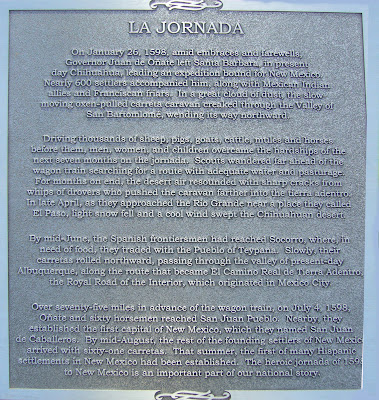
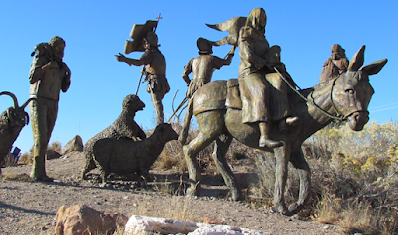
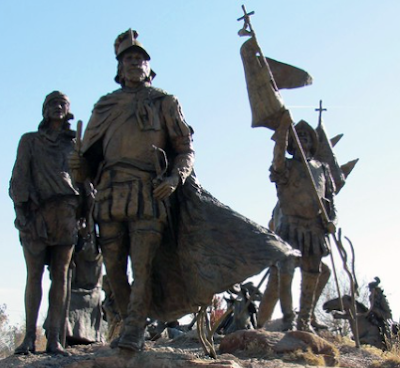
La Jornada

The La Jornada  - Interaction of mothers with
their children on the long journey

La Jornada shows the animals brought
with them on the long journey

Juan de Oñate statue formerly stood in Albuquerque, NM.
The monument was removed in 2020

So as the story goes missionaries came to the Americas with an escolta (military escort or armed guard.) My 8th great-grandfather Bartolome de Montoya was an Alferez (2nd Lieutenant or ensign) He escorted a band of friars Santa Fe on the second Juan de Oñate expedition. The colony consisted of 65 settlers.

The Montoya family alone consisted of my eight great-grandparents Bartolome de Montoyahis wife, Maria de Zamora their 5 children, Francisco, Diego, Jose, Lucia and Petronila. They also had 25 servants, cattle and equipment needed to begin a new life in New Mexico.


The missionaries would bring with them a portable alter as they approached a group of natives and would begin preaching through a translator. They built churches, housing and a defensive wall with heavy gates. The architectural splendor of the missions is a part of the romantic past tied to song, poetry and history. Theoretically, the missions were designed for a ten-year period, after which the missionaries were expected to move on to newly established villas.

The scheduled plan of conversion of natives to Catholicism didn't go as planned because the natives resisted as one might imagine. In the long run, the Spanish immigrants spent much of their time defending their community from native raids. And then to complicate things, after conquering the natives and taking their land, they took their women. I am a product of that behavior. My 4th great-grandfather Esteban Padilla was the son of a woman listed on the census as a Native American servant. This makes telling my story somewhat complicated. I feel the effects of this behavior on a deep level as I look at the stories from many perspectives because the stories are never just black and white. Native Americans say they were tyrannized by Spaniards. Hispanics say New Mexico wouldn't have its unique hybrid Spanish-native culture if it weren't for their ancestors. 

Santa Fe, New Mexico was settled in 1607 making it the first European settlement west of the Mississippi River. It's the oldest Capitol in the United States. Albuquerque was founded in almost 100 years later in 1706 by Francisco Cuervo y Valdes. 35 families were required by Spain to create a settlement and they only had 12 families so as you can imagine they were making their own rules as they went. 

Just a little back story to keep the history straight:

In 1519 Spanish Conquistador Hernán Cortés (my 1st cousin 11 x removed) led an expedition that caused the fall of the Aztec Empire in Mexico led by Emperor Moctezuma II and brought it under the rule of the King of Castile. Cortés was part of the generation of Spanish explorers and conquistadors who began the first phase of the Spanish colonization of the Americas.

Bartolome de Montoya was born on January 1,1572 in Cantillana, Andalucia, Spain. He met his wife, Maria de Zamora when he arrived in Mexico (New Spain) She was an Aztec born in 1573 in Mexico City and was the daughter of Pedro de Zamora, the Mayor of Oaxaca, Mexico. Bartolome de Montoya was the progenitor of the Montoya surname in New Mexico and virtually all Montoya families from New Mexico descend from him so his name appears often when doing ancestry research.


Juan de Oñate's parents were from Spain, he was born in Mexico (New Spain) and married to Isabel de Tolosa Cortés de Moctezuma. Her grandmother was Isabel Tecuichpo de Moctezuma (the granddaughter of Emperor  Moctezuma II.

I always assumed that I was a Montoya on my dad's side of the family, because his full name is Felipe Montoya Fajardo. Early on in my ancestry research, I was surprised to discover a 1900 Puerto de Luna census that showed my father's mother was a Labadie. The census was very accurately transcribed my my grandmother's Uncle Lorenzo Labadie. My paternal grandmother, Josefita Labadie) was the daughter of Captain Juan Labadie y Sanchez. He died when she was young and her mother, Dorotea Chavez Labadie, remarried a man named Antonio Montoya. Dorotea and all of her children took his last name, Montoya. Then on the 1910 census, when my grandmother was 16, she was living with her older sister, Jesusita and her husband, Prudencio Duran and she was listed as Josefita Duran on the census. So I don't think there is a DNA connection to the Montoya bloodline on my dad's side even though he grew up with them but I know of 3 connections on my mom's side. Both sides of my family lived in Puerto de Luna, during the last 1800's and early 1900's and it seems like it was a close community who took care of each other.

So I conclude this blog with the history of the Montoya surname. Montoya is a Basque surname which makes sense because I am 14% Basque. It originally comes from a hamlet near Berantevilla in Álava, in the Basque region of northern Spain. During the Reconquista, it extended southwards throughout Castille and Andalusia. The name roughly translates to "hills and valleys."


Thursday, September 17, 2015

La Malinche - Caught Between Two Cultures


Since my last entry I have been studying the life and times of Hernando (Hernan) Cortés, born in Castile, Spain in 1485. According to Ancestry.com, I am a descendant of Cortés and I have found that most branches of my family tree overlap over a 500 year period so there is more to this story. When you consider the average person has 4,096 10th great-grandparents and it has been said that Cortes has at the very least a half a million descendants because several women had his children, I have my work cut out for me. It has taken me over 4 months to finally sit down and put all of my research of the Spanish conquistadors arriving in Mexico into words. Reading about it in history is one thing however, it is difficult to fathom the DNA that circulates in my blood. Imagine, if you will, the Spaniards befriending the Aztecs, impregnating their women, creating a whole new breed of Meztizos and then killing Emperor Montezuma in their continued effort to gain wealth and land. It's is a little overwhelming but then I realized there was more to the story... the Aztecs weren't exactly angels either.

Hernan Cortés

Hernan Cortés as he appeared in his shining armor

Cortés arrived in Mexico on November 8, 1519. November 8 just happens to be my brother Phillip's birthday. He arrived with an entourage of about 400 men. They were light skinned and wore beautiful shining armor. They brought horses and wine, both unknown to this part of the world. Cocoa was the drink of choice in for the nobles of Mexico. I've had vivid dreams about riding on a horse wearing armor and drinking wine from a metal chalice, never knowing what those dreams meant but I will save that story for another blog. Their arrival coincided with an Aztec prophecy of a white-skinned God arriving from the east. This would explain why the ruler, Moctezuma II (also known as Montezuma II) greeted Cortés with lavish gifts allowing him to stay at the Aztec palace in the capital of Tenochitilán.

On November 8, 1519, Hernando Cortés was received
by Moctezuma II in the city of Tenochtitlán. 

On my journey through the past, one of my main objectives is to bring to life the strong, intelligent women in history from a woman's perspective. Most recently I found an extraordinary Aztec woman, Malinali, known today as La Malinche. Her claim to fame is that of being Hernan Cortes's beautiful and reputedly treacherous Indian translator and mistress. He gave her the name Doña Marina when she was baptized a Catholic. Her story starts out with a boom! Her given name, Malinalli, signified her birth date on the Aztec calendar, May 12, 1502. My birthday is May 12 which blows my mind because on this ancestral journey I have found that important dates have repeated time and time again over a 500 year time span. Key players in my ancestry seem to share both birthdays and death dates.

Statue of La Malinche
Coyoacán, Mexico
La Malinche Mural by Diego Rivera
La Malinche's parents were nobles, however, after beginning her life living a privileged childhood, tragically, her father died. Her mother then married her father's brother. They soon had a son and La Malinche was was claimed as dead, disinherited and sold into slavery. Talk about a Cinderella story!

When Cortés arrived in Mexico, La Malinche was one of twenty female slaves given to the Spaniards by a Mayan Lord along with other gifts of an Aztec calendar, gold, jewels, pelts and feathers.  At that time La Malinche was 16 and very capable of distinguishing herself with her beauty, grace and education. She immediately became Cortés' personal translator, negotiator and cultural mediator and then became his mistress. She gave birth to his first born son, Martin Cortés. La Malinche was in the forefront of written Mexican history. Cortés and La Malinche's son Martin was the first documented child of European and indigenous American ancestry, a Meztizo. Therefore La Malinche has been deemed the mother of the Mestizos, literally and metaphorically.

Monument of Cortes, La Malinche, and their son, Martin in Coyoacan

Needless to say, her story is intriguing and it is a perfect example of how history becomes distorted, depending on the story teller. For the most part of 500 years La Malinche has been condemned as traitor because she was was instrumental in the demise of the indigenous tribes of Mexico. Cortés stated in a letter: “After God, we owe this conquest of New Spain to Doña Marina.” She was perceived as a trader however, her actions saved thousands of lives from the brutal, blood-thirsty rulers by enabling Cortés to negotiate rather than slaughter while preventing human sacrifice and cannibalism. Coincidentally Cortés saved her from a life of slavery so in essence they really owed each other and built a sort of Romeo and Juliet bond on that connection. From my point of view, she was a fearlessly loyal heroine. But that is just me, a feminist, 500 years later. The disdain that's been felt towards La Malinche runs deep. There is a derogatory term for those who are attracted to foreigners, foreign values, thinking them superior or of better quality and worthy of imitation – "Malinchism" or "Malinchist." It even became a technical term, political, for everything that meant choosing foreign culture. Malinchistas were those who encouraged Mexico to open itself to the outside world. In a speech given in 1968 Mexican President Diaz Ordáz scolded the Mexicans saying “Our malinchismo is holding us back. We must get over it."  Needless to say racism isn't a new problem. It is built on the fear of what we do not understand about other cultures.

The Mexican artist Antonio Ruíz’s
Surrealist Painting “The Dream of Malinche,”

Malinche with Cortés: mural by Roberto Cueva del Río

Art Mimics Life

In Theatrical Productions -  La Malinche is sometimes portrayed as a victim of conquest, and sometimes the cause of her own destiny, but almost always, she is guilty. If she was indeed violated, it was because she didn't struggle enough. If she was a willing participant, she not only brought her own troubles, but she caused her child and all of her people to suffer.

In Art -  La Malinche is represents women's innate deception and guilt, using her beauty and sexuality to gain power and in so doing so, very much in need of punishment.

In Dance - The dichotomy persists. In "La Malinche," a ballet composed in 1949, she is at first an unwilling victim, then assumes the proud deportment of an aristocrat, and in the end, weighted down by the finery she wears. She then gives birth to the Mestizo child who then rejects her.

In Literature -  La Malinche has been compared to Eve, the temptress who through deception, leads men astray. Malinchismo represents one end of the spectrum of stereotypes of women while the Virgin of Guadalupe resides at the opposite end of the stereotypical spectrum. 


Painting of La Malinche and Hernando Cortés

See how much more interesting history lessons are when you have a woman injecting romance into the story? I'm not the only one. In the late 1960s and early 1970s, Chicana writers, artists, and activists began to examine the story of La Malinche. They discovered neither victim nor traitor but the strength of a survivor. This is a story I can relate to. La Malinche did not choose her destiny, but neither did she crumble in the face of adversity. I've explored her fate and her abilities to negotiate difficult cultural demands. Much more difficult than my own, yet helping me to understand the ongoing struggle for personal and world wide cultural power.

La Malinche learned to wear the finest clothes and jewels 


Hernan Cortes, La Malinche (Doña Marina)
and son Martin Cortés' home
57 Higuera St., Coyoacán, Mexico
Now owned by Guatemalan artists Rina Lazo Wasem
And her husband, Mexican artist Arturo García Bustos
Rina studied with Diego Rivera and his wife Frida Kahlo

.... And the plot thickens...... As the story goes Cortés, La Malinche and their son Martin lived in the house pictured above in Coyoacán, Mexico. La Malinche wore the finest clothes and jewels, living a storybook life for a time.... however.... Cortés had a wife in Cuba, Catalina Mercada Suarez who arrived in Mexico in 1522. She mysteriously died in this house. Some say Cortés had her killed for the love of La Malinche.

So there is your history lesson for the day. I am still scrambling through 500 years of ancestors who married into each others families over and over and over so I am not sure that the lineage below is absolutely correct. I am sure there will be corrections but it has been an interesting journey of discovery and there will be updates to follow. Moctezuma's daughter, Isabel, the last empress of Mexico, also had a daughter out of wedlock by Cortés. It is extremely difficult to characterize Cortés however, he gets points for leaving his many children well cared for in his will, along with every one of their mothers.


Click This Chart To Enlarge


When I started doing research on my ancestry, I seriously believed I would be able to become a member of ancestry.com for approximately 3 months, do some casual research and be done with it and be able to give everyone in my family a 10 page ancestry book for Christmas. I wasn't prepared to learn that about 10 generations ago my ancestors came from Spain and created a little havoc along the way making them very important characters in world history. I also didn't take into account that each of us has 4,096 10th great grandparents. So think about it, if only 96 of my 10th great-grandparents made it into the history books, that means I have 4,000 that were slackers!

Read this chart, it is mind blowing!
You have 1,048,576 18th great-grandparents!