Tuesday, April 18, 2023

The Arrival of the Montoya Family in New Mexico Part 1

I've been told many times that I should write a book about my ancestry research. This task would be next to impossible. I would have to settle on one ancestor and there are too many ancestors and too many intertwining stories to fit into one book. I've watched "Finding Your Roots" many times and Henry Louis Gates is usually hard pressed to find one ancestor in the famous person's past who is a historic figure. It's mind boggling to look into my family's past and find Hernando Cortes, Juan Onate, Kit Carson, Billy the Kid, just to name a few.

I started this journey to answer a few questions, then quickly realized the more I learn, the more questions I had. I discovered an extremely complex history filled with thousands of people and just as many challenges. There are so many perspectives from which to tell each story. Fortunately, my family has hundreds of years of recorded history, thanks to the Catholic church. I never expected to be able to look up so many of my ancestors in Wikipedia. There are hundreds of stories filled with exciting, romantic stories of my family immigrating from Spain to Mexico and then up to New Mexico beginning with Hernando Cortes in 1547. There are monuments, schools, buildings (castles) and streets named after many of my ancestors. All the while, I have to take into consideration that they came to conquer so there were atrocities and bloodshed. The pain and suffering has caused deep scars stored in my families DNA. We pass those wounds from generation to generation and the scabs can be picked off and the bleeding begins again until someone in the family is willing to do the work to heal the family dynamics. 

Today, Tuesday, April 18, is World Heritage Day. 
I've decided to write about the time in history when much of the controversy in New Mexico began.


In 1583 King Philip II of Spain's decree for the settlement of New Mexico was a call for a wealthy individual to step up and finance an expedition to what is now New Mexico. Juan de Oñate was not the only nobleman to put in a bid for the position of colonizer, but he was the best connected. On September 21, 1595 Juan de Oñate was awarded the contract by King Philip II  to settle New Mexico. Oñate was the first European to colonize New Mexico, thus extending the Comino Real by 600 miles and he was the state's first colonial governor.

El Comino Real or The King's Highway A single highway which connected Mexico City, and Santa Fe 


The king and his council approved missionaries to go to the Americas with the primary objective to spread Catholicism to the indigenous population. Oñate began the "Entrada" in early 1598 with a large caravan of settlers, missionaries and livestock to establish a colony.

This is all important to my family history because Oñate was my 10th great-granduncle and many of my other ancestors were colonists on this historical expedition. I know it's controversial to even say that these days but I can't change the past and where I came from. I feel like I can be proud of my Spanish heritage without maintaining some of the colonizer values as much as I can be an American today without agreeing with the politics, especially in the state of Texas, where I live.


I have mixed emotions about the statues of Oñate being taken down in 2020. To me, they were beautiful pieces of art and it represented our past. I don't agree with some of the things that have occurred in the name of Catholicism but I don't want all the churches torn down. They are a part of our history. I just have to wonder if toppling statues across America was necessary. It's history and we can't change our history. We can only attempt to do better in the future and maybe use the statues as a reminder.

Is it possible that some colonists came hoping to create a utopian society in the new world. Maybe some enlisted in hopes of extracting all the riches they could from the far off lands. I have often wondered why the Spanish King didn't take into consideration that the native people in the Americas had their own religion and customs. 

Due to the "Entrada" New Mexico became known as "Tierra de Guerra" "The Land of War." Land grants were given to the colonists and empowered them to collect tribute from the forced labor of natives. Oñate wasn't a saint by any means, but at the same time, the Spanish brought with them thousands of horses, cattle, mules, sheep, pigs, goats, wine and the mining industry.
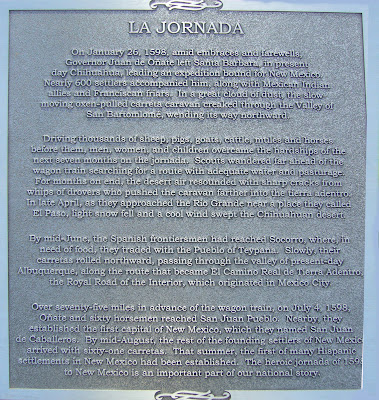
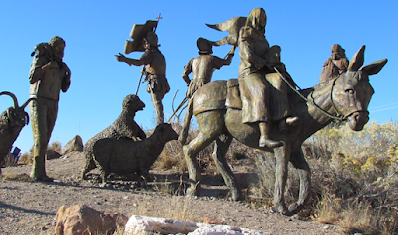
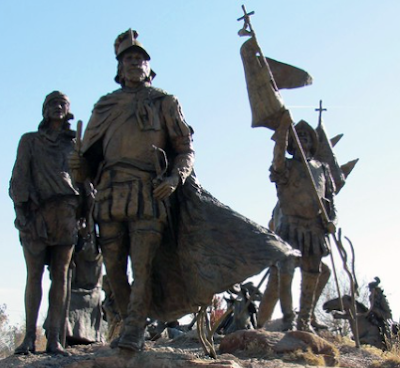
La Jornada

The La Jornada  - Interaction of mothers with
their children on the long journey

La Jornada shows the animals brought
with them on the long journey

Juan de Oñate statue formerly stood in Albuquerque, NM.
The monument was removed in 2020

So as the story goes missionaries came to the Americas with an escolta (military escort or armed guard.) My 8th great-grandfather Bartolome de Montoya was an Alferez (2nd Lieutenant or ensign) He escorted a band of friars Santa Fe on the second Juan de Oñate expedition. The colony consisted of 65 settlers.

The Montoya family alone consisted of my eight great-grandparents Bartolome de Montoya, his wife, Maria de Zamora their 5 children, Francisco, Diego, Jose, Lucia and Petronila. They also had 25 servants, cattle and equipment needed to begin a new life in New Mexico.


The missionaries would bring with them a portable alter as they approached a group of natives and would begin preaching through a translator. They built churches, housing and a defensive wall with heavy gates. The architectural splendor of the missions is a part of the romantic past tied to song, poetry and history. Theoretically, the missions were designed for a ten-year period, after which the missionaries were expected to move on to newly established villas.

The scheduled plan of conversion of natives to Catholicism didn't go as planned because the natives resisted as one might imagine. In the long run, the Spanish immigrants spent much of their time defending their community from native raids. And then to complicate things, after conquering the natives and taking their land, they took their women. I am a product of that behavior. My 4th great-grandfather Esteban Padilla was the son of a woman listed on the census as a Native American servant. This makes telling my story somewhat complicated. I feel the effects of this behavior on a deep level as I look at the stories from many perspectives because the stories are never just black and white. Native Americans say they were tyrannized by Spaniards. Hispanics say New Mexico wouldn't have its unique hybrid Spanish-native culture if it weren't for their ancestors. 

Santa Fe, New Mexico was settled in 1607 making it the first European settlement west of the Mississippi River. It's the oldest Capitol in the United States. Albuquerque was founded in almost 100 years later in 1706 by Francisco Cuervo y Valdes. 35 families were required by Spain to create a settlement and they only had 12 families so as you can imagine they were making their own rules as they went. 

Just a little back story to keep the history straight:

In 1519 Spanish Conquistador Hernán Cortés (my 1st cousin 11 x removed) led an expedition that caused the fall of the Aztec Empire in Mexico led by Emperor Moctezuma II and brought it under the rule of the King of Castile. Cortés was part of the generation of Spanish explorers and conquistadors who began the first phase of the Spanish colonization of the Americas.

Bartolome de Montoya was born on January 1,1572 in Cantillana, Andalucia, Spain. He met his wife, Maria de Zamora when he arrived in Mexico (New Spain) She was an Aztec born in 1573 in Mexico City and was the daughter of Pedro de Zamora, the Mayor of Oaxaca, Mexico. Bartolome de Montoya was the progenitor of the Montoya surname in New Mexico and virtually all Montoya families from New Mexico descend from him so his name appears often when doing ancestry research.


Juan de Oñate's parents were from Spain, he was born in Mexico (New Spain) and married to Isabel de Tolosa Cortés de Moctezuma. Her grandmother was Isabel Tecuichpo de Moctezuma (the granddaughter of Emperor  Moctezuma II.

I always assumed that I was a Montoya on my dad's side of the family, because his full name is Felipe Montoya Fajardo. Early on in my ancestry research, I was surprised to discover a 1900 Puerto de Luna census that showed my father's mother was a Labadie. The census was very accurately transcribed my my grandmother's Uncle Lorenzo Labadie. My paternal grandmother, Josefita Labadie) was the daughter of Captain Juan Labadie y Sanchez. He died when she was young and her mother, Dorotea Chavez Labadie, remarried a man named Antonio Montoya. Dorotea and all of her children took his last name, Montoya. Then on the 1910 census, when my grandmother was 16, she was living with her older sister, Jesusita and her husband, Prudencio Duran and she was listed as Josefita Duran on the census. So I don't think there is a DNA connection to the Montoya bloodline on my dad's side even though he grew up with them but I know of 3 connections on my mom's side. Both sides of my family lived in Puerto de Luna, during the last 1800's and early 1900's and it seems like it was a close community who took care of each other.

So I conclude this blog with the history of the Montoya surname. Montoya is a Basque surname which makes sense because I am 14% Basque. It originally comes from a hamlet near Berantevilla in Álava, in the Basque region of northern Spain. During the Reconquista, it extended southwards throughout Castille and Andalusia. The name roughly translates to "hills and valleys."


Thursday, April 13, 2023

Montoya and Lucero de Godoy Progenitors of New Mexico

Working on ancestry research is an amazing process. I currently have over 25,300 people listed on my family tree. The other day I felt that I had hit a brick wall. So I had a new goal of fixing some of the names that had double listings or had names that looked like they had been transcribed incorrectly. This task is never ending when one is working with names of ancestors from the 1500 or 1600's who originated in Spain. At that time in history, most people not only carried their father's surname but their mother's surname as well. Not having a full understanding of this, some people transcribe part of the last name as a middle name then to complicate things even more, many times when people in the United States transcribe the names, they added Don or Dona as a first name instead of using it as a suffix, not realizing that Don or Dona simply means Mr. or Mrs. So, needless to say, many times there have been issues joining my tree to another distant relative's tree on ancestry.com when the creator of the other tree has been overzealous with the titles. I sometimes find names that are two lines long. For example, I found one of my 8th great-grandfathers listed as "Conquistador Capitan Alferez Mayor Bartolome Jose de Montoya." He was in fact a Conquistador Capitan Alferez Mayor, however his name was "Bartolome de Montoya" so naturally, he didn't appear to be a match to the person on the other tree. I have become very familiar with him and his wife Maria de Zamora during my many years of ancestry research because they are my eight great-grandparents and he was the progenitor of the Montoya family in New Mexico. One can pretty much assume that if your ancestor came to New Mexico with Juan de Oñate they were a conquistador (a term used for a soldier or explorer) so writing it as part of their name is just a little redundant.

I started working on branch of my tree with a surname that I wasn't very familiar with that should read "Lucero de Godoy." You can't even imagine how many combinations of that name I found in my family tree.

The surname Lucero de Godoy in New Mexico began with Pedro Lucero de Godoy. He became the progenitor of thousands of Lucero de Godoy descendants of New Mexico. He is my eight great-grandfather and he married Petronila Montoya de Zamora, the youngest daughter of my other eight great-grandparents, Bartolomé de Montoya and his wife, Maria de Zamora. Much endogamy going on here? 

Pedro Lucero de Godoy arrived in the Villa de Santa Fe in 1617 at the age of eighteen. He came as a soldier-escort of wagon trains. I always wonder what motivated each of my ancestors to make the far-northern frontier of the Spanish empire their home. 

Bartolomé de Montoya and Maria de Zamora's son Diego de Montoya, attained the privilege of encomendero (an allotment of native labor) of the Pueblo of San Pedro, New Mexico. Encomenderos received tribute from the Pueblo Indians in return for armed military protection. 

Bartolomé de Montoya and Maria de Zamora's daughter, Petronila de Zamora, married Pedro Lucero de Godoy. I have read that he attained the privilege of encomendero (keeper of the land) I am guessing that means he was granted a land grant and and empowered him to collect tribute from the forced labor of natives. At any rate he became the progenitor of the New Mexican Lucero family.

Today, most of the people carrying the Montoya and Lucero surnames are descended of Diego and his sister Petronila, respectively. 


Sunday, March 19, 2023

My 7th Great-Grandmother, Josefa Baca - Matriarch of Pajarito Land Grant

One of the main reasons I started doing ancestry research was that I saw a need for diverse family histories to be written for future generations. Not only have women been treated as second-class citizens, but it goes unsaid that women have not been represented well in history. I personally know that my mother is a huge part of my immediate family history. 50% to be exact. Why hasn't that strong feminine presence been reflected in history books? I spent a couple of months with my mother just before she passed away creating a slide show for her memorial service. She picked out the photos and the text to be written. It was an amazing experience and I realized how important it was to have her history told from her perspective. When I retired I had time to take it a step further and create a written account of my family in my blog christinafajardo.blogspot.com

I never enjoyed history class, I thought it was because most of my history teachers were coaches who were only interested in football. Then I realized that not only was the class itself lopsided, history itself was lopsided, largely written by men. Specifically, the men who won the battles, the wars. Men who conquered, took land, cattle and women. The stories of women were white washed and minimalized. Historically women have been used as pawns so I just kept searching until I found some success stories.

I recently came across a story about my 7th great-grandmother, Josefa Baca. She was born in 1682 in Pajarito, New Mexico. Pajarito is just outside of Albuquerque’s city limits. It is situated between the South Valley communities of Los Padillas to the south and Atrisco to the north. The Rio Grande sits to the east and the West Mesa is to the west.

Josefa Baca
Matriarch of Pajarito Land Grant

Her family arrived with the Oñate colonizers in 1598. Even though she never married she was able to acquired the Pajarito land grant and founded a ranch with 950 head of sheep, horses, cattle, and goats with her livestock brand.

Josefa’s marital status and identity of her 6 children’s father cannot be determined. Perhaps the social status of her parents positioned her to acquire the land. It's interesting that Josefa obtained a land grant given that she lived in a patriarchal society. As an unwed or perhaps widowed woman it would have been hard for her to become a land owner. Although it's also possible that besides her family connections the unknown father influenced her acquisition. Another possibility is that she had certain skills that played into the Spanish legal system that allowed women to own land and property unlike the English/ U.S. colonial system were women did not have this right.

Pajarito Hacienda and Covered Wagon

Pajarito Hacienda

Regardless of their mother’s marital status and the unknown identity of their father, Josefa’s children acquired the Pajarito land grant and established the village of Pajarito. Josefa became the progenitor of generations of New Mexicans. The Village of Pajarito developed around the Baca family compound. The Sitio de San Ysidro de Pajarito, which included a hacienda and large tract of land south of present-day Albuquerque.


Land grant records show that Josefa Baca left it to her children and other Pajarito residents in her last will and testament signed in 1746. Land grant records show that Josefa Baca acquired the Pajarito land grant. She left it to her children and other Pajarito residents in her last will and testament signed in 1746. In her will, written on October 5, 1746, Josefa lists an inventory of 500 sheep, 100 goats, 2 horses, a musket, 2 bridles, 7 horse collars, a new cart, 4 whips, 2 axes, 3 hoes, three blouses, white skirts, stockings, shoes, a bed with mattress. She owned her own brand. Her estate was valued at 2,822 pesos. Upon her death, she requested that two Indian women who had been her servants be set free and be given ten sheep each. Additionally, an image of Our Lady of Dolores was passed down through at least three generations.

More than 100 years later, the will was presented during litigation in U.S. territorial courts as evidence for her receiving the title of land and their inheritance. The Pajarito Grant can be traced back to 1746 when Spain was the sovereign of present day New Mexico.

Fast forward 100 years to when the United States gained control of present-day New Mexico, and the grants of land made under Spanish control were promised to be upheld by the U.S. government. This is the point where many land grant histories begin their accounts of failed promises and land loss. However, the story of Pajarito is different. The Pajarito Land Grant was ultimately confirmed by the U.S. government, but the land grant’s history is far from being an example of the United States maintaining its promise. 

Josefa's son, Antonio, sold the Pajarito tract to Clemente Gutierrez. His heirs sought confirmation of their claim to the land from the surveyor general in 1877. The Court of Private Land Claims, on the presumption that a grant had been made to Josefa Baca, confirmed the Pajarito Land Grant in 1894 and patented it in 1914.

Five generations after Josefa's death, her land and ranch remained with the same family, passing to a fifth great-granddaughter and direct descendant, Juliana Gutierrez, wife of James Hubbell. The hacienda, lands, acequias, and orchards that survive today are a testament to the family's prosperity.


Monday, February 27, 2023

Baa Baa Black Sheep


The Black Sheep of the Family

The term black sheep is most often used to describe the odd one out in one's family. The one that is significantly different from the rest of their family. In other words, they stand out in ways the family can't accept.

The so-called black sheep of the family are often the most sensitive, creative honest and aware members of the family. They do not conform to the norms or traditions of the family system to keep peace. They often seek to revolutionize beliefs, going against the old beaten paths of family traditions. Because their thoughts go against the grain, they are often criticized, judged and even rejected. These free spirited souls are usually the healers of generational trauma. They are called on to free the family tree of cycles that have been repeated for generations.

The black sheep think outside of the box while the rest of the family is most comfortable not rocking the boat. They may have spent their early life crying rebelliously, while being hushed by their family for wanting to have a voice. Sometimes they have to separate from the family to break the family dynamic and return on new terms to repair branches of the family tree.


To you, the black sheep, let no one cause you to doubt. Be grateful for your rare soul is the most precious flower of your family tree. Be proud that you have been chosen to be the creator of the new story which will be passed down to future generations. You are the dream of all your ancestors.


Tree of Life
by Gustav Klimt


Please watch this video called

"It Didn't Start With You"

by Mark Wolynn

Tuesday, January 24, 2023

Hippie Chick Memories

January has always been my least favorite month. The holidays are over, days are shorter and it's cold. Putting away Christmas decorations is depressing after traditionally falling asleep on the couch during the month of December, basking in the glow of Christmas tree lights. It's no wonder that there is actually a disorder called SAD (Seasonal affective disorder)

I'm always left in a vulnerable state after the New Year celebrations have ended. This year was no different ... only worse. I flew home from a month long visit in St Louis on January 9. The next evening I received sad news from New Mexico that my friend, Linda Quintana had passed away. She had been ill, still, nobody is ever ready to hear that someone you care about is gone. She was one of those people that I had so much in common with that we could go a while without talking and pick up right where we left off. We were both passionate about our jobs working for newspapers, we loved music, art, our kids and grandkids. Not specifically in that order.

Artwork by Christina Fajardo


Linda was married to my cousin Tommy Quintana. She and I became close when I lived with my Grandma Rosita during my junior year in high school,1971-72. Tommy and Linda lived in a cute little house in Santa Rosa, NM. To me it seemed like the storybook perfect place described in the Crosby Stills & Nash song "Our House." With a garden next to the acacia on a back street of a small town. I loved staying at their house on occasion. Linda and I were both earthy Taurus girls, her birthday was May 5, 1950 and mine is May 12, 1955. If fate would have had it, my birthday would have been 5 days earlier on 5/5/55.

Apparently, according to the town crier, I was having too much fun in Santa Rosa because my parents made me go back to school in Amarillo for my senior year. It was just as well. I was able to go to school half day and work half day. I saved my money and was able to go back to Santa Rosa the summer of '73 after I graduated and rented a little adobe house on the hill.


This is the only photo I have of that house. I painted a Texas style primitive mural on the living room wall. My cousin Barbara lived down the street. On this particular day, her 2 boys, Timothy and Kris came over to visit. That summer Linda and I discussed going to Highlands
University in Las Vegas, NM. I had high hopes of what I could do with the 3 chords I could play on the guitar and my limited writing skills. My parents had very different plans for me. They came to Santa Rosa, swooped me up and moved me to Austin where I was to babysitter for my sister's 3 year old son, Derek. Oddly, it didn't dawn on me that as an 18 years old I had the choice to live MY dream. Looking back, I realize my plans were rarely taken into consideration. It took me years to realize I was what Prince Harry is referred to as "the spare to the heirs." In other words, what I wanted didn't matter because I was the youngest female in our traditional Hispanic family. I was basically there to be a support system for the family. Not to live my dream. But that is a whole other blog.
Music had always been something I gravitated to. Music lessons were never an option because from the time I was in the 2nd - 6th grade I had a little brother who was ill. In high school, I took it upon myself to learn what I could on my own. I used to sit in my bedroom at my parent's house teaching myself how to play my dad's guitar.


I had a turn table and a short stack of albums. In the summer of '71, my friend Chris Montano had hopped on a Greyhound bus from Santa Rosa to Amarillo bearing gifts. He gave me 3 of the albums listed below that became the soundtrack of my teenage years along with my sister's Beatle albums.
  • Crosby, Stills and Nash
  • Carol King - Tapestry
  • Crosby, Stills and Nash - Deja Vu
  • James Taylor - Sweet Baby James
  • Joni Mitchell - Blue
Jackson Browne was to come in the next year. Needless to say, the news of Linda's passing 2 weeks ago had all of these songs circling around in my head along with all my other memories of being a hippie chick from the Texas Panhandle living in rural New Mexico. You can only imagine the crushing surprise when the news came the week after Linda passed away that David Crosby had also passed away. 

Naturally, over this past week, I've been listening to all the old CSN music and reminiscing. The song that resonates the most is "Teach Your Children." The version on the "Deja Vu" album to be specific, because it has Jerry Garcia on steel guitar. Only now, 50 years later, "Teach Your Children" has a totally different meaning to me as a 67 year old grandmother. 

Listen to it and read the lyrics. You'll see what I mean.

Click here to see video of "Teach Your Children"


I loved CSN as a teenager because they were cute musicians from California, my dream land. Now I know they were wise beyond their years. In the 80's when I moved to Los Angeles, I used to drive through Laurel Canyon just to get a feel for what it may have been like 10 or 15 yrs earlier, when these songs were being written. There certainly was the same vibe that used to be present in South Austin back in the day.

I'm so sorry that I lost track of what David Crosby had been doing for the past few years. He continued to be a positive force AFTER his battle with drugs. I was pleasantly surprised to discover "Ask Croz" on Youtube the other day. Up until about a year ago if you had a question for David Crosby you could email askcroz@rollingstone.com or tweet your question with a hashtag #askcroz. If you felt you had a question to weird embarrassing to ask, you could send it to him.

Click here to watch "Ask Croz"

In closing these past two week have been rough on many levels. It has served as a reminder that the baby boomers produced a massive amount of dreamers, artists and musicians otherwise known as hippies and flower children who were determined to change the world. We have reached that age when the hours and minutes of our days and nights are not taken for granted. I am grateful for rediscovering Croz, even after his death. His interviews with Howard Stern are uplifting, positive and funny. I wish I had found them in the beginning of the pandemic when I was living in so much fear. He's sort of the west coast Willie Nelson. His love of music was beautiful and he truly loved sharing it was with all of us. Even at the age of 81 with many health issues, he seemed to have a positive, sweet, mellow presence with a lack of ego. I'm pretty sure there should be a bumper sticker that says "What Would Croz Do?"

Happy trails Linda Quintana and David Crosby ... I hope you find each other on the other side. Ya'll will be great friends.


Saturday, August 20, 2022

My Father's Chair

My Father, Felipe Montoya Fajardo, was a woodworker. He loved wood the way a quilt maker loves fabric. I've always assumed his love of woodworking began when he was a young man in the Civilian Conservation Corps, the work relief program that gave millions of young men employment during the Great Depression. In New Mexico alone, more than thirty-two thousand signed up for CCC camps which provided them with shelter, clothing, food and a wage of $30 (equivalent to $1000 in 2022) per month ($25 of which had to be sent home to their families.)

With so many people out of work, there was little demand for traditional arts and a good chance that some of these skills would disappear. The CCC woodworking program created an environment that helped revitalize the tradition. Craftsmen were trained in furniture making, carpentry and carving. My father said he had carved a table and several chairs yet he only ended up with one chair. If you look closely at the photo below, you will see that this chair was hand carved and put together with no nails. I had always cherish this jewel of a chair that was usually covered with paint splotches in my dad's workshop. When I was about 40 and he was 80, I asked him if I could have it. The morning of August 20, 2001 I had a dream that someone had stolen the chair and I woke up in a panic. He passed away that afternoon, at the age of 86. The dream early that morning was very symbolic that he was gone.

Handmade Chair by Felipe M Fajardo

My Dad, Felipe Montoya Fajardo

After his death, my 3 siblings and I had the surreal experience of going to a funeral home in Amarillo to make funeral arrangements and pick out his casket. As we walked through a room of what seemed like a thousand caskets, there was no question that our father would be buried in the best dark mahogany wooden casket available. He loved mahogany.

As a child, I spent hours in my father's workshop, watching him carefully mixing stains and clamping broken furniture together after I had helped him carefully apply wood glue to the surface.  It was his art. His life. When I was really young, I used to go on house calls with him because there were always nice ladies who would serve up cookies and milk while we chatted and watched my dad fix a damaged corner of a dining room table or nightside. I never realized that I was in the early training stages of becoming an artist myself.

It wasn't until about 10 years after my father died that I started researching our ancestry. I immediately learned the origins and meaning of our surname. The surname "Fajardo" was first found in the province of Galicia, Spain in the northwestern corner of the Iberian peninsula. A topographic name for someone who lived by a beech tree or in a beech wood (from Late Latin fagea (arbor) ‘beech (tree)’ a derivative of classical Latin fagus ‘beech’. 

Beech Tree in Spain

All of a sudden it made sense that my father would be a woodworker. When he was in the Civilian Conservation Corps, he and 4 others also carved the enormous double doors at the Saint Rose of Lima Catholic Church in his hometown of Santa Rosa, New Mexico. I don't have a photo of those doors because they were eventually replaced because they were so heavy that when the wind blew, people would get knocked off of the stairs that lead up to the church. I understand they are now owned by an individual in Santa Rosa.

Saint Rose of Lima Catholic Church
Santa Rosa, NM

Christina Fajardo 
at Saint Rose of Lima Catholic Church
Santa Rosa, NM

Before I was born daddy had a furniture repair company called "F & H Furniture Repair." (Fajardo and Hernandez) My dad repaired the wood and his friend, Oscar Hernandez did the upholstering. 

My brothers Phillip and Gilbert
in front of Dad's truck in about 1952

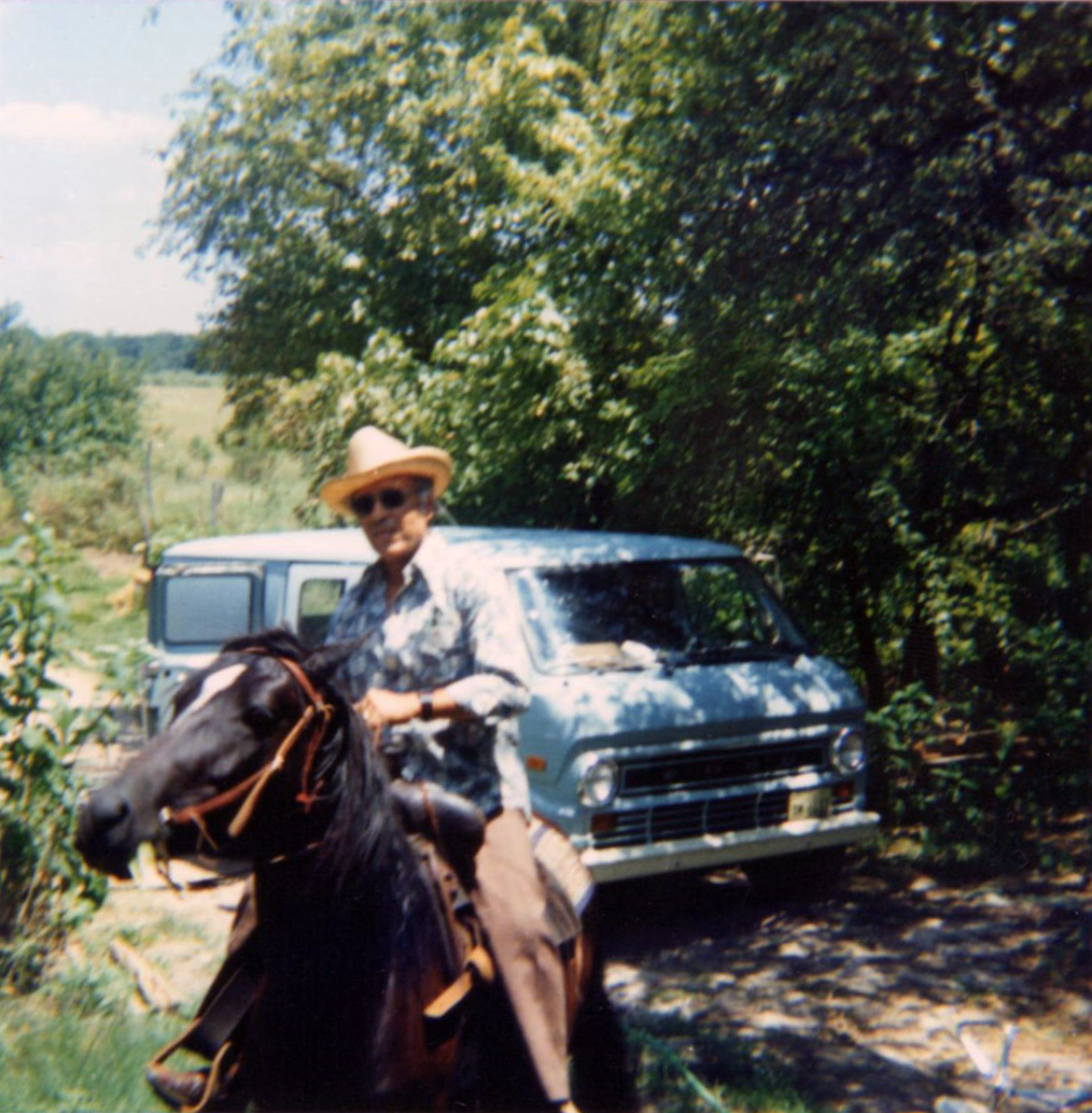
When I was in elementary school I remember Daddy going to night school at Amarillo College to became a certified air conditioning and refrigeration repairman. He eventually went back to repairing furniture at Heath Furniture and then worked at Sears Roebuck for 25 years and even after he retired, the Sears delivery guys would drop furniture off at his shop for him to repair pieces that were too complicated for the new guy to repair. Even when had that job, he fixed furniture on the side. I still have the magnet sign that he displayed on his Ford Econoline work van.

My dad riding my horse in Manchaca, Texas
with his blue Ford Econoline van in the background.


I still have this magnet sign that he displayed on his blue van.

I often wish my parents could have lived long enough for them to enjoy all of the information I've gathered about our family on the internet. My father ordered a hardback book with information about the Fajardo surname and he had a framed Fajardo Coat of Arms on the wall of his office. He bought them in 1983 when I was busy taking care of my 5 year old, Adriane and 3 year old Christian. 

"Fajardo book bought by my father in 1983.


The Fajardo Coat of Arms

The Fajardo Coat of Arms


The Fajardo Coat of Arms