Wednesday, July 20, 2016

Los Padillas!

When I began my ancestral journey,  I was looking forward to writing this blog about my Padilla ancestors because it was the branch of my family I knew most about. Little did I know I would discover literally thousands of relatives that I never knew existed. I discovered Padillas on both sides of my family! My dad's 3rd great-grandmother was a Padilla. Not to worry, as you can see on the chart below, there's enough other DNA in the mix to make that safe.


In the beginning of my research, I got stuck on my maternal Great-Grandfather Jose Manuel Padilla because I had his middle name wrong. To make it even more difficult, there are thousands of Jose Padillas in the world. After all of my research, I have concluded that there seems to be parallel family units in several countries with the same surnames as the ones in my family tree. I've discovered multitudes of Padilla, Fajardo,Valdez, Chavez and Montoya families that have married each other all over the world. For instance, I found a Felipe Fajardo who was born in 1883 and lived in Albuquerque. He was  and he and his wife had children named Phillip and Anita. Uh... those are my father, my brother and my sister's names. That parallel family had me very confused for a few days when I began looking for my dad's sister, my Aunt Anita. I thought there may be some skeletons in the closet that I had not been told about. Even now, I only have a couple of photos of my Aunt Anita and no census information on her or my father when they were children because their mother died of the 1918 Spanish Influenza. My father was only 3 years old.

So, my first important discovery was that my paternal grandmother Josefita was a Labadie not a Montoya as I had always thought. She and her siblings had been adopted by her step-father Antonio Montoya so my dad is a Labadie, not a Montoya! This was a BIG find. In that branch of the family tree, my 4th Great-Grandfather Dominique Labadie MD, was born in 1738 in in Veloc, Gascony, France. (in the South of France) He first settled in St Louis, MO. This may have been my family's first connection to St Louis. Then he came to New Spain, Kingdom of New Mexico in Santa Fe in 1765. As a young medical doctor, the 27 year old married my 4th Great-Grandmother, Maria Micaela Padilla, (I love her name) who was born in 1748 in San Juan, Rio Arriba, New Spain, Kingdom of New Mexico. Maria Micaela was the daughter of one of the original founding families of Albuquerque. She was born in 1748, in San Juan, Rio Arriba. They married in Santa Fe on November 2, 1766. and had 15 children. It became very common in the next few years for the young men of St Louis to venture west and marry into the Hispanic families who were rich in land and cattle. She died in 1804 and he died July 23, 1815 in Santa Fe.

I was able to trace that branch of Padillas back to Spain about a year ago but I was unable to connect that Padilla to my maternal branch of Padillas until this week. While doing some research the other night I finally hit the jackpot, in discovering my great grandfather's name was Jose Manuel Padilla. So here is the comparison of my mom's Padilla lineage to my dad's Padilla lineage:


My mother was very proud of her Padilla/Valdez heritage. She often spoke proudly of her great uncles and their importance in shaping the early political climate of New Mexico. The Labadies were as important, if not more so, in shaping the early New Mexican government. More about that later but I do come by my political passion honestly. I only learned about 2 generations of family history and I am guessing it's because that was all my mom knew about. There's no way I would have been able to do all this research without a whole lot of time on my hands, lots of coffee, my trusty little Macintosh laptop with ultra fast internet speed.


I've always known that "Los Padillas" is a community south west of Albuquerque, New Mexico obviously settled by Padillas but I couldn't connect those Padillas to my family in Puerto de Luna, a few miles to the east. This week I discovered "Los Padillas" was settled by my 4th Great-Grandfather Diego de Padilla. His grandparents had lived there prior to the 1680 Pueblo Revolt when the indigenous Pueblo people fought back against the Spanish colonizers in the province of Santa Fe de Nuevo Mexico, present day New Mexico. 400 Spanish people were killed the remaining 2,000 settlers were temporarily driven out of the province. This is where the reality of the history strikes a chord with me. I now know, from the deepest part of my soul that history does in fact repeat itself and it is our job is to learn from the past and use that knowledge to better our future. Our current political climate and division among us is nothing new but it makes much more sense to me because I have a deeper, personal knowledge of the past.

It is no secret that during the Spanish Inquisition some of my Sephardic Jewish ancestors were literally kicked out of Spain due to their religious beliefs, meanwhile some of my ancestors were responsible for these atrocious actions. As if that weren't enough, my Spanish ancestors were then sent to the Americas to convert everyone to Catholicism by the power hungry Spanish government and it's religious officials. They proclaimed the need for a pure and unified Spanish-Catholic race, forbidding intermarriage between Catholics and anyone else, believing this would destroy their ideal of purity of blood. Well, in my case, it worked fairly well for them for close to 500 years, even after leaving Spain. According to my DNA test, I am 26% Native American, so 74% of my ancestors played along with staying in the herd.

As in every situation, some of the settlers had good intentions, others came to the Americas out of greed and the need for power. In the long run, thousands of Spanish explorers and indigenous Americans died in the name of religion. The division we are seeing in our country today is nothing new. But instead of the King of Spain we have a greedy, power hungry top 1% of the population who are more than happy to elect a leader to lead the blood hungry masses into complete chaos in their attempt to divide and conquer for personal gain while using religion as an excuse to hate people. The reality is that no religion teaches us to hate people due to different beliefs or skin color. There should be no walls to keep people in or out. We are all created equal, yet the the fear of lack and greediness of those who are most often in power overshadows the need love one another. My very insightful son said to me the other day that most often people see those with money as the ones to support and follow, when in fact it is the healers and the mystics that deserve our respect and honor. I think that the Native Americans knew that yet they were often forced to change their beliefs or die. My journey is not to learn about those that divided and conquered in the name of religion. My goal is to learn about those that have been the spiritual leaders, the healers that brought people together. I am happy to say I have found many in my personal history that were just that. I am blessed to have their DNA.

So there is your Padilla history lesson for the day! I have interesting stories about many of these Padillas but the basic run down is that Juan de Padilla was born in Seville, Andalucia, Spain in 1558 and for 4 generations after that, the Padillas were in transit from Spain, through Mexico, into New Mexico. I am sure they endured many hardships on their journeys. Those memories live on in my DNA and I honor their memory.


Wednesday, April 13, 2016

This day in History - April 13, 1556


This is a story of an amazing woman, Doña Gracia Nasi (her Christian name was Beatrice de Luna Micas) Her family was from Aragon, Spain. I have been able to trace my mother's side of the family back to the key players to this time and place in history. This would have been 14 generations or 400 years before my time. Gracia Mendes Nasi's family fled Spain to Portugal when the Catholic Monarchs, Queen Isabella I of Castile and King Ferdinand II of Aragon, expelled the Jews from Spain. 

Doña Gracia Nasi was born in Portugal in 1510. Even though her aristocratic Jewish family had fled Spain they had recently been forcibly baptized Catholic. In her dramatic life, she became one of the most respected figures of the Sephardi world in the sixteenth century. She was renowned as a resourceful businesswoman and a leader of the Sephardi. She became known among her contemporaries simply as “La Señora.”

On this date in history, April 14, 1556, twenty-five crypto-Jews were burned at the stake in Italy. In response, Doña Gracia bribed the Pope to delay the establishment of the Inquisition in Portugal and organized a merchant boycott of the Port of Ancona, Italy which brought ruin to the town.

Little is known of her early life. She was descended from the distinguished Spanish Jewish family bearing the name Nasi. Her parents may well have been among the Spanish-Jewish exiles who left Spain for Portugal in 1492, only to be forcibly baptized in Portugal in 1497. Her family assumed “de Luna” as its Christian name.

Doña Gracia realized the power of wealth and spent her money wisely by helping people. She established centers for Jewish study, and synagogues and spent a great deal of resources trying to take care of the poor. She helped Marranos escape persecution and relocate to Turkey, and organized a trade embargo on the Pope’s lands. She was arrested several times for helping evicted families. Although she was denounced by her sister, nothing stopped her from helping Jewish people. Doña Gracia settled in Ferrara of Italy, where she openly declared herself a Jew. She continued to help a large number of Jews hiding their identity. She became the patroness of scholars.

Little is known of Gracia Nasi’s last years as well. When she died in 1569, the loss was deeply and widely felt. Her death spelled the loss of a legendary personality— along with her sense of privilege and imperious behavior, symbolized triumph over great adversity, and intense devotion to Jewish life.

Doña Gracia Mendes Nasi was one of the wealthiest women of Renaissance Europe,” but there was so much more to her than her wealth! Widowed in her twenties, she was left with an infant daughter and a partnership in the House of Mendes, one of the great banking houses of the time. She and her husband were Conversos or secret Jews, whose families had been forcibly converted to Christianity but who secretly maintained their commitment to Jewish life and tradition. Besides being a businesswoman, Doña Gracia also managed one of the largest refugee operations in European history, moving converso families out of Spain and Portugal into the Ottoman Empire, where they could openly practice their Judaism and where they were no longer under the threat posed by the Inquisition. At the same time, she was a high-profile refugee herself, moving from city to city as politics shifted. She eventually moved to Istanbul where she died in 1569.

Read about Gracia Mendes Nasi in the Jewish Currents

Thursday, March 31, 2016

March 31, 1492 Jews Expelled from Spain

In 1469 Catholic monarchs King Ferdinand II and Queen Isabella married to unite the kingdoms of Aragon and Castile. On March 31, 1492 they gave the Jews four months to convert or leave Spain. Many Jews converted to Christianity to escape persecution, but many "conversos" continued practicing Judaism in secret.

“Tens of thousands of refugees died while trying to reach safety. In some instances, Spanish ship captains charged Jewish passengers exorbitant sums, then dumped them overboard in the middle of the ocean. In the last days before the expulsion, rumors spread throughout Spain that the fleeing refugees had swallowed gold and diamonds, and many Jews were knifed to death by brigands hoping to find treasures in their stomachs.”

The Spanish Inquisition is the most famous of the inquisitions carried out between the 12th and 19th centuries by the Roman Catholic Church.


Image of a page of the original Edict
Signed by Ferdinand and Isabella
Source: The Nahum Goldmann Museum of the Jewish Diaspora, Israel.


Saturday, March 19, 2016

...More on the Fajardo, Labadie and Padilla Family Tree

Last month on February 16, 2016 at 2:00 pm., my dad's first cousin Lola passed away.  I remember her as a beautiful, petite, red head who was quiet and kind hearted. She was always dressed beautifully and loved to dance. She had been married to the love of her life, John Solano, since 1949. John was also an adorable, sweet soul who loved to play music. They were a perfect match. They had two adorable children Andy and Lorraine. This month on March 17, 2016 at 2:00, one month and one day after Lola passed away, John joined her in heaven. Truly a love story that would make a great movie. I just imagine that Lola greeted John in heaven and they happily waltzed away together.

 
 Johnny and Lola
with their children Andy and Lorraine
and grandson Steve

Before I started my ancestry research, it was difficult for me to understand the relationship I had to the trail of "relatives" that came over and sat in my parent's living room speaking "Spanglish" over a pot of coffee. Other than the numerous first cousins, aunts and uncles that we spent holidays with, at my maternal grandma Rosita's farm in Puerto de Luna, I just accepted that I was somehow related to anyone that came over and spoke "Spanglish."

Lola and my dad were first cousins. Twice. My dad's mother Josefita Labadie was married to Doroteo Fajardo and her older sister Lucinda was married to Doroteo's older brother Victoriano Fajardo. Lucinda and Josefita's parents were Dorotea Dolores Chavez and Juan Labadie but when they were young girls their father passed away and their mother married Antonio Montoya. I imagine that my grandma Josefita's stepfather was a very nice man because she named my father Felipe Montoya Fajardo. This created a lot of confusion when I began doing research on my father's side of the family tree. It took me over a year to narrow down where the French name Labadie came into play in the family tree.  To confuse things even further, church records showed that my grandparents were married on May 12, 1915 my father was born May 26, 1915. Then only 3 years later in 1918 my dad's mother Josefita passed away of the Spanish Influenza. At some point during that 3 year period, my dad's sister Anita was born. My dad spent a lot of time with his first cousins so they were in fact much more like brothers and sisters.

Lola was from a large family and had an older brother named Jose that my father was very close to growing up. Jose married my mother's younger sister Connie before he went to serve in WWII.


My mother Agueda Padilla,
with her younger sister Connie
and Connie's husband Jose Fajardo
In Puerto de Luna, NM


When Jose and my father Felipe returned from the war, Jose and Connie convinced my mother to go out on a date with my dad. She had mixed feelings about the whole thing because my dad had a Ford Model T and was known for charging the girls a quarter for a ride in his car from Santa Rosa to Puerto de Luna for the dances on the weekend. Soon, my mom would just pay him for the whole night with the money she made working at the post office so she wouldn't have to share him with the other girls. Within a month of dating, my dad's step-mother Perfecta became deathly ill in Amarillo, where his father and his new family had moved to so my grandpa Doroteo worked for the Santa Fe Railroad. My mom refused to go with him because it was improper for her to go on a trip with him so.... he asked her to marry him. He admitted he was afraid that if he left her in Santa Rosa, one of the others who had just returned from the war would swoop her up. I didn't hear this story until shortly before my mother passed away in 2005 after asking her why I had never seen wedding photos. There were none.

Here's Doroteo and Josefita's family tree compared to Vicoriano and Lucinda's. They are both Fajardos on their father's side and Labadies on their mother's side:


Click on image to enlarge

Click on image to enlarge


So as I mentioned my mother Agueda and her little sister Connie married the two Fajardo boys. Here's the comparison of our family trees. Much like the family trees above, only in this case, the women are Padillas and the men are Fajardos.

My Mom and Dad's Family Tree:


Click on image to enlarge


Aunt Connie and Uncle Jose's Family Tree:


Click on image to enlarge


Tuesday, March 8, 2016

Happy International Women's Day!


Happy International Women's Day!

This is a day of gratitude to all of the women (and men) in our lives and those that have gone before us, who made freedom and opportunity for women possible in our lifetime. I especially want to thank my mom for doing her best to make a better life for her children. She was very active in the Democratic Party and used to take me with her to work on elections. I can't thank her enough, however, I did get to take her to the governor's mansion when Anne Richards was Governor. 

Here's to each and every one of you! 


Click here to hear Michelle Obama speak about
International Women's Day


Monday, January 4, 2016

Phenomenal Woman

This is one of my favorite poems written by one of my favorite women. When I am feeling a little down, I read it. When I feel like I have been judged unfairly, I read it. I read it out loud to speak it into being. It is powerful and it is true. 

Phenomenal Woman
Written By Maya Angelou - 1978

Pretty women wonder where my secret lies.
I'm not cute or built to suit a fashion model's size 
But when I start to tell them,
They think I'm telling lies.
I say,
It's in the reach of my arms,
The span of my hips, 
The stride of my step, 
The curl of my lips. 
I'm a woman
Phenomenally.
Phenomenal woman, 
That's me.

I walk into a room
Just as cool as you please, 
And to a man,
The fellows stand or
Fall down on their knees. 
Then they swarm around me,
A hive of honey bees. 
I say,
It's the fire in my eyes, 
And the flash of my teeth, 
The swing in my waist, 
And the joy in my feet. 
I'm a woman
Phenomenally.
Phenomenal woman,
That's me.

Now you understand
Just why my head's not bowed. 
I don't shout or jump about
Or have to talk real loud. 
When you see me passing,
It ought to make you proud.
I say,
It's in the click of my heels, 
The bend of my hair, 
The palm of my hand, 
The need for my care. 
'Cause I'm a woman
Phenomenally.
Phenomenal woman,
That's me.
And that is you.

Saturday, October 17, 2015

DNA Test Results - I Am Excited!

I'm not sure why it took me so long to get my DNA test. Probably because my brother, Phillip got his done about 3 years ago and I didn't understand the results. I wasn't prepared to learn the difference in an autosomal DNA test, X-DNA test, Y-DNA test and mtDNA test or learning what my personal Haplotype is. I looked at the info and decided it was way over my head. So I did three years of research on my ancestry and now they are now able to provide information on my mother and father for the same price that my brother paid for just our father. I find them to be equally important so I am glad I waited.

Since I created my family tree on Ancestry.com I had my DNA test done by them so I can easily find others in my family tree. I sent my saliva sample to these lovely folks and bingo they created a colorful pie chart, map and graph that made me very happy, proving once again that I am an artist unwilling to compute numbers and figures but I get all giddy about colorful pie charts and maps that only sort of make sense because it is as it states, a very colorful ethnicity estimate. I have the raw data files that I will attempt to figure out later. I just recently found out that forty-six chromosomes make up our DNA. 23 from our father and 23 from our mother. So here is my pretty little DNA Pie Chart.


As the pie chart above shows, I have 45% Iberian Peninsula and 26% Native American ethnicity. That is the easy part because the rest of the pie chart doesn't make sense unless you refer to a written description on Ancestry.com and the map below. Obviously the Iberian Peninsula is the darkest blue area which includes Spain and Portugal but the paper work says because of migration, or as I would call it hanky panky with the neighbors, it also includes Sisily, Italy, France, Morocco and Algeria. And then the large light blue circle that encompasses 10 other regions including more of Italy and France and then there is Switzerland, Germany, England and a tiny bit of Ireland. And last but not least the 5% Middle Eastern from Morocco and Tunisia. Which makes perfect sense when you consider that from the 8th to the 15th centuries, parts of the Iberian peninsula were ruled by the Moors who crossed over at the Strait of Gibraltar from Morocco to Spain. The Strait of Gibraltar is only 9 miles across.


The graph above compares my ethnicity to the average person that lives in Spain today. I have 45% Iberian Peninsula DNA compared to their 51%. The people living in the Iberian Peninsula region are fairly admixed, which means that when creating genetic ethnicity estimates for people native to this area, there are similarities to DNA profiles from other nearby regions.


My DNA didn't change, but science does.

This is an updated calculated in Aug 2019.


My cousin, Davy Delgado tells me that some of that 26% Native American is very likely from my Castillo-Padilla branch of the family tree. Davy and I share a great-grand parents, Jose Delores Padilla and Marcelina Castillo. He tells me that the Castillo-Padillas were Comancheros before and after the Bosque Redondo era. I am going to take his word for it because he is the New Mexican historian extraordinaire. He lives and breaths our family history.

Early on in my ancestry journey, I met a cousin, Eric Castillo who lives in Pueblo of Isleta is nestled in the scenic Rio Grande Valley, 15 miles south of Albuquerque. It is one of the larger 19 Pueblos within New Mexico and was established in the 1300s. Isleta Pueblo covers an area of more than 329 square miles, surrounded by the Manzano Mountains to the east and to the desert mesa lands of the Rio Puerco on the west. The name Isleta in Spanish means "Little Island."

With that being said, I might possibly be part Navajo and Mescalero Apache and maybe even Hopi. As the story goes, from 1863-1868 the U.S. Army forcibly moved the the Navajo tribe from their traditional homelands in Arizona to The Bosque Redondo Indian Reservation in Ft Sumner. It was a tragic period of U.S. history. It is as difficult for me do research on this era of my history as it is to do research on Cortes conquering Mexico and the Spanish Inquisition. It seems that I always end up on my couch at 2:00 in the morning, with tears welling up in my eyes as I read about people being wrongly uprooted from their homes.

The Navajos were starved into submission and also forced to march hundreds of miles to the Bosque Redondo Reservation. They call this journey "The Long Walk." Some 53 different forced marches occurred between August 1864 and the end of 1866. Four different routes were used, based on the weather, water and rations available along the way. The Spanish Mission of San Agustin de la Isleta was built in the pueblo around 1629 or 1630 by the Spanish Franciscan friar Juan de Salas. During the Pueblo Revolt of 1680, many of the pueblo people fled to Hopi settlements in Arizona while others followed the Spanish retreat south to El Paso del Norte, present-day El Paso. After the rebellion, the Isleta people returned to the Pueblo, many with Hopi spouses.

So much for the history lesson of injustice. That lesson seems to repeat itself and it is something I would like to see healed amongst the human species. I really would like to see the day when we all realize that there is more than enough for everyone if there wasn't such greed amongst some.

Back to the DNA information. I also learned that sibling's DNA vary slightly. My brother Phillip and I had already sort of figured that out as it has always felt like maybe our siblings Gilbert and Nita got the Fajardo Catholic gene and Phillip and I got the mystic Jewish gene. Memories are carried in our genes. It is a proven fact and you can read about that  here.

Scientists have found that memories may be passed down through generations in our DNA

Your DNA contains a record of your ancestors, but you aren’t a carbon copy of any one of them. The particular mix of DNA you inherit is unique to you. You receive 50% of your DNA from each of your parents, however you may receive different segments of DNA than your siblings. 

Here is a chart that shows the possible variations in a family.
This is not my family, just a sample.


Thursday, September 17, 2015

La Malinche - Caught Between Two Cultures


Since my last entry I have been studying the life and times of Hernando (Hernan) Cortés, born in Castile, Spain in 1485. According to Ancestry.com, I am a descendant of Cortés and I have found that most branches of my family tree overlap over a 500 year period so there is more to this story. When you consider the average person has 4,096 10th great-grandparents and it has been said that Cortes has at the very least a half a million descendants because several women had his children, I have my work cut out for me. It has taken me over 4 months to finally sit down and put all of my research of the Spanish conquistadors arriving in Mexico into words. Reading about it in history is one thing however, it is difficult to fathom the DNA that circulates in my blood. Imagine, if you will, the Spaniards befriending the Aztecs, impregnating their women, creating a whole new breed of Meztizos and then killing Emperor Montezuma in their continued effort to gain wealth and land. It's is a little overwhelming but then I realized there was more to the story... the Aztecs weren't exactly angels either.

Hernan Cortés

Hernan Cortés as he appeared in his shining armor

Cortés arrived in Mexico on November 8, 1519. November 8 just happens to be my brother Phillip's birthday. He arrived with an entourage of about 400 men. They were light skinned and wore beautiful shining armor. They brought horses and wine, both unknown to this part of the world. Cocoa was the drink of choice in for the nobles of Mexico. I've had vivid dreams about riding on a horse wearing armor and drinking wine from a metal chalice, never knowing what those dreams meant but I will save that story for another blog. Their arrival coincided with an Aztec prophecy of a white-skinned God arriving from the east. This would explain why the ruler, Moctezuma II (also known as Montezuma II) greeted Cortés with lavish gifts allowing him to stay at the Aztec palace in the capital of Tenochitilán.

On November 8, 1519, Hernando Cortés was received
by Moctezuma II in the city of Tenochtitlán. 

On my journey through the past, one of my main objectives is to bring to life the strong, intelligent women in history from a woman's perspective. Most recently I found an extraordinary Aztec woman, Malinali, known today as La Malinche. Her claim to fame is that of being Hernan Cortes's beautiful and reputedly treacherous Indian translator and mistress. He gave her the name Doña Marina when she was baptized a Catholic. Her story starts out with a boom! Her given name, Malinalli, signified her birth date on the Aztec calendar, May 12, 1502. My birthday is May 12 which blows my mind because on this ancestral journey I have found that important dates have repeated time and time again over a 500 year time span. Key players in my ancestry seem to share both birthdays and death dates.

Statue of La Malinche
Coyoacán, Mexico
La Malinche Mural by Diego Rivera
La Malinche's parents were nobles, however, after beginning her life living a privileged childhood, tragically, her father died. Her mother then married her father's brother. They soon had a son and La Malinche was was claimed as dead, disinherited and sold into slavery. Talk about a Cinderella story!

When Cortés arrived in Mexico, La Malinche was one of twenty female slaves given to the Spaniards by a Mayan Lord along with other gifts of an Aztec calendar, gold, jewels, pelts and feathers.  At that time La Malinche was 16 and very capable of distinguishing herself with her beauty, grace and education. She immediately became Cortés' personal translator, negotiator and cultural mediator and then became his mistress. She gave birth to his first born son, Martin Cortés. La Malinche was in the forefront of written Mexican history. Cortés and La Malinche's son Martin was the first documented child of European and indigenous American ancestry, a Meztizo. Therefore La Malinche has been deemed the mother of the Mestizos, literally and metaphorically.

Monument of Cortes, La Malinche, and their son, Martin in Coyoacan

Needless to say, her story is intriguing and it is a perfect example of how history becomes distorted, depending on the story teller. For the most part of 500 years La Malinche has been condemned as traitor because she was was instrumental in the demise of the indigenous tribes of Mexico. Cortés stated in a letter: “After God, we owe this conquest of New Spain to Doña Marina.” She was perceived as a trader however, her actions saved thousands of lives from the brutal, blood-thirsty rulers by enabling Cortés to negotiate rather than slaughter while preventing human sacrifice and cannibalism. Coincidentally Cortés saved her from a life of slavery so in essence they really owed each other and built a sort of Romeo and Juliet bond on that connection. From my point of view, she was a fearlessly loyal heroine. But that is just me, a feminist, 500 years later. The disdain that's been felt towards La Malinche runs deep. There is a derogatory term for those who are attracted to foreigners, foreign values, thinking them superior or of better quality and worthy of imitation – "Malinchism" or "Malinchist." It even became a technical term, political, for everything that meant choosing foreign culture. Malinchistas were those who encouraged Mexico to open itself to the outside world. In a speech given in 1968 Mexican President Diaz Ordáz scolded the Mexicans saying “Our malinchismo is holding us back. We must get over it."  Needless to say racism isn't a new problem. It is built on the fear of what we do not understand about other cultures.

The Mexican artist Antonio Ruíz’s
Surrealist Painting “The Dream of Malinche,”

Malinche with Cortés: mural by Roberto Cueva del Río

Art Mimics Life

In Theatrical Productions -  La Malinche is sometimes portrayed as a victim of conquest, and sometimes the cause of her own destiny, but almost always, she is guilty. If she was indeed violated, it was because she didn't struggle enough. If she was a willing participant, she not only brought her own troubles, but she caused her child and all of her people to suffer.

In Art -  La Malinche is represents women's innate deception and guilt, using her beauty and sexuality to gain power and in so doing so, very much in need of punishment.

In Dance - The dichotomy persists. In "La Malinche," a ballet composed in 1949, she is at first an unwilling victim, then assumes the proud deportment of an aristocrat, and in the end, weighted down by the finery she wears. She then gives birth to the Mestizo child who then rejects her.

In Literature -  La Malinche has been compared to Eve, the temptress who through deception, leads men astray. Malinchismo represents one end of the spectrum of stereotypes of women while the Virgin of Guadalupe resides at the opposite end of the stereotypical spectrum. 


Painting of La Malinche and Hernando Cortés

See how much more interesting history lessons are when you have a woman injecting romance into the story? I'm not the only one. In the late 1960s and early 1970s, Chicana writers, artists, and activists began to examine the story of La Malinche. They discovered neither victim nor traitor but the strength of a survivor. This is a story I can relate to. La Malinche did not choose her destiny, but neither did she crumble in the face of adversity. I've explored her fate and her abilities to negotiate difficult cultural demands. Much more difficult than my own, yet helping me to understand the ongoing struggle for personal and world wide cultural power.

La Malinche learned to wear the finest clothes and jewels 


Hernan Cortes, La Malinche (Doña Marina)
and son Martin Cortés' home
57 Higuera St., Coyoacán, Mexico
Now owned by Guatemalan artists Rina Lazo Wasem
And her husband, Mexican artist Arturo García Bustos
Rina studied with Diego Rivera and his wife Frida Kahlo

.... And the plot thickens...... As the story goes Cortés, La Malinche and their son Martin lived in the house pictured above in Coyoacán, Mexico. La Malinche wore the finest clothes and jewels, living a storybook life for a time.... however.... Cortés had a wife in Cuba, Catalina Mercada Suarez who arrived in Mexico in 1522. She mysteriously died in this house. Some say Cortés had her killed for the love of La Malinche.

So there is your history lesson for the day. I am still scrambling through 500 years of ancestors who married into each others families over and over and over so I am not sure that the lineage below is absolutely correct. I am sure there will be corrections but it has been an interesting journey of discovery and there will be updates to follow. Moctezuma's daughter, Isabel, the last empress of Mexico, also had a daughter out of wedlock by Cortés. It is extremely difficult to characterize Cortés however, he gets points for leaving his many children well cared for in his will, along with every one of their mothers.


Click This Chart To Enlarge


When I started doing research on my ancestry, I seriously believed I would be able to become a member of ancestry.com for approximately 3 months, do some casual research and be done with it and be able to give everyone in my family a 10 page ancestry book for Christmas. I wasn't prepared to learn that about 10 generations ago my ancestors came from Spain and created a little havoc along the way making them very important characters in world history. I also didn't take into account that each of us has 4,096 10th great grandparents. So think about it, if only 96 of my 10th great-grandparents made it into the history books, that means I have 4,000 that were slackers!

Read this chart, it is mind blowing!
You have 1,048,576 18th great-grandparents!


Sunday, August 30, 2015


Today I was saddened to hear of the passing of Wayne Dyer, author and speaker in the field of self-development. I was just one of millions. There was a time when I listened to his CDs and watched his videos so much that I jokingly called him my boyfriend. It seemed that every time I had a question, he magically appeared with the perfect message. Sometimes on facebook, an email, on a CD, video or a number of ways. This month, in celebration of his life, his Facebook Page has been offering his books and CDs at a very low price and today offered free podcasts. I turned on a podcast while doing some art earlier today. I had just been pondering my relationship with one of my children and of course there was Wayne with the answer. He had 8 children of his own so who would know better about individual relationships with offspring and how different each child is. As he said, children are born with their own personalities and lessons to learn. He quoted Kahlil Gibran from the poem "On Children"

Your children are not your children.
They are the sons and daughters of life's longing for itself.
They come through you but not from you,
And though they are with you yet they belong not to you.


You may give them your love but not your thoughts,

For they have their own thoughts.
You may house their bodies but not their souls,
For their souls dwell in the house of tomorrow,
which you cannot visit, not even in your dreams.
You may strive to be like them,
but seek not to make them like you.
For life goes not backward nor tarries with yesterday.


You are the bows from which your children

as living arrows are sent forth.
The archer sees the mark upon the path of the infinite,
and He bends you with His might
that His arrows may go swift and far.
Let your bending in the archer's hand be for gladness;
For even as He loves the arrow that flies,
so He loves also the bow that is stable. 


Logically I know this to be true. Yet sometimes it's difficult to let go and allow your child to walk on their own path and learn their own lessons in the manner in which they have chosen. This is especially true if their road takes a turn away from the road you once walked together, onto a road that your perceive as more difficult than the one that you dreamed of for them. There is an instinctive attachment that a parent feels for their children, a bond like no other that makes it difficult to just let go and watch them walk away with the partner of their choice if your instinct tells you that their life could be easier if they were making different choices.

So what does one do. Deep down I know that there is power in partnership, this I know for a fact, not having a partner for some time. But not just any partner. "God Idea Partners"  There is a verse in the Bible that speaks of the company we keep:

Proverbs 13:20
Walk with the wise and become wise, for a companion of fools suffers harm.


My instincts tell me to let go, My parents continued to make important choices for me well after I was 18 and I believe my life would have been so much different if that had not been the case. I wanted to go to college at Highlands University in Las Vegas New Mexico. They went and got me and made me come to Austin to babysit for my sister's son. Because of that, I have always made a point to offer help to my children when asked yet allowed for mistakes, knowing that everything happens for a reason and IF you pay attention there is a lesson in everything.  It is possibly the hardest thing I have ever done, yet all the while my final prayer at night is for my children's well being and my first prayer in the morning is the same. Sometimes that is all you can do. God knows we are all a work in progress with no judgement so I am thinking the key is self forgiveness.

So here's to letting go and allowing out children to make their own choices and mistakes. I only wish that they knew that their crown has been paid for by all of their ancestors that cam before them and it is just a matter of putting it on and wearing it. Never let anyone put you down and when someone tells you who they are believe them. There is a place within you that is sacred. Go there. In your heart, you know what is best for you. Do it.


Sunday, July 19, 2015

The Hero's Journey


On the endless journey of researching my heritage, I've lived vicariously through more than 500 years of my ancestor's experiences, hardships and victories. Every week I have found myself walking in someone's else's shoes, sometimes in a different country, a different century, some times as a woman, most times as a man. On this journey, I have come to know from the deepest part of my soul that we are all one. One world, one people under God. I know now more than ever that division comes only through those that are fearful and greedy, most often, using religion to divide and conquer.

Alvar Nunez Cabeza de Vaca

A recent exciting discovery is that I am a descendant of Alvar Nunez Cabeza de Vaca. He came to North America from Spain in the 1500's. Being raised as a Catholic, he lived in the time of the Spanish Inquisition, the third largest genocide in history when the Catholic Monarchy killed Jews and Moors to take over Spain in the name of Catholicism. When he came to the Americas, he met many Native American tribes befriended them and wrote a journal about them all. He realized that we are all one people under God. If he had been operating from a place of fear, he would have made the Native American's beliefs wrong. Instead he learned from them and taught them what he knew. He was seen as a Shaman and a healer because he brought with him his knowledge and used native plants to heal. He was a brave soul walking a hero's journey.

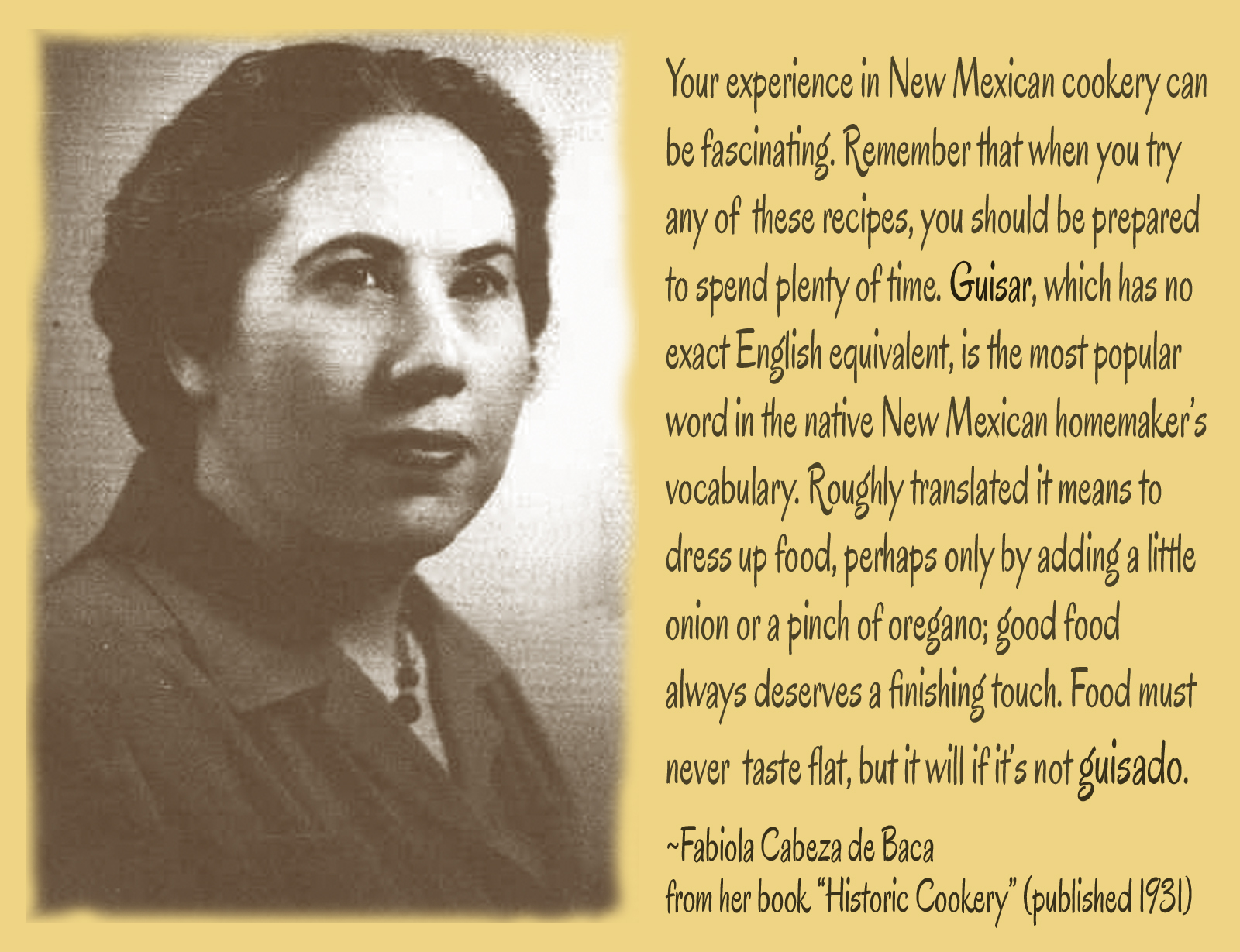
Fabiola Cabeza de Baca


On May 16, 1894 another descendant of Alvar Nunez Cabeza de Vaca's was born in New Mexico. Her name was Fabiola Cabeza de Baca, my 1st cousin, 2 X removed. I believe that she followed as closely in Alvar's footsteps as anyone could have. After she earned a degree in Las Vegas NM, she became a school teacher and then spent a year studying in Spain and doing genealogical research. (A woman after my own heart!) She then returned to New Mexico and embarked on a thirty-year career as an extension agent, teaching the indigenous people in rural New Mexico (consisting of Native Americans, Hispanic and Anglo Americans) about preserving and canning food. She invented the u-shaped hard taco shell and introduced green chile to the Anglo communities. I can only imagine the fear that she encountered from the various tribes on the red dirt back roads of New Mexico. She was another brave soul walking a hero's journey.


That is just the story of two of my ancestors! Over the 500 year time span that I have studied most of my ancestors were of Spanish descent, they encountered many different cultures on their journeys. Every tribe, every denomination differed in their tradition, ritual, practice of faith and worship. Many were Converso Jews (Jews forced to convert to Catholicism by the Spanish Monarchy.) Some were Catholics who killed the Aztecs and married their wives in order to take over Mexico and then later there were some of Spanish descent who married those of French descent in New Mexico. And then of course my parents moved to Texas and I married and had children by a man who was of German and English descent. Through the years our customs and traditions have been meshed together like a beautiful woven tapestry. Throughout the centuries, I have encountered many ancestors who were such brave souls, willing to walk the hero's journey.


What I have deduced that it isn't which ritual or religion that you practice that matters. I believe that in prayer or meditation you become one with God and what you call it doesn't matter. Our souls are constructed of layers of consciousness carried in our DNA. We, individually and collectively are the result of the love of thousands. It's only out of ignorance that people make others wrong because they don't speak the same language, say the same prayer, have the same skin color or call God by the same name.

Because I spend my time doing research or creating art, I spend very little time watching TV. I have never been a big talk radio person and I completely stay away from websites that look like they are designed by amateurs. It seems that there are a lot of untruthful, hateful, fearful information being shared by those hoping to get the masses to buy into their fear. It saddens me to know that people buy into the fear at their own cost. There have always been those that teach of gloom and doom being caused by those in power. I understand that there are bad people in the world but I believe that to think about them constantly, is to give them power. I also believe that there is one God that created us all equally. A God that is the seed of everything that ever existed. I have chosen to believe that there is no division between all of us who inhabit this planet. I believe there are good and bad within each class, race, color and creed. There is good and bad within each of us.

Now more than ever, I am baffled at the arrogance that anyone in this day and age still believes that God only speaks their language or that their tradition of worship is the only path to heaven. Who is to say which language or conversation with God is the right one. I say that all conversations with God are the right one. If you believe your religion and your God is better than someone who is different from you, I would urge you to see the world as God sees it. Through God's eyes, not yours. There is one God, however, people around the world speak different languages. Their grandparents told they different fables. Be forgiving of others stories and beliefs. It is not for you to judge. I challenge you each of you to go beyond religion and live in prayer. Recognize the presence of God in every moment. See the world through the filter of God.

Here is a great song that I recorded last night that feels to me like walking the hero's journey.
Mystery Monday at El Mercado
"Walk A Mile In My Shoes"
Jimmy LaFave, Christine Albert, John Inmon, David Carroll and Bobby Kallus