Showing posts with label Padilla. Show all posts

Friday, February 27, 2026

Healing Ancestral Trauma


For centuries people have been captivated by genealogy, tracing their ancestors through historical records for various reasons. In recent years, DNA tests have taken genealogy to a whole new level. This is a DNA chart of me, my sister Nita and my brother Gilbert. Siblings have different DNA, despite sharing the same parents. We each inherit a unique, random combination of 50% from each parent. Phillip isn't on this chart because he didn't take his DNA test with Ancestry.com.

About 16 years ago, my brother Phillip was the first in my family to take a DNA test. He was interested in finding out if we had Sephardic Jewish ancestry. Unfortunately, at the time the $99 DNA test he took only supplied information on our father’s side of the family. A year later I had a DNA test done by Ancestry.com. By that time the average DNA test provided both paternal and maternal DNA information. In the beginning my interest was in healing generational trauma because I saw a pattern repeating in my life which involved extremely unfair real estate deals that I couldn't logically explain. It became obvious that healing generational trauma would require disrupting established power structures within the family which would require me, the youngest female in a very traditional Hispanic family, to break inherited cycles of dysfunction. Through self-awareness and emotional processing, I could clear the trauma in my lineage. I realized that I went along with the status quo to keep peace in the family and it never worked in my favor. 

Previously, since my DNA is mostly Spanish, I was  taking on the responsibility of the misplaced Jews who lost their homes and all their belongs during the Spanish Inquisition and the misplaced Native Americans due to the Spanish Colonizers in the Americas. But then I realized I am 43% Spanish, 20% Native American, 10% Sephardic Jew and a 27% mixture of a whole bunch of other stuff. In other words, my ancestors experienced both victory and defeat. So, logically, how could I be responsible for the Spanish Inquisition? LOL

I then discovered the study of epigenetics and found that we can carry our ancestors' trauma through epigenetic inheritance. Stress impacts gene expression, turning genes "on" or "off" like a dimmer switch without changing the DNA sequence itself. This affects our descendants' stress responses, mental health and behaviors. That would explain why children born into the same family experience different levels of stress-related behaviors. Past traumatic experiences can leave biological marks, influencing the hormonal systems and brain function in future generations, leading to heightened anxiety or depression. While these marks exist, healing is possible through therapy, and acknowledging family history to prevent passing on these chains. So here I am, trying to heal my family.

Our family's DNA did have an impact that aligned with Phillip's interest in discovering his Sephardic Jewish ancestry, but maybe not the way he thought it did. He passed away September 4, 2025 and in our last personal conversation, he said he wanted to get an updated DNA test. I wish he could have for so many reasons. He seemed to be trying to come to terms with a few things in his last days. Phillip was the only immediate family member who had read my blog regularly over the years and I miss his commentary immensely. There were times when he and I had long phone conversations about spirituality and quantum physics, in the same conversation. He always had a way of taking the conversation to the next level. In the last few years of his life, he didn't get to spend time with the Fajardos. There were unspoken moments when I knew we didn't see eye to eye on religion & politics so we just left well enough alone. 

It seemed almost poetic that my research had taken me back to the 13th century Spain when the Fajardo Army of southern Spain, described as a prominent, elite lineage, had consolidated their forces with the Catholic Monarchs, Ferdinand and Isabella to take over all of Spain during the Spanish Inquisition. Tstatutes, they were among the primary enforcers of these discriminatory Spanish laws that required proof of Christian ancestry "pure blood." These laws were used to exclude Jews, Muslims, or non-Christians from public office and universities. Yet, on the flip side, the surname Fajardo is considered to be of Sephardic Jewish origin due to its historical connection to converso (forced convert) families who fled. Our lineage first went to the Canary Islands and then to New Mexico right after the Spanish Inquisition. It reminds me of the extremes in current day United States, especially Phillip's immediate family of "Born Again Christians" vs the rest of the Fajardo family. It's a perfect example of how all families throughout the ages have their differences. Some of the Fajardos during the Spanish Inquisition were on the side of the Catholic Monarchs and some were Sephardic Jews. We truly do carry our ancestors' trauma through epigenetic inheritance. 

Phillip was diagnosed with a brain tumor in May 2025. He was having seizures and suffered a severe brain bleed that his hospice nurse confirmed would ultimately take his life. Earlier today I opened facebook and this post appeared to remind me that he was diagnosed with a brain tumor and had it removed exactly 16 years ago today. At that time, 16 years ago, the neurologist said he only had 2 years which tell me that Phillip was misdiagnosed. 


But there I was in August, just a couple of weeks before he passed away, having our last private conversation. His wife was glaring at us across the room. It wasn't until then that I realized just what an oppressive relationship he had been in for all of these years. 
It had proven to be useless to bring up any topic his wife didn't approve of. My ongoing research into the "Common Hispanic Mutation" (CCM1 - Cerebral Cavernous Malformation)  and the fact that it is often misdiagnosed as a brain tumor was right at the top of the list of topics that weren't allowed to be discussed. Phillip's wife was treating him with a hand full of non prescribed drugs and he had signed Advance Directives saying he didn't want any more medical care. So there I sat with all my years of research about the genetic mutation that's highly prevalent in our New Mexican blood line on both our father and mother's side of the family. Yet his family ignored the fact that our genetic legacy came from a small group of early Spanish settlers, linked directly to the historical ideology of Limpieza de Sangre (purity of blood) that is scientifically known to cause brain bleeds.

During our conversation Phillip said to me "You and I were cut from the same cloth." I smiled and said proudly "Yes, we were." I felt that in the depths of my heart, yet in the back of my mind I was thinking "Yes, with the same genetic disease, caused by our ancestor's fixation on having pure Spanish blood. And sadly, the same mindset of the right-wing Christian nationalists government who want to keep 'America' white." 

I couldn't save my brother. I strongly believe he is in a better place. When I think of him, I see his healthy, brilliant face in a beautiful field of of mushrooms. 

Phillip Fajardo

The good news is that others have found my blog helpful and informative. I had a doctor from Dallas and one from El Paso who found my blog about 6 years ago. They were both impressed with my research and asked if I would be interested in taking part in their CCM1 studies. At the time, I was in my mid-sixties and I don't drive long distances, so I refrained, but my research was helpful in tracing some of my relatives with the CCM1 gene to the Santa Rosa, NM area. I have also been contacted by many distant cousins who have found my blog because they are on the same journey of self discovery through ancestry. When you do a Google search of Puerto de Luna, New Mexico, my blog is the first thing that comes up because it is literally a ghost town now. 

I discovered much more information than I bargained for when I signed up to become a member of Ancestry.com, thinking I would keep the membership for 3 months. Here it is 15 years later and I have been on a quest that has taken me on an amazing journey through my family's colorful past. Tracing the Fajardo surname back to Spain as far back as the 1200's has been a mind blowing, educational experience.

I started writing about my research for my children and grandchildren because after my parents passed away, I felt like I should have asked more questions. The next generation may be interested in it some day, but meanwhile I am connecting with cool cousins. At the bottom of this post you can click on "See More Posts" and it will take you to older posts.

The journey actually began when I was 16 years old, my junior year in high school, when my parents sent me to live with my Grandma Rosita Padilla in Puerto de Luna, New Mexico as a punishment for skipping school. I was having anxiety attacks at school. That all disappeared when I went to Santa Rosa High. I felt seen and heard. I loved my art teacher, Mr Lopez. I felt a deep connection to my ancestors who had been in New Mexico for over 400 years. In the quiet times, alone on the farm, in my grandma's adobe house, that my mother had helped to build and in the chile fields next to the acequia. Or on the weekends when my cousin Percy Padilla and I worked at the small store/gas station in Puerto de Luna  called "Mercado Coronado." The store was next door to what used to be the Grzelachowski General Store, which is is known for having the likes of Billy the Kid as a regular customer in the late 1800's. I felt that I was surrounded by the spirits of my ancestors and there was an underlying feeling that I had been there in the previous century. It all felt oddly familiar. I felt like I was finally home.

I didn't have time to do a deep dive into my past until years later, after my parents had passed away and my children were grown. Building my family tree has been a nightly activity. The historical discovery of my parents homeland of New Mexico and the journey of my ancestors from Spain has been truly fascinating.

I've learned that a well-researched family tree typically reaches back to the 17th or 18th century with good parish recordsI've traced my mother's paternal Padilla lineage back to Anton Martin de Padilla who was born in Sevilla, Spain in 1536. I've traced my father's Fajardo lineage back to my 9th Great-Grandfather Jose Miguel Fajardo born in the Canary Islands in 1591. But I can't help but think his family was just traveling through when he was born because his son, my 8th Great-Grandfather Alonso Fajardo was born in Santa Fe, New Mexico in 1656

Fajardo Coat of Arms

I haven't found a connection but there was an Alonso Fajardo de Entenza, Governor-General of the Philippines (1618–1624), who was a Spanish nobleman born in Murcia, Spain and he was the son of Admiral Don Luis Fajardo. He was a Knight of the Order of Alcántara. The Fajardos had been sent out to conquer the world and it appears that some ended up in in the Philippines just before the first Fajardos came to New Mexico. They had to be related but I don't know exactly how.

The surname Fajardo originated in the northwestern region of Galicia, Spain. With roots traced to a nobleman, Pedro Anes Galego, Lord of Santa Marta de Ortigueira. He was the progenitor of the Fajardo surname. Fajardo is a Galician/Latin term for a beech wood or tree. Then the Fajardo family emigrated to Murcia in 1296 and became high-ranking officials of the Crown of Castile. 

You can't imagine the mixture of emotions I had when I discovered that the Fajardo family was the most powerful and prestigious noble lineage in the Kingdom of Murcia, Spain beginning in the 13th century. 

The prestigious Spanish noble title held by the Fajardos was Marqués de los Vélez. It was a title that held major influence in the region for centuries and was first granted to Pedro Fajardo y Chacon in 1507. He was a prominent military leader and politician. I just read a blog written in 2022 about  Pedro Fajardo y Chacon's iconic Castillo de Vélez-Blanco, also know as the Castillo de los Fajardo located in the town of Vélez-Blanco, Andalusia, Spain. It is said to be a remarkable example of a Spanish Renaissance Castle and it has been declared a historical-artistic monument belonging to the National Artistic Treasury since 1931.

Castillo de Vélez-Blanco,
also know as the
Castillo de los Fajardo

Read more about the castle here.

The importance of the Fajardo family in the history of the Crown of Castile didn't go unnoticed by great authors of Spanish literature. In the 16th-century, because the Fajardo family of the Kingdom of Murcia, held such immense power, they became natural subjects for Spain’s greatest writers. There were satirical plays written for them. Research into Spanish literature highlights connections between the poet Acevedo and members of the Fajardo family

With all of that being said, I have known from the start of my ancestry research that the Fajardo and Padilla lineages are only 2 of many of my lineages. Those are just the names I was assigned in our patriarchal naming system. I actually have more Chavez, Padilla and Baca DNA because they are on both sides of my family tree.

In closing, for years I had come across stories of my Spanish ancestors expelling Jews from Spain and conquering the Americas. Ancestral trauma healing involves identifying and releasing emotional, physical and spiritual wounds that have been passed down through the generations. These wounds manifest as unexplained fears and toxic patterns. Healing requires forgiveness. Forgive yourself above all and forgive others. Ancestral research empowers future generations. I've always felt there has to be a reckoning of accumulated damage done by our ancestors. Being a deep thinking, peace loving healer, I wondered if I had been chosen in my lineage to even up the score. Not as a punishment, but to heal the lineage for my family and future generations. Therefore, I have experienced genetic health issues and botched real estate deals to bring it all to my attention. This blog is just one layer of my personal healing process. Thank you for being a part of my journey.


Monday, July 18, 2022

Dodge, Madrid, Page, Padilla Families - Puerto de Luna, New Mexico - Part 2

 In February I posted that I had just recently joined a Facebook group called Dodge, Madrid, Page, Padilla Families - Puerto de Luna, New Mexico 

Since then I have come to realize that the families such as the Nelson and Page families of Virginia overlap as much as the families in New Mexico like the Padilla and Fajardo families. Now I have been totally entertained by the fact that the Page and Nelson families of Virginia overlap many times over with my children's Ethridge branch of the family tree. This has lead to hours of reading about the United States' founding families of Virginia. Up to this point I had only been interested in the founding families of New Mexico.

This week my cousin, John Dodge posted that he had just visited his fifth and sixth great grandfathers’ graves in Yorktown Virginia, Thomas Scotch Nelson Senior and his son, Brigadier General Thomas Nelson Jr. 

Photo of Thomas Nelson Grave
Taken by John Dodge July 16, 2022

John Dodge July 16, 2022

That prompted me to see how Thomas Nelson is related to my children on their dad's side of the family and here's what I found.


Lucy Grymes

Thomas Nelson Jr. was born in Yorktown, Virginia in 1738 to a very wealthy family who owned a large plantation. He was sent to England for his education, as many members of wealthy Virginia families were. He graduated from Cambridge and returned to Virginia soon after. He married Lucy Grymes in 1762, a member of Virginia’s Randolph family. They had 13 children. Here is where the overlapping of our family tree begins. Lucy was my ex-husband's 2nd cousin 7x time removed. (2nd cousin 7 generations ago) which makes her my children's 2nd cousin 8x time removed. Lucy Grymes' back story is that her great-grandparents were William Randolph I and Mary Isham. Their famous descendants include many prominent individuals including Thomas Jefferson, Robert E Lee, John Marshall, Paschal Beverly Randolph, Peyton Randolph and many others. Due to William and Mary Randoph's many progeny and marital alliances, they have been referred to as "the Adam and Eve of Virginia." 

This is an Ancestry chart of how my children are related to Thomas Nelson Jr.


Here are some more photos of Photo of the Thomas Nelson Grave.


 Nelson became a planter and an estate manager. When he and his fellow signers pledged “our lives, our fortunes and our sacred honor,” the men of the Second Continental Congress took that risk seriously. He gave his fortune and his health to further the cause of American Independence. 

Thomas Nelson Jr. wasn't a healthy man and the mission of independence took a lot out of him resulting in an early death at the age of 50. He also donate all of his money it to help win the War of Independence. 

He was elected to Virginia’s House of Burgesses and was a very outspoken opponent of Britain and their policies toward the colonies and was one of the first leaders in the colonies to entertain the idea of an independency for the colonies. He believed that it was absurd to have the colonists hold an “affection for a people who are carrying on the most savage war against us.” On November 7, 1774, Nelson was a member of the Yorktown Tea Party. Citizens of York County, Virginia had passed a non-importation boycott in response to the Tea Act of 1773. When the British ship Virginia docked at Yorktown, enraged citizens marched onto the ship and dumped two imported half-chests of tea into the water. The boycott was an effort to pressure the British Parliament to repeal tax laws and regulations.

Nelson was appointed as a member of the Second Continental Congress in mid-1775, replacing George Washington when Washington left the Congress to go to Boston to take command of the Continental Army. He had returned to Virginia and was in Williamsburg on May 15, 1776 when the Fifth Virginia Convention passed a series of resolutions declaring Virginia was no longer a part of the British Empire. Nelson immediately carried the news from Virginia to Philadelphia where Richard Henry Lee on June 6, 1776 made the official resolution for independence within the Second Continental Congress, that would lead to the Declaration of Independence. He eventually had to resign from the Congress due to poor health.

Nelson was later appointed a brigadier general in the Continental Army and commanded the Virginia militia during the battle of Yorktown in 1781 during the American Revolutionary War. It was here that one of the most selfless acts of his life took place as he ordered the artillery of the Continental Army to fire on his home, where several British officers were headquartered. The home was heavily damaged. The surrender of the British troops at Yorktown occurred soon after.

In June of 1781, Nelson became the second governor of Virginia, succeeding Thomas Jefferson. He had to resign in November of 1781 due to poor health. By this point in his life, he had lost almost everything. His businesses were destroyed. He was owed over two million dollars by the United States government for his loans to help finance the French fleet and their aid to the war effort. He was never repaid and his financial well-being was destroyed.

Nelson passed away at his home at the age of 50 in 1789 due to severe asthma. His body was originally buried in an unmarked grave in Yorktown because of a fear that creditors may hold his body for collateral until his debts were paid. He now rests under a beautiful stone that pays tribute to him and his service to the United States, including honoring his service as a signer of the Declaration of Independence.


Monday, July 4, 2022

4th of July

Today, July 4th, the United States celebrates Independence Day. in In 1776 the Continental Congress declared the 13 American colonies to be a new nation. The USA was no longer part of the British Empire. That seems like a great reason to celebrate! 


Let me tell you a little about what was going on in my personal history in the 1700's and beyond. The majority of my ancestors are from the western side of what is now known as the United States of America. In 1776 it was not yet part of the USA. It was New Spain. 

So picture this. 28 years before the Declaration of Independence my paternal 4th great-grandmother, Maria Micaela Padilla, was born in the high mountain valley of El Rito in Rio Arriba County, New Spain. It is now present day New Mexico. The exact location is 14 miles south of Abiquiú, 18 miles northwest of Espanola, 15 miles northwest of Ojo Caliente and 56 miles northwest of Santa Fe, with the Sangre de Cristo Mountains to the east. 

With those very detailed directions being given, the present day locals will tell you, tongue in cheek, the very small community of El Rito is about 300 years northwest of Santa Fe because much of the current day population lives off of the grid. 

Maria Micaela was born into the prominent founding Padilla family of New Mexico in 1748. It was common for men to migrate from the east and marry into the large wealthy Hispanic families in the west. In 1765 a handsome 27 yr old doctor, Dominique Labadie, who had been born in Veloc, Gascony, in the southwest of France. migrated from St Louis to New Mexico. He and Maria Micaela were married on November of 1766.Ten years before the Declaration of Independence. The marriage took place at La Parroquia Church in Santa Fe, NM which was built between 1714 –1717. The very popular present day Cathedral Basilica of Saint Francis of Assisi was built 
on the site of La Parroquia church between 1869 and 1886 . Maria Micaela and Dominique Labadie had 15 children and they were all baptized in that church.

Fast forward to January of 1795, the French were lobbying for the return of Louisiana to France. Spain was fearful of the encroachment of the United States and France. Since Dominique was French and married to Maria Micaela Padilla, who was Spanish, their property was inventoried and the couple and their 15 children were confined to their residence for a period of time.

Because the information that's been written in our history books and taught in our schools is extremely slanted, I have had to dig deep for my personal history. In 1776 
King Charles III of Spain gave my maternal 5th Great Uncle, Captain Antonio Montoya, 50,000 acre Piedra Lumbre Land Grant in New Mexico. Did you read anything about that in your history books? Probably not. The 21,000 acres that comprise Georgia O'Keefe's Ghost Ranch is part of the Piedra Lumbre Land Grant and is now owned by a Presbyterian Church. I won't go into how it went from being a family land grant to being owned by a church. 

I would rather tell you a little more about the Labadie family. Lorenzo Labadie was the grandson of Micaela and Dominique Labadie and my 3rd Great-Uncle. He is one of my ancestors that I have grown to know and love through my research. Lorenzo was described as a handsome, honorable man who wore many hats. 

Lorenzo Labadie

In 1851 he was the Sheriff in Valencia County where he served 3 terms. Like his friend Kit Carson, he was a sympathetic and a loyal friend of many Native Americans. In 1855 he was appointed as a U.S. Indian Agent for 15 years and gained respect and confidence seldom obtained by the Native Americans as an Agent. Under his watchful eye, the Native Americans worked side-by-side with soldiers, damming the Pecos River to irrigate crops, planting trees, and building a slaughter house. this is very close to my heart because I watched my uncles work that land as a child, growing chile and raising cattle. Under Lorenzo's watchful eye in the late 1800's they had 94 gardens spread over a 100 acre area and grew melons, pumpkins, chile and green beans. 

Lorenzo was removed as an Indian agent because he protested against the Native Americans being furnished unwholesome food by the government. I picture him in my minds eye as a honorable man, much like my father, someone who could never fully retire. In 1871 Lorenzo took out merchants license and opened a wine shop. There were vineyards and orchards in Puerto de Luna. I can only imagine how beautiful and lively it was when my parents were born there in the early 1900's.

Here are photos of the Labadie Ranch in Puerto de Luna, NM as it looks today. Lorenzo's daughter, Beatrice Labadie and her husband, Juan Patron lived in this house. It is no longer owned by the Labadie family.

Labadie Ranch House
In Puerto de Luna, NM
Labadie Ranch House
In Puerto de Luna, NM
Labadie Ranch House
In Puerto de Luna, NM
Labadie Ranch House
In Puerto de Luna, NM
Labadie Ranch House
In Puerto de Luna, NM
Labadie Ranch House
In Puerto de Luna, NM

Lorenzo Labadie was the census taker of Puerto de Luna and the surrounding areas during 1880, 1890 and 1900. Because of his excellent record keeping abilities, it made it very easy for me to become very familiar with Puerto de Luna when it was an active, thriving community. I have never seen any other census taken with such precision. There's so much family history in these documents, including records of Billy the Kid (William H. Bonney) living and working on my great-great uncle's ranches. 

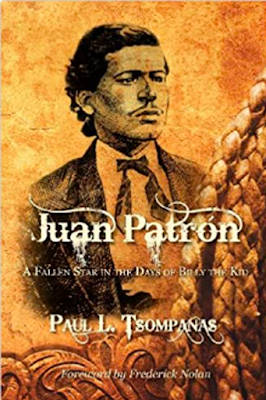
During the day he kept land and cattle rustlers at bay and in the evenings when the work day was done, he taught my Great Uncle Hilario Valdez to speak and read English at the age of 7. That tells me he probably wasn't the bad guy that the history books make him out to be. Instead he was loyal to the Hispanic families who had taken him in and treated him like family. There is a book written about Lorenzo Labadie's son-in-law called "Juan Patron: A Fallen Star in the Days of Billy the Kid." 


Juan had moved his family back to Puerto de Luna from Lincoln County during the Lincoln County Wars only to be shot down in cold blood in Puerto de Luna. 
The killer was Mitchel E. Maney, a cowboy from a wealthy Texas ranching family. 

Juan had raised the money to build the Nuestra Señora del Refugio Church in Puerto de Luna. Sadly, the first mass held in the church was was his funeral. His was buried in the church. I hope to some day write a book based on the information that Lorenzo collected in the pages of his census.

The Nuestra Señora del Refugio Church
Puerto de Luna, NM

So there you have it. A very condensed version of what was going on with just a couple of branches of my family tree in the west when the original 13 eastern colonies became the United States. It wasn't until January 6, 1912, 3 years before my father was born that New Mexico actually became the 47th state. In 1776 it was New Spain.

I had a few ancestors who were in 13 colonies. I just discovered in the past couple of years that my family tree has a couple of branches who are direct descendants of the United States founding fathers. My children are 2nd cousins 8 times removed from President Thomas Jefferson on their dad's side. William Randolph I and his wife, Mary Isham are my children's 9th great-grandparents in the in the Ethridge lineage. I had an Aunt Marcelina Padilla Page who was also married into that lineage so there are some Page/Nelson/Dodge families that cross back and forth from my mom's side of the family to my ex-husband's family. This is very typical for those of us in New Mexico but my ex-husband was born in Houston, TX. I'll save that story for another blog. The funny thing is, my mother moved me far, far away from New Mexico so I wouldn't marry a distant cousin and I married a distant cousin anyway. hahaha!

This Independence Day, I am just going to visualize independence from this modern day madness we call our government. I'm praying for many, many needed miracles. Women's healthcare is at the top of my list.

Friday, February 18, 2022

Dodge, Madrid, Page, Padilla Families - Puerto de Luna, New Mexico - Part 1

Just recently I was invited to join a Facebook Group by my cousin Timothy Dodge. The group is called:

Dodge, Madrid, Page, Padilla Families - Puerto de Luna, New Mexico 

I've had a really great time on this Facebook page getting to know my cousins who I never really got to know, on my mom's side of the family because our closest connection, my mom's older sister, Marcelina Padilla Page, died in 1939. 

Marcelina married Joseph Page and her daughter, Marcelina married Antonio Dodge. 

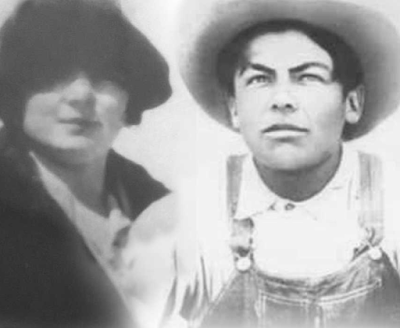
Marcelina Padilla Page and Joseph Page

However, the families from Puerto de Luna are related sometimes several times over. My Great-Great Aunt Juana de la Trinidad Sandoval was married to Henry Lafayette Dodge, the first Dodge to go to New Mexico from Dodgeville, Wisconsin.

As I was looking at my family tree, I noticed that the Page-Nelson family connected to the same founding  families of Virginia that my children are connected to through their father's lineage. With a little research I discovered that we are all related to William Randolph I, born November 7, 1651. He was a politician in Colonial Virginia who played an important role in the development of the colony. He married Mary Isham, born November 21, 1717. Due to their many progeny and marital alliances, they have been referred to as "the Adam and Eve of Virginia." For instance, President Thomas Jefferson was the great-grandson of William and Mary Randolph. Their  descendants also include other prominent individuals including John MarshallPaschal Beverly RandolphRobert E. Lee, Peyton RandolphEdmund RandolphJohn Randolph of RoanokeGeorge W. Randolph, and Edmund Ruffin. 

In July of 2020, I discovered that my ex-husband, Davis Ethridge and my sister, Nita's ex-husband, Jack Hatley are 5th cousins in that same lineage. I wrote about it in this blog post. The discovery was uncanny because Nita met Jack in Amarillo and I met Davis in Austin. The two of them grew up on opposites ends of Texas and only met once at my wedding in 1977. So it seemed unlikely that they would be related and my children and my sister's son would be related on their dad's side of the family as well as their mother's side. It seemed so miraculous that I created a blog specifically for my extended family including my children Adriane Ethridge and Christian Ethridge, my grandchildren, Dylan Ethridge, Andrew Ethridge and Jacqueline Ethridge. My step-daughter Sarah Ethridge and her daughter Emerson Ethridge. Also for my nephew Derek Hatley, his wife Heather and their two daughters Bianca Hatley and Ava Hatley. And for my ex-husband, Davis Ethridge and my sister's ex-husband, Jack Hatley. Now this blog is dedicated to my extended Dodge, Madrid, Page, Padilla Families of Puerto de Luna, New Mexico. 

As a genealogist, it's extremely exciting when I discover a new lineage that has in depth documented information. I have been studying our founding families of New Mexico for about 12 years so the new found Virginia and St Louis connections are fun, especially now that I am in St Louis for the winter.

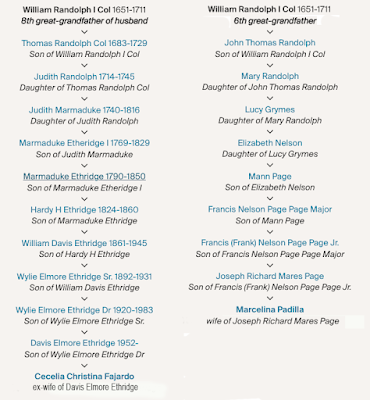
Here's just a couple of samples. The first one is of the lineage back to William Randolph for both the Ethridge and Page families. But just like all our families from Puerto de Luna, the overlap many times over.


William Randolph was my children's 9th great-grandfather and would also be all of my cousins' in New Mexico reading this, 8th great-grandfather.


This shows that Francis Nelson was related to my children's Ethridge side of the family as well.

There are so many connections, I will be adding to this blog. I just wanted to express how much all of my relatives mean to me. We have a huge family that we should all be so proud of and I am sure that our parents, grandparents and all the great great grandparents and beyond are with us in spirit. 

Always. Bless you all.


Thursday, May 27, 2021

Maximilliano Mike "Max” Henderson


Maximilliano Mike Henderson 


This is Maximilliano Mike "Max” Henderson. He was my first cousin, the son of my mother's older sister, Maria Padilla Henderson and my Uncle Sam Henderson.

I love this photo of Mike because he reminds me of my brother, Phillip.

Mike was born June 10, 1937 in Puerto de Luna, New Mexico. Ten years later, his family moved to Tucumcari. The move was traumatic for Mike because he had been attending school in a one-room schoolhouse, surrounded by his family's Spanish language. His formative childhood experience was the complete opposite from mine. I  was born and went to elementary and middle school in Amarillo, Texas and then went to live in Puerto de Luna with my Spanish speaking grandma in the eleventh grade. I can honestly say it was in the top five best experiences of my life and it  changed the trajectory of my life.

April 19, 1954, the year before I was born, Mike married, Mary Esther Moya  in Amarillo, TX. He was 17. The couple moved to Los Angeles where they stayed for 10 years. They then moved to Albuquerque and eventually back to Tucumcari, where Mike made a living doing car paint and body work. By this time, the couple had eight children. Mike had began to create furniture and art for their house.

Later Mike started selling some of his art in Santa Fe. Then when an elderly man showed him a wooden figure of Christ that was broken and held together with duct tape, Mike volunteered to repair it, taking the opportunity to examine the design. He began studying the work of famous artists and books of saints and found encouragement from several famous santeros in northern New Mexico.
Santeros are artists who carve and paint santos, images of saints.

Mike was an International Artist with artwork in Wood Carving and Religious Statues. He was a member the New Mexico Spanish Colonial Art Society.

Mike was closer to my mother's age than he was to my age so I didn't know him very well. We would often stop at my Aunt Mary and Uncle Sam's house when we drove from Amarillo to Puerto de Luna to visit my grandma but Mike was rarely around so we usually only saw each other at weddings and funerals.

Maximilliano Mike Henderson passed away December 14, 2007 at the age of 70, at Dan C. Trigg Memorial Hospital in Tucumcari. He was survived by his wife Mary Esther Henderson; two daughters, Cynthia (Larry) Winn of Gallup, NM, and Judith (Phillip) Guttman of Rio Rancho, NM; six sons, Michael (Cris) Henderson of Pojoaque, NM, David Henderson Clovis, NM, Ronnie (Dawn) Henderson of Rio Rancho, NM, Ray Henderson of Tucumcari, NM, Jay (Louella) Henderson of Pecos, NM, and Tom Henderson of Altus, OK; two brothers, Gracien Henderson of Los Angeles, CA, and Walter (Bertha) Henderson Tucumcari, NM; and numerous grandchildren and great-grandchildren. He was preceded in death by his parents, one son, three brothers, and three sisters.

Maximilliano Mike Henderson


Monday, September 24, 2018

Trip to New Mexico

Sunflower at "Palacio de Milagros"

I just returned from a short trip to New Mexico a couple of weeks ago, I always return a changed person. The connection I feel to the land of enchantment and it's culture is indescribable. I went with my long time friend, Brenda. We flew into Albuquerque and rented a car and drove to Taos for Michael Hearne's Big Barn Dance. The Annual Big Barn Dance is held at the Kit Carson Park in Taos is attended largely by friends of mine from Texas. I could have just stayed home, right? No. It's truly an experience to hang out with my friends in the land of enchantment.


Christina and Brenda at Michael Hearne's Big Barn Dance

So the first night we arrived at the Barn Dance just in time to catch Bill Kirchen close out the show. As we were walking up in the parking lot, I was telling Brenda about my friend, Gary Roller, who now lives Taos who is an artist and musician. We walked in the front gate and there he was with his art on display and he played with Michael Martin Murphy a couple of nights later.

Christina and Gary Roller

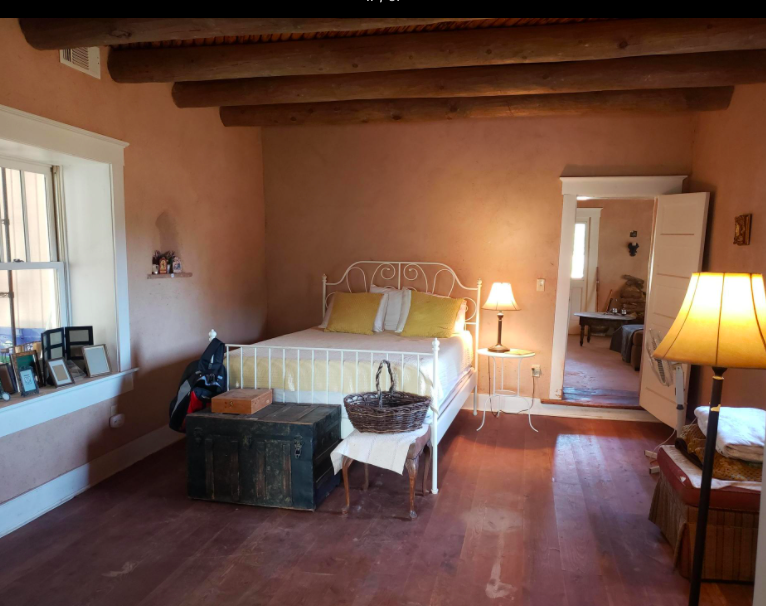
After the show, we drove to the airbnb where we were staying with a group of friends. It was a large beautiful adobe house north of Taos called "Palacio de Milagros." Waking up to the cool mountain air was just amazing.

Christina and a Sunflower at "Palacio de Milagros"
My bedroom door at "Palacio de Milagros"

"Palacio de Milagros"

Our days were spent listening to our friends play music at the Big Barn Dance and shopping in the downtown plaza of Taos. But always, in the back of my mine, I am thinking that this is where the Spanish Conquistadors that I am a direct descendant of, came to look for gold. This is where they met with the Native Americans. This is where the mix of 65% Spanish and 30% Native American occurred in my bloodline. It's sacred ground to me. 


On the last day of our trip, while looking on a map to go to the Rio Grande Gorge, I saw that Valdez, NM was just a couple of miles up the road. I would  love to wonder around there for a day since my maternal grandma is a Valdez but we had run out of time. On this trip, the big find was the breathe taking Rio Grande Gorge. 

Rio Grande Gorge From The Bridge

Rio Grande Gorge Bridge From The Parking Lot
We parked to walk across the bridge and the most beautiful little Native American woman was sitting up a table to sell her goods. I walked over to take a look. She was selling kachinas made by her husband. I felt like crying when I picked one of them up. It took me back to the time in the mid 80's I used to dream about kachinas and since I grew up in Texas, I had no idea what they were or the significance of a kachina. I had seen a life size kachina in the moonlight, on a nature trail in the middle of Austin, TX one night. It appeared and disappeared just as quickly then I was given a book of original kachina drawings by a Hopi. By this time, I was telling anyone that would listen about them and  Christian and I used to draw kachinas when he was young. Needless to say, I had a connection to them that I couldn't explain.

So Brenda and I walked across the Rio Grande Gorge bridge, in awe, we took photos and came back and bought 2 of the adorable hand made kachinas. One for me and one for Christian.

The One on the Left is the Sun Kachina -
Representing Warmth and Shelter for the Old and a Bright Future, and Playfulness for the Young
I bought the Rose Quartz Buffalo to Add to My Buffalo and Cow Collection
The One on the Right is a Hemis Kachina - Representing Happiness of a Successful Harvest
We got back into our rental car to drive to Santa Fe. Brenda programed "Waze" on her iPhone and we were on our way. Suddenly we both realized we were headed down a dirt road. I'm always a little skeptical of "Waze" taking us the best way since the last time I was in New Mexico we ran out of gas in the dessert... so here I am again. Then immediately we both realized we were headed to the bottom of the Rio Grande Gorge and it was breathe taking. We reached the bottom and there was a herd of bighorn sheep crossing the road and climbing some rocks. We pulled over and I took several photos but all the photos I took with my iPhone had this strange aura around the bighorn sheep.

Bighorn sheep at the bottom of the Rio Grand Gorge
the Bottom of the Rio Grande Gorge

I stood on a small bridge and listened to the Rio Grand water flowing and I felt the spirits of my ancestors lingering in the air. It was magical, emotional and calming and overwhelming all at the same time. I felt like I never wanted to leave. It is almost impossible to wrap my mind around the thought that I am a direct descendant of the Spanish Conquistador Francisco Vazquez de Coronado. He is my 11th great-grandfather. Coronado, was born in Salamanca, Spain in 1510. He led one of the most remarkable European explorations of North America. 


My lineage to Coronado
He was my 11th great-grandfather

The first Europeans to see the Taos valley were conquistadors with the Francisco de Coronado expedition. In 1540, he sent his Captain of Artillery, Hernando de Alvarado with twenty soldiers accompanied by Fray Juan de Padilla from the Zuni Indian Reservation, west of Albuquerque to explore to the northeast. Upon reaching the Rio Grand River, they were visited by twelve representatives of pueblos to the north with friendly greetings, so Alvarado, his soldiers and Fray Juan Padilla traveled up to Taos. The explorers returned with glowing accounts of the beauty of the area, but reported that there was no gold—the primary purpose of the expedition.


In my research I always find unexpected treasures. Father Juan de Padilla is one of them. I am assuming he is related to me because he was born in Andalusia, Spain in 1500 and I have many Padillas in my family tree on both sides of the family that go back to Andalusia.  Father Juan de Padilla was a Spanish Roman Catholic Missionary who spent much of his life exploring North American with Coronado. Padilla was one of the first Europeans to see the Grand Canyon. Coronado wasn't interested in going that direction because he was really only interested in finding gold.

Padilla was killed in Kansas in 1542 by Native Americans, and is considered to be one of the first Christian martyrs in the U.S. Juan de Padilla is associated with a miracle known as the "Rising of the coffin of Padre Padilla." The story of seeing his coffin rise above the ground was repeated for many years, and was believed by many people in Isleta, where the Padilla is believed to be buried. It has since becoming New Mexico folklore.