Thursday, September 16, 2021

Hispanic Heritage Month - Sept 15 - Oct 15


You're probably wondering why Hispanic Heritage Month begins September 15 instead of at the first of the month. The beginning date is a nod to the anniversaries of national independence for a number of Latin American countries:

Costa Rica, El Salvador, Guatemala, Honduras and Nicaragua who all declared independence from Spain on September 15, 1821.

Here's where my personal history comes in. On September 16, 1821 Mexico gained its independence from Spain. At that time, Mexico's northern provinces included California, New Mexico and Texas. I can only imagine the celebration when Mexico declared independence from Spain after being ruled by the monarchy for 300 years. It's hard for me to fathom that one of my heroes, my Great Great Uncle Lieutenant Colonel Lorenzo Labadie was born in 1825, just 4 years after New Mexico transformed from a colony of Spain to a territory of Mexico. 

American settlers began arriving in New Mexico via the Santa Fe Trail. Then it was ceded to the United States in 1848 through the Treaty of Guadalupe Hidalgo. Then, finally on January 6, 1912, the territory was admitted into the Union as the State of New Mexico. 


Treaty of Guadalupe Hidalgo

This is when I start feeling like a gender-neutral trying to explain to someone how to formally address me and my flavor of Hispanic culture. I often feel the need to do so because the country in which I live, hasn't done a very good job educating us. The information handed to us in text books has historically been extremely one sided. The average American thinks all of our ancestors arrived on boats at Ellis Island or maybe if you are Hispanic, your ancestors came with Christopher Columbus on the Niña, the Pinta or the Santa Maria. I have news for you....Columbus didn’t “discover” America and he never set foot on the land of North America.

So once a year during Hispanic Heritage Month, I attempt to educate the readers of my blog of the Hispanic heritage of the very misunderstood southwestern United States. I've realized that the majority of folks who lead our country in Washington DC, are only interested in their history and the majority of them are descendants of immigrants who arrived at Ellis Island. I am constantly reminding people that the Spanish settlers in New Mexico began to arrive in 1540. 

So..let me back up and tell you some of previous important dates of my Hispanic heritage: On November 8, 1519, my first cousin 10 generations back, Hernándo Cortés, landed in Tenochtitlán (present day Mexico City) with 500 Spanish conquistadors. They had conquered Mexico for Spain by 1521. Then on July 11, 1598 Juan de Oñate came north from the Valley of Mexico with 500 Spanish settlers and soldiers and 7,000 head of livestock, founding the first Spanish settlement in Villa Nueva de Santa Fe

Then in 1680, there was an uprising of most of the indigenous Pueblo people against Spanish religious, economic and political institutions imposed upon the Pueblos in the province of in Villa Nueva de Santa Fe called "The Pueblo Revolt." 400 Spaniards were killed and the remaining 2,000 Spanish colonizers went to El Paso de Norte (present day El Paso) along the upper Rio Grande River establishing the first Spanish base in 1680. It is easy to see this migration in my family, especially amongst my Padilla ancestors. Twelve years later many of them returned to Villa Nueva de Santa Fe Some remained in El Paso de Norte and just about a year ago I met a 5th cousin with the surname Padilla who lives in El Paso. 

The Hispanic culture of New Mexico historically identified strongly with their Spanish heritage yet have varying levels of Native American heritage as well. (Apache, Comanche, Pueblo, Navajo and Hopi) The majority of us are not Mexicans. On the average, the Hispanic population of New Mexico have approximately 70% Spanish DNA and 30% Native American DNA. I am personally about 62% Spanish, 24% Native American and the rest is a mix of mostly Italian and French.

This map shows where my
Spanish DNA originated

This map shows where my
Native American DNA originated

New Mexico didn't become a part of the United States until January 6, 1912, 3 years before the birth of my father. Needless to say, our history is somewhat different than the majority of the United States. New Mexico has the highest percentage of Hispanics, 47% of its population. 29% of the state's population speaks Spanish at home. So you can only imagine what it may have been like for my mother who's first language was Spanish, moved to Texas and was treated like a second rate citizen for speaking her native language. Both of my parents were born in Puerto de Luna, New Mexico, however my father moved to Guymon, OK after his mother died at the age of 3 and was schooled there. He had a Texas accent. 

So this is just a reminder... my ancestors didn't cross the border.... the border crossed us. We have been here for almost 500 years and Spanish is our native language. 

Okay, I am stepping off of my soap box and enjoying the rest of Hispanic Heritage Month in hopes that my readers have learned a little bit of history and will act accordingly.


Sunday, August 29, 2021

Fine Spanish Colonial Art - Retablos

 RETABLOS

A gift from my niece Cayce
and her husband Mario from Santa Fe

Retablos, or in English alter pieces, is a structure or element placed on or above an alter, better known as 'laminas' in Mexico, are small oil paintings on wood and sometimes tin. They are used in home altars in respect of Catholic saints. The literal translation for 'retablo' is 'behind the altar.' This unique genre of art, deeply rooted in European history, was brought to Mexico with the arrival of the Spanish and then ultimately adopted by New World mestizo natives to become what is known today as the Mexican folk retablo.

Retablo was an art form that flourished in post conquest Mexico and reached its pinnacle of popularity in the last quarter of the 19th century. With some exceptions, mostly untrained artists created these sacred images.

Retablos were sold to devout believers who displayed them in home altars to honor their patron saints. There are virtually hundreds of saints, each invoked to remedy a different situation.


Monday, August 23, 2021

Mercado de Coronado - Puerto de Luna, New Mexico

Painting of My Grandma's House
by Christina Fajardo

In 2017 I wrote a blog reflecting back 45 years to 1972, when I was 16 years old. I was born and raised in Amarillo and had lived on Magnolia Street in the Hamlet neighborhood my whole life, up to that point.  I am sure when my parents moved there from Garfield Street, it felt like heaven. It was a new middle income neighborhood when I was born. North Amarillo was booming because of the airbase. We were in walking distance to the largest park in Amarillo. Thompson Park was my paradise. It had a Zoo, swimming pool and an amusement park called Wonderland. Life as I knew it, was pretty freaking good on Magnolia Street. We had a 4 bedroom house and my dad had a workshop in the backyard and we always had a beautiful yard due to the fact that one of my dad's favorite pass times was watering the grass, feeding birds and stray cats.

This is the house I grew up in at
1804 Magnolia, Amarillo, Texas

Both of my brothers and my sister had gone to the local north side high school, Palo Duro High. However the dynamics of the high school had changed considerably by the time I arrived there for my junior year. My best friend Regina's parents transferred her to Alamo private Catholic school. My parents decided to take me to Puerto de Luna, New Mexico to live with my 90 year old grandma on her farm. I realized later, this was simply to make a point, to show me how tough things really could be since I was seemly unhappy living in my perfect teenage bedroom with blacklight posters, walk-in closet and blue princess phone. 

Playing guitar in my bedroom

I had a cute boyfriend who lived down the street. We were either on the phone or hanging out at the swimming pool or Wonderland at Thompson Park.

Jay Spann and Christina Fajardo

Next thing I knew, I was, living with my grandma Rosita in Puerto de Luna, New Mexico. It made for a very interesting living situation since she was blind and she only spoke Spanish. My saving grace was that my Uncle Gilbert and Aunt Rita Padilla and their 8 kids lived next door. 

Me with my cousins who lived next door
 to my Grandmas Rosita, in Puerto de Luna, NM
From left to right: Percy Padilla, Christina Fajardo,
Mark Padilla, Rita Padilla and Michael 
Padilla

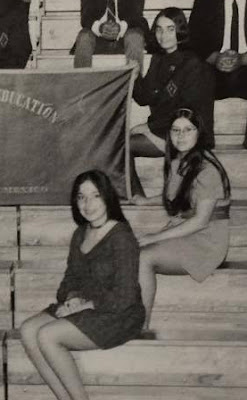
Distributive Education Class
Santa Rosa High
Bottom Row - Christina Fajardo
Middle Row - Connie Campos
Back Row - Percy Padilla

I wasn't really aware that my parents had taken me to Puerto de Luna to convence me of how good my life in Texas really was. Needless to say, they were extremely surprised when they returned a couple of weeks later to take me home and found that I had settled into my new dusty New Mexico farm life very well. I didn't mind sleeping on a roll away bed in my grandma's bedroom. I found it comforting to hear her pray the rosary at night in the dark with an owl hooting in the tree outside my window. The 12 mile school bus ride to Santa Rosa High wasn't so bad because the radio station seemed to play Jose Feliciano's "Ain't No Sunshine" every morning at the same time. I loved being the new girl in school and the teachers thought I was brilliant. Especially my art teacher, Mr. Lopez, who bought me canvas and oil paints while everyone else was painting on paper. I loved that the school cafeteria served rice, pinto beans, potatoes and tortillas for lunch. For the first time in my life, I felt like I was really at home. I found a group of friends who have remained lifelong friends, unlike the majority of the kids I had gone to school with for the previous 10 years. And the icing on the cake is that I have since learned that most of them are my cousins.

I didn't miss spending my weekends going out with the party animals of Amarillo. In fact, there was a small co-op grocery store/gas station in Puerto de Luna called "Mercado de Coronado." My first cousin Percy Padilla and I worked there on the weekends. It was located in an old, light green adobe building next to what used to be the Grzelachowski General Store, established 100 years earlier, around 1872. 

Photo of the "Mercado de Coronado" It has been closed for many years
Grzelachowski General Store, Puerto de Luna, NM

There were a couple of young men who were VISTA volunteers who helped organize "Mercado de Coronado." The other day I received an email from Sam, one of the VISTA volunteers. He said he had stumbled across my blog a couple of years ago while looking for news of Puerto de Luna. It was so cool to hear from him. I have such fond memories of that little store. The front room had a cash register, shelves of essentials like canned goods, bread, crackers and the not so essential candy and a refrigerator full of generic sodas. Then there was a pool table in the other room. The regulars would come by with money in hand to put their quarter on the pool table to take their turn at pool and another quarter for a soda. We also sold gasoline as you can see by the rusty old Conoco gas sign still standing out in front of the building in the photo.

The church where my parents were baptized and married was in walking distance and across the road was our family cemetery where my little brother, Larry was buried.

Nuestra Senora del Refugio Catholic Church

At the time, I had not a clue what historic events had taken place in that very location a century before. My paternal grandmother Josefita Labadie Fajardo's family lived in Puerto de Luna as well. My first cousin (3 generations back) Beatriz Labadie was married to Juan Patron. They had been living in Lincoln but the Lincoln County War had broken out so they moved to Puerto de Luna to live on the Labadie ranch. Upon their arrival, Juan raised money to have the church, Nuestra Senora del Refugio (Our Lady of Refuge) built in 1982. Unfortunately, the first mass held in the church was for Juan Patron's funeral. He was murdered at a salon in Puerto de Luna.
He is buried under the nave of the church. He could have very well become the governor of New Mexico but instead he was needlessly assassinated before the age of 30.

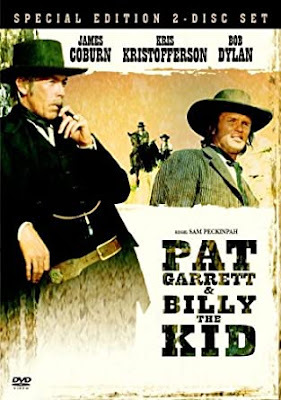
The following year one of my all time favorite movies, "Pat Garrett and Billy the Kid" was released. I never thought twice about why I felt so emotionally attached to the movie and the sound track. 

Movie poster for Pat Garrett and Billy the Kid

There were very few remnants left of what a bustling little community Puerto de Luna was 100 years before. It was the county seat, so there was a court house, post office and a beautiful Catholic church. 

Court House in Puerto de Luna, NM

My cousin Juan Patron, a young, up and coming politician had raised the money to build the church. He was murdered in a Puerto de Luna saloon on April 15, 1884, just 
as the church was being finished. His funeral was the first mass to be held in the new church and he is buried in the nave. He was the son-in-law of my Great-Great Uncle Lorenzo Labadie, who was one of the most impressive characters in my family history during the 1800's. He had been a Lieutenant Colonel, a sheriff and when he got older he had orchards and vineyards. He had a license to sell wine and was the he was a very accurate census taker. While doing my ancestry research, I always know that if the census was filled out by Lorenzo Labadie, it is complete and accurate. 

Now, reflecting back, I wish I would have asked a lot more questions of the local farmers who came in to buy gas at "Mercado de Coronado." I wish I had know a little more history of this dusty little ghost town when I lived there. Bobby Gerhardt (my  second cousin) was one of my favorites who often came into the store. He was a tall, blue eyed rancher with the a golden farmer's tan. He always wore a grin and joked with everyone he met. He spent evenings at my grandma's smoking cigarettes and drinking a cold one with my Uncle Jose Padilla out in the screened in porch by the light of the moon. 

This is when a healthy dose of time travel would come in handy. William Bonney AKA "Billy the Kid" spent a lot of time in Puerto de Luna at the Grzelachowski General Store in the late 1800's. I was beyond surprised when I found his name on census 1880 census when I was researching John Gerhardt. Interestingly enough, John Gerhardt was my Great Aunt Doloritas Padilla Gerhardt's father-in-law and he was also my Great Uncle Hilario Valdez's father-in-law. This is where one of the branches of my family tree gets a little tangled. My mom's Aunt Doloritas Padilla, on her dad's side was married to John Gerhardt's son, Henry Gerhardt. AND my mom's Uncle Hilario Valdez, on her mom's side was married to John Gerhardt's daughter, Katie Gerhardt. John was the only practicing doctor in the vicinity. I remembered stories of my Great Uncle Hilario being the Gerhardt Ranch foreman for many years prior to marrying Katie. Later Hilario and Katie had a ranch in Los Ojitos and Grandma Rosita Valdez Padilla and my Grandpa Ascencion Padilla had an adjoining ranch. I'd heard the old folks speak of all of these characters my whole life but didn't pay much attention to the Spanglish (half English and half Spanish) conversations and private jokes that they had shared for years. 

Oddly, when I started doing ancestry research I adopted a cat named Katie and then another named Rosita. It was purely serendipitous. It felt like it was a little private cosmic joke on me from the Universe that they came with the names of my grandma Rosita and her sister-in-law, Katie. Often, as I drank tea engrossed in my late night research, I imagined the sister-in-laws, Kate and Rosita, cooking posole together as they tended to fire in the wood burning stove and the children playing on the dusty wooden floors of their adobe houses while their husbands, Hilario and Ascencion worked the sheep ranches.

So my time in Puerto de Luna was short lived. My parents made me go back to Amarillo for my senior year. When I returned to Amarillo, I went to school half day and worked half day, saving my money to get back to New Mexico the summer after I graduated. I rented a little adobe house in Santa Rosa that summer with Yolanda Smith. I had big plans to attend Highlands University in the fall. My parents had other plans. They snatched me up and took me to Austin where I would remain most of my adult life. 

My house in Santa Rosa
My cousin Barbara Quintana Baca's children,
Timothy and Kris Baca
In front of my macrame and
mural on the living room wall
in my tiny house on the hill, in Santa Rosa

Moving back to New Mexico has always been in the back of my mind...but for now my heart and soul live there and I just go back to visit every couple of years.


One of my favorite photos of Puerto de Luna


My cousin Davy Delgado just told me that the Puerto de Luna area has been inhabited by descendants of indigenous Pueblanos and llaneros, Hispanos and Mexicanos since 1541. Manuel Chavez' familia was there before 1849 and Hacienda de Agua Negra Land Grant settlers were there by 1824. The first three "residents" of Puerto de Luna were Fray Juan Padilla and two others in 1541, according to documented history. 

Wednesday, July 28, 2021

Musica De Mi Corazon

A couple of  days ago I was scrolling through Facebook while drinking my morning coffee and came across an interesting post on:

 Everything New Mexico: Photos, memories, canciones, recipes, art, y mas

The video was of a band from New Mexico called  'Lone Piñon' performing a song called "La Julia."  

If you know this song, you are probably related to me. HaHaHa.... I'm only half joking. The song is from a collection called “New Mexican Folk Music: El Tesoro del Pueblo,” available from the University of New Mexico Press. 

So when I clicked on the video I was transported back to my childhood. It's crazy how this polka could stir such powerful subconscious childhood memories and emotion.


The song "La Julia"  brought back vivid memories of significant occasions, like family funerals and weddings. As a child, these events were one and the same. It merely meant the gathering of my siblings and first cousins at my grandma's adobe farm house in Puerto de Luna, New Mexico, staying up late and feeling totally connected. Meanwhile, my mom and my aunts cooked fresh green chile and squash, beans, rice and tortillas on a wood burning stove at my Aunt Rita and Uncle Gilbert's house. Next door at my grandma's house my dad and uncles would play music, drink beer and smoke cigarettes. Fun was had by all.

My dad, Felipe Montoya Fajardo

My dad and Uncle Joe played guitar, Uncle Guillermo played the accordion and they all sang traditional New Mexican music while dusty children ran in and out of the houses, down to the mora tree by the acequia. From sun up til sun down we played tag and chased pigs and chickens while eating fresh tortillas with butter dripping on the ground.

Some of you won't relate to this song on the level that I do because it's not a mainstream song but for me it's a little like hearing those old Beatle songs, James Taylor, Jackson Browne or early Willie Nelson. Hearing "La Julia"  was even more profound than that. It caught me off guard because I didn't even know the name of the song and until a couple of days ago and I only knew a few of the lyrics because I understand Spanish but I don't speak it fluently. So hearing the song for the first time since my dad died in 2001 was like stepping into a time machine that I wasn't prepared for.

My Uncle Joe had a band in Albuquerque
Grandma Rosita, my Aunt Connie,
Aunt Rita, my cousin Josie
and my Uncle Joe

My cousin, Paul Fajardo
with his dad's guitar and amp

As we all know, the relationship between music and memory is powerful. I saw the healing effects of music  first hand years ago when my friend, Billy Doss took me to see his aging father who was suffering from dementia. He couldn't remember what he had for breakfast that day but when Billy picked up his guitar and started singing his father's songs, he sang along and didn't miss a word. I realized then that music is an important mnemonic device. 

My Uncle Guillermo Padilla
in Puerto de Luna

My Uncle Guillermo Padilla
in Puerto de Luna

So let me back up and tell you how all of this connects for me and why it's of interest. I love music. Fortunately, am from a musical and artistic family. I realized sort of late in life that my family is somewhat unusual to have so many artists, musicians and generally a close knit family heavily influenced by our Hispanic family traditions. When I realized my family wasn't typical to those I knew in Texas, I dove head first into genealogical research as a hobby to learn more about my Spanish ancestors who settled in New Mexico in the late 1500s. I discovered that I'm related to half the population of New Mexico and now I've discovered there been some really cool songs passed down through the generations along with some great recipes that my son now serves at Taco Circus, his restaurant in St Louis. That's the good news. The bad news is that there's a rare disease that runs rampant in my family called Cerebral Cavernous Malformation or CCM1 also known as the Common Hispanic Mutation. It's been given that name because it is particularly prevalent among the Hispanic population of New Mexico. The defective gene has been passed down through at least 14 generations and the origin can be traced back to the earliest Spanish settlers, my ancestors on both my mother and my father's side of the family. Neurological issues are way too common in my family so I am constantly on a quest to learn how the brain works and how to improve brain function due to my own neurological issues. This new discovery is so cool because I have found that music is particularly healing on many levels. 

So without getting too technical, the hippocampus and the frontal cortex are two areas in the brain associated with memory. They take in a lot of information, however, as I've gotten older, I've found that retrieving information isn't as easy as it used to be. Science has proven that listening to and performing music reactivates areas of the brain associated with memory, reasoning, speech, emotion and reward. Music doesn't just help us retrieve stored memories, it also helps us lay down new ones. A perfect example was when my granddaughter Jackie was a couple of years old, my son, Christian was trying to teach her how to say "Taco Circus" she was getting confused so he sang it to her slowly and she learned how to sing it immediately. Music provides rhythm and rhyme which helps to unlock and store information. It's the structure of the song that helps us to remember, as well as the melody and the images the words provoke.  

Music can also make us feel strong emotions so rather than just being able to recite the lyrics when we hear songs from our past, we feel the lyrics. For instance, when I hear old Bob Dylan songs, I remember sitting in my bedroom as a teenager, teaching myself how to play my dad's Silvertone guitar and talking to Jay Spann on the phone. That's a memory that I cherish.

The solemn teenager in my bedroom
learning Bob Dylan songs.


So here are the lyrics in Spanish and then below in English to the song "La Julia"  I hope you enjoy listening to it even half as much as I have. I can still hear my dad singing this song with a huge smile on his face.

lyrics

 "La Julia" 
Su mamá le dice a Julia, ¿Qué te dijo ese señor?
Mamá, no me dijo nada, no más me trató de amores.
La vecina de aquí en frente se llamaba Maria Clara,
Y si no se hubiera muerto todavía se llamara.

La vecina de aquí en frente me mató mi gallo blanco
Porque le andaba escarbando las semillas de cilantro.

La vecina de aquí en frente tenía un gato muy barato,
Y le dice a su marido, Mira viejo, tu retrato.

credits

"La Julia" 
Julia’s mom asks her, What was that gentlemen saying to you?
Nothing, Mom, he was just hitting on me.

The neighbor-lady across from here was named Maria Clara,
If she hadn’t have died she would still be named that.

The neighbor-lady across from here killed my white rooster
‘Cause it was digging up her cilantro seeds.

The neighbor-lady across from here had a really cheap cat,
And she says to her husband, Look, old man, it’s like looking at a portrait of you.
I looked up 'Lone Piñon' on Spotify to see if I recognized any of their other songs. "El Valse de la Grama" is my second favorite. Especially since it sounds like it was recorded at my grandma's house with the sound of an acequia flowing in the background with her rooster crowing in perfect timing.
My mom Agueda Padilla Fajardo 
and my grandma Rosita Valdez Padilla
eating mora under the mora tree
with the acequia flowing in the background
watering the chile field.
Gracias 'Lone Piñon' for keeping the traditional music of New Mexico alive. I hope to see you perform live some day. You have no idea what fond memories I have of my dad singing these satirical lyrics of old-fashioned New Mexican songs. I am deeply grateful.

credits


Thursday, May 27, 2021

Maximilliano Mike "Max” Henderson


Maximilliano Mike Henderson 


This is Maximilliano Mike "Max” Henderson. He was my first cousin, the son of my mother's older sister, Maria Padilla Henderson and my Uncle Sam Henderson.

I love this photo of Mike because he reminds me of my brother, Phillip.

Mike was born June 10, 1937 in Puerto de Luna, New Mexico. Ten years later, his family moved to Tucumcari. The move was traumatic for Mike because he had been attending school in a one-room schoolhouse, surrounded by his family's Spanish language. His formative childhood experience was the complete opposite from mine. I  was born and went to elementary and middle school in Amarillo, Texas and then went to live in Puerto de Luna with my Spanish speaking grandma in the eleventh grade. I can honestly say it was in the top five best experiences of my life and it  changed the trajectory of my life.

April 19, 1954, the year before I was born, Mike married, Mary Esther Moya  in Amarillo, TX. He was 17. The couple moved to Los Angeles where they stayed for 10 years. They then moved to Albuquerque and eventually back to Tucumcari, where Mike made a living doing car paint and body work. By this time, the couple had eight children. Mike had began to create furniture and art for their house.

Later Mike started selling some of his art in Santa Fe. Then when an elderly man showed him a wooden figure of Christ that was broken and held together with duct tape, Mike volunteered to repair it, taking the opportunity to examine the design. He began studying the work of famous artists and books of saints and found encouragement from several famous santeros in northern New Mexico.
Santeros are artists who carve and paint santos, images of saints.

Mike was an International Artist with artwork in Wood Carving and Religious Statues. He was a member the New Mexico Spanish Colonial Art Society.

Mike was closer to my mother's age than he was to my age so I didn't know him very well. We would often stop at my Aunt Mary and Uncle Sam's house when we drove from Amarillo to Puerto de Luna to visit my grandma but Mike was rarely around so we usually only saw each other at weddings and funerals.

Maximilliano Mike Henderson passed away December 14, 2007 at the age of 70, at Dan C. Trigg Memorial Hospital in Tucumcari. He was survived by his wife Mary Esther Henderson; two daughters, Cynthia (Larry) Winn of Gallup, NM, and Judith (Phillip) Guttman of Rio Rancho, NM; six sons, Michael (Cris) Henderson of Pojoaque, NM, David Henderson Clovis, NM, Ronnie (Dawn) Henderson of Rio Rancho, NM, Ray Henderson of Tucumcari, NM, Jay (Louella) Henderson of Pecos, NM, and Tom Henderson of Altus, OK; two brothers, Gracien Henderson of Los Angeles, CA, and Walter (Bertha) Henderson Tucumcari, NM; and numerous grandchildren and great-grandchildren. He was preceded in death by his parents, one son, three brothers, and three sisters.

Maximilliano Mike Henderson


Saturday, May 22, 2021

Francisco Perea 1830–1913


 Francisco Perea of New Mexico, who fought to keep his territory loyal to the Union and served a term as a Delegate to the U.S. House of Representatives during the Civil War, was born on this date in Los Padillas, New Mexico. Perea attended private schools in New Mexico, and studied at colleges in St. Louis and New York City. Two of Perea’s schoolmates from New Mexico, Jose Francisco Chaves and Miguel Antonio Otero, later served as Delegates to Congress. After college, Perea returned to New Mexico and built a successful distribution and ranching business. From the summer of 1861 to the summer of 1862, Union forces attempted to dislodge Confederate occupiers of the New Mexico Territory. Over a four-month period, Perea rallied prominent New Mexicans, then under pressure to support the Confederacy, to remain with the Union. He raised a battalion at his own expense and served as lieutenant colonel of a regiment, seeing action against insurgents and Native Americans in the decisive battle of Apache Canyon that broke the back of the Confederate offensive in New Mexico. During the summer of 1863, Perea challenged José Manuel Gallegos for a seat in Congress. Narrowly elected as a Delegate to the 38th Congress (1863–1865), Perea submitted bills for war damage compensation and disputed land claims for his constituents. A close friend of Abraham Lincoln, Perea was seated near Lincoln’s box at Ford’s Theatre when the President was assassinated. Defeated for re-election to the 39th Congress (1865–1867) by Chaves, Perea returned to his business activities in New Mexico. He died in Albuquerque, on May 21, 1913.

Republican Delegate Francisco Perea of New Mexico
rallied New Mexicans to side with the Union in the Civil War. He was a Republican Congressman from 1863 - 1865

Francisco Perea capitalized on his family’s prominence and his military service to propel his career in territorial and national politics. The first Republican Hispanic-American Member of Congress, he dedicated his single term as Territorial Delegate to serving his constituents and containing the Indian threat to settlers by championing a controversial reservation system.

Perea was born in Los Padillas, New Mexico, on January 9, 1830, to Juan Perea and Josefa Chaves de Perea. Perea’s maternal grandfather, Francisco Xavier Chaves, was Mexico’s governor of the New Mexico province in the 1820s, and two of Perea’s maternal uncles eventually succeeded his grandfather. Perea’s father served in the Fourth Departmental Congress in 1846 and in the New Mexico Legislative Assembly in 1852 and 1857. After the U.S. war with Mexico, José Leandro, Perea’s paternal uncle, represented Bernalillo County in the First Legislative Assembly. Years later, his cousins Pedro Perea and José Francisco Chaves would serve as New Mexico’s Legislative Delegates to the U.S. Congress. Francisco studied at a local Bernalillo school in 1836 and 1837. He and his cousin José Chaves attended a Santa Fe school in 1837 and 1838, and Francisco transferred to a school in Albuquerque the following academic year. From 1839 to 1843, Perea tutored his younger siblings. Like many elite New Mexicans, he received a college education in Missouri, mastering English (again, with his cousin José F. Chaves) at Jesuit College in St. Louis from 1843 to 1845. While the Mexican-American War raged on, Perea traveled to New York City’s Bank Street Academy in 1847, completing his studies in 1849. During this sojourn, Perea and a colleague visited East Coast cities including Philadelphia, Baltimore, and Washington, D.C.; they also traveled to northern New York and Chicago.

Perea returned to New Mexico in 1850 to pursue a career in business that included ranching, trade, and commerce. He served as a distributor of manufactured goods to New Mexicans by importing products from cities such as St. Louis, and Independence, Missouri, at the head of the Santa Fe Trail. He also herded sheep to California for sale in the markets. After making a fortune selling sheep, Perea invested in the Atlantic and Pacific Railroad. Perea married twice. He had 18 children with his first wife, Dolores Otero (a niece of Territorial Delegate Miguel Antonio Otero’s), whom he wed in 1851, but many of them died in infancy. Dolores died in 1866. In 1875 Perea married Gabriela Montoya, with whom he had 18 more children, but only 10 were living at the time of his death.1

Perea entered politics when he was elected to New Mexico’s Eighth Legislative Assembly in 1858 for a two-year term representing Bernalillo County.2 Aside from his pedigree, his motivation to run for political office is unclear. A staunch Republican, Perea considered Abraham Lincoln’s election to the presidency in 1860 to be fortuitous for the Union. The news of Lincoln’s election, Perea recalled, “was celebrated by immense processions of men and boys marching through the principal streets to the music of many brass bands, the firing of cannon, and the discharging of anvils.”3 Nevertheless, New Mexican loyalties were split between pro-Confederate Democrats and pro-Union Republicans; the territory became a flashpoint for conflict during 1861 and 1862.

In the summer and fall of 1861, Perea advocated for New Mexico to remain in the Union by appealing to “every prominent man in the … territory.” In light of New Mexico’s precarious condition, Lincoln authorized Governor Henry Connelly to raise two full regiments and four battalions of four companies each. Perea organized a volunteer battalion at his own expense and was commissioned as a regimental lieutenant colonel.4 Dubbed “Perea’s Battalion,” the unit was stationed near Albuquerque, where its namesake commander led various campaigns against Apaches and Navajos in 1861 and 1862. The battalion also saw action in the Apache Canyon at the Battle of Glorieta Pass, a pivotal engagement that forced the Confederates out of New Mexico in March 1862. Shortly thereafter, Perea resigned his commission and returned to civilian life.5

In January 1863, Perea ran for the position of Territorial Delegate to the U.S. House in the 38th Congress (1863–1865), winning the Republican nomination that June. He outlined his proposed legislative priorities in a public letter that was printed in New Mexico newspapers. Perea’s experience fighting Indians convinced him that the two cultures could not coexist. He condemned past treaties as “worse than useless,” suggesting that American Indians were liable “to do wrong in accordance with the instincts of the savage nature.” Justifying his solution—to remove Indians to reservations—he argued, “It will be acting the part of wisdom in our own behalf and the part of philanthropy on behalf of the savages … [there] they may be compelled to earn their subsistence by the labor of their own hands, and have the opportunity given them to cultivate the habits and enjoy the blessings of civilization and Christianity.”6

The economic leg of his platform was closely associated with suppressing American Indians, particularly the Apaches, because their removal would open more land to settlers and allow the exploitation of New Mexico’s mineral resources. Perea believed mining would determine the territory’s financial fortunes. “Nothing can give our Territory as much prominence in the eyes of the people throughout the United States as the fact of the existence of rich gold producing mines in our midst,” he wrote. To remove the Indians, Perea promised that as Delegate, he would make “every exertion I can put forth … to strengthen the hands of our [military] Department commander and give him sufficient force to expel the savages from the bounteous fields which should now be furnishing profitable employment to thousands of our people.”7

Perea advised against implementing statehood in the midst of war, noting that the issue might be exploited by “men ambitious of place and power” and arguing that public sentiment did not support it.8 Nevertheless, he urged continued support for the Lincoln administration, asserting, “It is the duty of all citizens to occupy themselves with the stern realities with which we are confronted and do all in their power to maintain the integrity of the government.” He left no doubt that as Delegate, he would exert “the whole of my influence … in favor of the reestablishment of the Union as it was and the enforcement of the constitution as it is.”9

Perea’s opponents were José Manuel Gallegos and Judge Joab Houghton, a former chief justice of the superior court under New Mexico’s military government and an associate of Miguel Otero’s brother Antonio José.10 Houghton dropped out of the race in July 1863 and threw his support to Perea.11 Gallegos, a prominent but controversial priest-turned-politician, served as a Territorial Delegate in the 33rd and 34th Congresses (1853–1857), but was unseated in his second term after Miguel Otero contested his election. However, Gallegos remained a power in territorial politics, serving as speaker in the Tenth, Eleventh, and Twelfth Legislative Assemblies (1860–1862).12 Although Gallegos ran as a Democrat, he was pro-Union and was imprisoned during the Confederate occupation of Santa Fe, but his party designation left him open to charges of collaborating with secessionists.

Perea’s supporters resurrected tactics other territorial politicians had used against Gallegos, advertising his suspension from the Catholic priesthood and his affiliation with a cadre of activist priests before the American occupation. A seamy campaign poem entitled El Padrecillo (“The Father”), circulated by Perea’s backers, mocked Gallegos’s connections to administrative corruption and his obliviousness to such ethical lapses. The poem also publicized Gallegos’s controversial relationship with Candelaria Montoya, a widow.13 According to one account, Perea visited nearly every part of the territory and frequently spoke to crowds.14 The initial results showed that Perea won the election, with 7,231 votes to Gallegos’s 6,425.15 However, a variety of seeming irregularities in various counties persuaded Republican governor Henry Connelly to have “the vote reconstructed from the tallies kept by election officials in the precincts, and these were tabulated in place of the actual ballots.” The recount confirmed Perea’s majority.16 Gallegos and his supporters contested the results, arguing that Connelly had exceeded his authority, but when Gallegos was denied an extension to obtain more testimony from voters, his case fell apart, and the House Committee on Elections awarded the seat to Perea.17

Like the other Delegates of the era, Perea was not permitted to sit on a standing committee when he was sworn in to the 38th Congress (1863–1865). Nevertheless, he submitted bills regarding a range of constituent services and personal legislative interests; but because Republicans controlled the chamber and tended to support the development of national infrastructure, Perea’s initiatives enjoyed only modest success.18 In early 1864, Perea requested funds to construct a military road between Taos, New Mexico, and the territorial capital of Santa Fe. Another measure requested financial aid for communities in the New Mexico Territory and the newly created Arizona Territory, and a third measure asked for the implementation of boundaries between the New Mexico, Colorado, and Arizona Territories. Perea responded to the needs of military veterans by submitting private relief bills and requesting payments for volunteer companies that served against hostile Indian tribes and in the Mexican-American War. All the bills were read and submitted to the appropriate committees, but no action was taken.19 Perea tried to secure money for surveying land in New Mexico in H.R. 786, a miscellaneous appropriations bill, but he was unsuccessful.20 True to his campaign promise, he took particular interest in a Senate bill that requested “aid in the settlement, subsistence, and support of the Navajo Indian captives upon a reservation in the Territory of New Mexico.” The bill mustered enough votes to pass, but Senator William Windom of Minnesota killed it using a parliamentary tactic.21

During his tenure, Perea became close friends with President Lincoln, to whom he was introduced by former New Mexico Territorial Delegate John S. Watts in 1864. “I met the President in the White House, in company with a number of senators, representatives, and others,” Perea recalled. Perea went to see Lincoln “time after time on business connected with complaints against [territorial] officials and other difficulties.” Perea reported that he “occupied the seat in the pit of the theater directly under the Lincoln box” on the evening of April 14, 1865. “I heard the shot fired by [John Wilkes] Booth,” he said.22 Also, Perea served as one of three delegates to the Republican National Convention in Baltimore, Maryland, in 1864.23 According to a contemporary account, Perea “bore aloft the Star Spangled banner, over which streamed a pure white penant bearing … the motto: ‘New Mexico–the Union and the Monroe Doctrine forever.’ The flag and its motto attracted great attention and elicited loud applause.”24

Perea used his influence as a Territorial Delegate to persuade federal officials in Washington, D.C., to attack political opponents and promote the careers of his allies back home. During the contested election case, Perea wrote a number of letters to Secretary of State William H. Seward about the professional conduct of William F. M. Arny, the territorial secretary and a committed ally of José Manuel Gallegos. In one letter, Perea enclosed documents alleging that Arny’s performance had alienated constituents. Perea also noted that Arny had “undertaken to come to Washington with(out) leave” from territorial superiors to hire lawyers to represent Gallegos in February 1864.25 A month later, Perea informed Seward about Arny’s support of Gallegos, neglecting to tell him about Governor Connelly’s relationship with the Perea family. Perea wrote, “It becomes obvious beyond question, that he has been not only instrumental in exciting a contest for my seat in Congrefs, but that the principal object … is to act as an agent in behalf of the contestant.” Perea considered Arny’s conduct “reprehensible, in disturbing the political quietude of the Territory by agitating this contest, after the voice of the people had spoken and their decision had been announced in the form of law” and asked that he be removed.26

Early in 1865, Perea became involved in a dispute between the New Mexico and Colorado Territories concerning The Conejos, a large tract of land on New Mexico’s northern border that was ceded to Colorado upon its incorporation in 1861. In a published letter to James Ashley of Ohio, Chairman of the House Committee on Territories, Perea alleged that “the sole purpose of such a severance was to give evenness and symmetry to the southern boundary of Colorado … at the serious expense of New Mexico.” Perea noted that the “population of Los Conejos … are almost entirely Mexicans. They are foreign in language … from the great body of the people of Colorado. The laws of that Territory are enacted and published only in the English language, which they do not understand and the legislative discussions and deliberations are conducted in the same language.” Perea emphasized the Conejans’ foreignness, their affinity for Spanish institutions, and their incompatibility with Colorado Anglos and American jurisprudence. He deemed the situation “utterly repugnant to the true principles of liberty” and requested its immediate amelioration.27

Perea insisted that New Mexican citizenship would satisfy the cultural aspirations of the Conejans. He noted that one of the earliest acts of the New Mexico territorial government was to declare “that the principles of the civil law should prevail in all civil causes that might arise before their courts; and the Congress of the United States, in approving that legislation … manifested its appreciation of their desire to preserve and perpetuate their ancient and venerated system of jurisprudence.”28 New Mexicans, Perea maintained, were uniquely suited to managing this still-foreign people. Although “they have formed a patriotic fondness for this government, and are now earned and true in their allegiance to their new sovereign, the change was not a matter of their own choice. The acquisition of their country was the fruit of war waged by the United States against their native land, and by every consideration of justice and humanity they are entitled to the enjoyment of their native language, and their system of law and domestic usages, so long … as they do not conflict with the principles of the general government.” Perea submitted the bill in the waning weeks of the session, and the Committee on Territories did not act on it. After acquiring the region, Colorado retained it through its territorial period (1861–1876); today Los Conejos remains part of that state.29

Perea began running for re-election in January 1865. In a glowing editorial, the Santa Fe Weekly Gazette noted that he had been a highly effective legislator and had stood firm in his support of the Lincoln administration. While admitting Perea’s “efforts have secured but very meager appropriations—sums far below the amounts obtained by his predecessors,” the editors blamed the war for siphoning off federal funds. Alluding to the tempestuous tenures of earlier Territorial Delegates, they appealed to constituents to keep Perea in office because he was experienced. In an effort to defuse potential contenders’ use of a native-son platform, the editors suggested that replacing Perea would be “unfair to the Mexican people as a race” because it would deprive New Mexicans of an incumbent with seniority. Other Members of Congress “are possessed of advantages which the New Mexican people are unwilling to give to their own sons,” they wrote. If Perea “is successfully opposed by a native, that native will be no further advanced than his predecessor.… Thus always we shall have inexperienced Representatives, and so always be subjected to the same imputation and disadvantages.”30 To Perea, the editors wrote, “[You are] worthy of our confidence; you have done your work well and are entitled to the reward of re-election to the place which for two years you have so worthily filled.”31 Perea responded that he was “grateful to the public for past favors” [and] would “endeavor to continue to merit their approbation” upon being re-elected.32

Perea’s acceptance letter for the Republican nomination in July 1865 outlined his successes and his plans for another term. Adopting the party platform, he acknowledged that much of his energy was focused on containing “our deadly enemies” the Navajo Indians. As part of that platform, he embraced a developing military-led effort to forcibly remove Navajos to a reservation known as the Bosque Redondo in eastern New Mexico. Perea noted, “I have steadfastly, in Congress, before the Committees on Indian Affairs in both Houses and before the Interior and War Departments of the Government, advocated the policy which is now observed of keeping that tribe on the Reservation at the Bosque Redondo.” After vigorously defending the policy, he added, “Those who oppose the Government in its efforts to thus relieve us of our despoilers are the worst enemies the Territory can have.” If he was re-elected for another term, Perea promised, “I shall continue to use all the influence I possess to have the reservation system made permanent and in this way, secure lasting peace with the Indians.”33

Perea’s principal election opponent was his cousin, José Francisco Chaves. Although both men were Republicans, they represented distinct territorial factions. Perea was nominated to lead the Union Party ticket. Unionists, explains historian Howard Lamar, “supported the Indian reservation policy … praised General [James H.] Carleton and the troops participating in the Indian campaigns, recognized the supremacy of the United States Government, and condemned Abraham Lincoln’s assassination.” Chaves was an Administration Party candidate. The Administration faction’s loyalties were identical to those of Unionists, but they opposed Carleton’s policy of forcing the Navajos onto the Bosque Redondo Reservation.34

Perea noted that although he and Chaves were “connected by the most endearing ties of consanguinity,” his cousin had “allowed himself to pass into the hands of my enemies, the enemies of my political friends and, as I hold, the enemies of the Territory.”35 The campaign hinged on the Bosque Redondo Reservation experiment. Perea fully supported its expansion, whereas Chaves opposed it. Chaves also criticized Perea’s efforts to regain Los Conejos. Throughout the summer of 1865, Perea’s political standing suffered from his association with the controversial General Carleton, who was eventually removed from his post.36 Chaves prevailed, with a 58 to 42 percent victory.37

Afterward, Perea returned to his business activities in New Mexico and, according to his eulogist W. H. H. Allison, retained a large amount of political influence by controlling federal appointments to the territory under President Andrew Johnson’s administration. Later, Perea was elected to the territory’s Sixteenth and Twenty-Sixth Legislative Assemblies (1866–1867 and 1886–1887, respectively) as a representative of Bernalillo County. In 1881 Perea owned and operated a resort hotel in Jemez Springs, New Mexico, where he also served as postmaster from 1894 to 1905. Perea died in Albuquerque at age 83 on May 21, 1913.38

Biographical Directory of the American Congress, 1774-1971. The Continental Congress (September 5, 1774 to October 21, 1788) and the Congress of the United States (from the first through the ninety- first Congress March 4, 1789, to January 3, 1971, inclusive). Washington, DC: U.S. Government Printing Office, 1971. Biographies begin on page 487. (BiDrAC) Biographical Directory of the United States Congress, 1774-1989. The Continental Congress, September 5, 1774 to October 21, 1788 and the Congress of the United States from the first through the one hundredth Congresses, March 4, 1789, to January 3, 1989, inclusive. Bicentennial Edition. Washington, DC: U.S. Government Printing Office, 1989. Biographies begin on page 507. (BiDrUSC) Biography Index. A cumulative index to biographical material in books and magazines. Volume 16: September, 1988-August, 1990. New York: H.W. Wilson Co., 1990. (BioIn 16) The Hispanic American Almanac. A reference work on Hispanics in the United States. By Nicolas Kanellos. Detroit: Gale Research, 1993. Use the Index to locate biographies. (HispAmA 1) The Hispanic American Almanac. A reference work on Hispanics in the United States. Third edition. Detroit: Gale Group, 2003. Use the Index to locate biographies. (HispAmA 3) Mexican American Biographies. A historical dictionary, 1836-1987. By Matt S. Meier. New York: Greenwood Press, 1988. (MexAmB) Who Was Who in American Politics. A biographical dictionary of over 4,000 men and women who contributed to the United States political scene from colonial days up to and including the immediate past. By Dan and Inez Morris. New York: Hawthorn Books, 1974. (WhAmP)