Showing posts with label Fajardo. Show all posts

Friday, February 27, 2026

Healing Ancestral Trauma


For centuries people have been captivated by genealogy, tracing their ancestors through historical records for various reasons. In recent years, DNA tests have taken genealogy to a whole new level. This is a DNA chart of me, my sister Nita and my brother Gilbert. Siblings have different DNA, despite sharing the same parents. We each inherit a unique, random combination of 50% from each parent. Phillip isn't on this chart because he didn't take his DNA test with Ancestry.com.

About 16 years ago, my brother Phillip was the first in my family to take a DNA test. He was interested in finding out if we had Sephardic Jewish ancestry. Unfortunately, at the time the $99 DNA test he took only supplied information on our father’s side of the family. A year later I had a DNA test done by Ancestry.com. By that time the average DNA test provided both paternal and maternal DNA information. In the beginning my interest was in healing generational trauma because I saw a pattern repeating in my life which involved extremely unfair real estate deals that I couldn't logically explain. It became obvious that healing generational trauma would require disrupting established power structures within the family which would require me, the youngest female in a very traditional Hispanic family, to break inherited cycles of dysfunction. Through self-awareness and emotional processing, I could clear the trauma in my lineage. I realized that I went along with the status quo to keep peace in the family and it never worked in my favor. 

Previously, since my DNA is mostly Spanish, I was  taking on the responsibility of the misplaced Jews who lost their homes and all their belongs during the Spanish Inquisition and the misplaced Native Americans due to the Spanish Colonizers in the Americas. But then I realized I am 43% Spanish, 20% Native American, 10% Sephardic Jew and a 27% mixture of a whole bunch of other stuff. In other words, my ancestors experienced both victory and defeat. So, logically, how could I be responsible for the Spanish Inquisition? LOL

I then discovered the study of epigenetics and found that we can carry our ancestors' trauma through epigenetic inheritance. Stress impacts gene expression, turning genes "on" or "off" like a dimmer switch without changing the DNA sequence itself. This affects our descendants' stress responses, mental health and behaviors. That would explain why children born into the same family experience different levels of stress-related behaviors. Past traumatic experiences can leave biological marks, influencing the hormonal systems and brain function in future generations, leading to heightened anxiety or depression. While these marks exist, healing is possible through therapy, and acknowledging family history to prevent passing on these chains. So here I am, trying to heal my family.

Our family's DNA did have an impact that aligned with Phillip's interest in discovering his Sephardic Jewish ancestry, but maybe not the way he thought it did. He passed away September 4, 2025 and in our last personal conversation, he said he wanted to get an updated DNA test. I wish he could have for so many reasons. He seemed to be trying to come to terms with a few things in his last days. Phillip was the only immediate family member who had read my blog regularly over the years and I miss his commentary immensely. There were times when he and I had long phone conversations about spirituality and quantum physics, in the same conversation. He always had a way of taking the conversation to the next level. In the last few years of his life, he didn't get to spend time with the Fajardos. There were unspoken moments when I knew we didn't see eye to eye on religion & politics so we just left well enough alone. 

It seemed almost poetic that my research had taken me back to the 13th century Spain when the Fajardo Army of southern Spain, described as a prominent, elite lineage, had consolidated their forces with the Catholic Monarchs, Ferdinand and Isabella to take over all of Spain during the Spanish Inquisition. Tstatutes, they were among the primary enforcers of these discriminatory Spanish laws that required proof of Christian ancestry "pure blood." These laws were used to exclude Jews, Muslims, or non-Christians from public office and universities. Yet, on the flip side, the surname Fajardo is considered to be of Sephardic Jewish origin due to its historical connection to converso (forced convert) families who fled. Our lineage first went to the Canary Islands and then to New Mexico right after the Spanish Inquisition. It reminds me of the extremes in current day United States, especially Phillip's immediate family of "Born Again Christians" vs the rest of the Fajardo family. It's a perfect example of how all families throughout the ages have their differences. Some of the Fajardos during the Spanish Inquisition were on the side of the Catholic Monarchs and some were Sephardic Jews. We truly do carry our ancestors' trauma through epigenetic inheritance. 

Phillip was diagnosed with a brain tumor in May 2025. He was having seizures and suffered a severe brain bleed that his hospice nurse confirmed would ultimately take his life. Earlier today I opened facebook and this post appeared to remind me that he was diagnosed with a brain tumor and had it removed exactly 16 years ago today. At that time, 16 years ago, the neurologist said he only had 2 years which tell me that Phillip was misdiagnosed. 


But there I was in August, just a couple of weeks before he passed away, having our last private conversation. His wife was glaring at us across the room. It wasn't until then that I realized just what an oppressive relationship he had been in for all of these years. 
It had proven to be useless to bring up any topic his wife didn't approve of. My ongoing research into the "Common Hispanic Mutation" (CCM1 - Cerebral Cavernous Malformation)  and the fact that it is often misdiagnosed as a brain tumor was right at the top of the list of topics that weren't allowed to be discussed. Phillip's wife was treating him with a hand full of non prescribed drugs and he had signed Advance Directives saying he didn't want any more medical care. So there I sat with all my years of research about the genetic mutation that's highly prevalent in our New Mexican blood line on both our father and mother's side of the family. Yet his family ignored the fact that our genetic legacy came from a small group of early Spanish settlers, linked directly to the historical ideology of Limpieza de Sangre (purity of blood) that is scientifically known to cause brain bleeds.

During our conversation Phillip said to me "You and I were cut from the same cloth." I smiled and said proudly "Yes, we were." I felt that in the depths of my heart, yet in the back of my mind I was thinking "Yes, with the same genetic disease, caused by our ancestor's fixation on having pure Spanish blood. And sadly, the same mindset of the right-wing Christian nationalists government who want to keep 'America' white." 

I couldn't save my brother. I strongly believe he is in a better place. When I think of him, I see his healthy, brilliant face in a beautiful field of of mushrooms. 

Phillip Fajardo

The good news is that others have found my blog helpful and informative. I had a doctor from Dallas and one from El Paso who found my blog about 6 years ago. They were both impressed with my research and asked if I would be interested in taking part in their CCM1 studies. At the time, I was in my mid-sixties and I don't drive long distances, so I refrained, but my research was helpful in tracing some of my relatives with the CCM1 gene to the Santa Rosa, NM area. I have also been contacted by many distant cousins who have found my blog because they are on the same journey of self discovery through ancestry. When you do a Google search of Puerto de Luna, New Mexico, my blog is the first thing that comes up because it is literally a ghost town now. 

I discovered much more information than I bargained for when I signed up to become a member of Ancestry.com, thinking I would keep the membership for 3 months. Here it is 15 years later and I have been on a quest that has taken me on an amazing journey through my family's colorful past. Tracing the Fajardo surname back to Spain as far back as the 1200's has been a mind blowing, educational experience.

I started writing about my research for my children and grandchildren because after my parents passed away, I felt like I should have asked more questions. The next generation may be interested in it some day, but meanwhile I am connecting with cool cousins. At the bottom of this post you can click on "See More Posts" and it will take you to older posts.

The journey actually began when I was 16 years old, my junior year in high school, when my parents sent me to live with my Grandma Rosita Padilla in Puerto de Luna, New Mexico as a punishment for skipping school. I was having anxiety attacks at school. That all disappeared when I went to Santa Rosa High. I felt seen and heard. I loved my art teacher, Mr Lopez. I felt a deep connection to my ancestors who had been in New Mexico for over 400 years. In the quiet times, alone on the farm, in my grandma's adobe house, that my mother had helped to build and in the chile fields next to the acequia. Or on the weekends when my cousin Percy Padilla and I worked at the small store/gas station in Puerto de Luna  called "Mercado Coronado." The store was next door to what used to be the Grzelachowski General Store, which is is known for having the likes of Billy the Kid as a regular customer in the late 1800's. I felt that I was surrounded by the spirits of my ancestors and there was an underlying feeling that I had been there in the previous century. It all felt oddly familiar. I felt like I was finally home.

I didn't have time to do a deep dive into my past until years later, after my parents had passed away and my children were grown. Building my family tree has been a nightly activity. The historical discovery of my parents homeland of New Mexico and the journey of my ancestors from Spain has been truly fascinating.

I've learned that a well-researched family tree typically reaches back to the 17th or 18th century with good parish records. I've traced my mother's paternal Padilla lineage back to Anton Martin de Padilla who was born in Sevilla, Spain in 1536. I've traced my father's Fajardo lineage back to my 9th Great-Grandfather Jose Miguel Fajardo born in the Canary Islands in 1591. But I can't help but think his family was just traveling through when he was born because his son, my 8th Great-Grandfather Alonso Fajardo was born in Santa Fe, New Mexico in 1656. 

Fajardo Coat of Arms

I haven't found a connection but there was an Alonso Fajardo de Entenza, Governor-General of the Philippines (1618–1624), who was a Spanish nobleman born in Murcia, Spain and he was the son of Admiral Don Luis Fajardo. He was a Knight of the Order of Alcántara. The Fajardos had been sent out to conquer the world and it appears that some ended up in in the Philippines just before the first Fajardos came to New Mexico. They had to be related but I don't know exactly how.

The surname Fajardo originated in the northwestern region of Galicia, Spain. With roots traced to a nobleman, Pedro Anes Galego, Lord of Santa Marta de Ortigueira. He was the progenitor of the Fajardo surname. Fajardo is a Galician/Latin term for a beech wood or tree. Then the Fajardo family emigrated to Murcia in 1296 and became high-ranking officials of the Crown of Castile. 

You can't imagine the mixture of emotions I had when I discovered that the Fajardo family was the most powerful and prestigious noble lineage in the Kingdom of Murcia, Spain beginning in the 13th century. 

The prestigious Spanish noble title held by the Fajardos was Marqués de los Vélez. It was a title that held major influence in the region for centuries and was first granted to Pedro Fajardo y Chacon in 1507. He was a prominent military leader and politician. I just read a blog written in 2022 about  Pedro Fajardo y Chacon's iconic Castillo de Vélez-Blanco, also know as the Castillo de los Fajardo located in the town of Vélez-Blanco, Andalusia, Spain. It is said to be a remarkable example of a Spanish Renaissance Castle and it has been declared a historical-artistic monument belonging to the National Artistic Treasury since 1931.

Castillo de Vélez-Blanco,
also know as the
Castillo de los Fajardo

Read more about the castle here.

The importance of the Fajardo family in the history of the Crown of Castile didn't go unnoticed by great authors of Spanish literature. In the 16th-century, because the Fajardo family of the Kingdom of Murcia, held such immense power, they became natural subjects for Spain’s greatest writers. There were satirical plays written for them. Research into Spanish literature highlights connections between the poet Acevedo and members of the Fajardo family

With all of that being said, I have known from the start of my ancestry research that the Fajardo and Padilla lineages are only 2 of many of my lineages. Those are just the names I was assigned in our patriarchal naming system. I actually have more Chavez, Padilla and Baca DNA because they are on both sides of my family tree.

In closing, for years I had come across stories of my Spanish ancestors expelling Jews from Spain and conquering the Americas. Ancestral trauma healing involves identifying and releasing emotional, physical and spiritual wounds that have been passed down through the generations. These wounds manifest as unexplained fears and toxic patterns. Healing requires forgiveness. Forgive yourself above all and forgive others. Ancestral research empowers future generations. I've always felt there has to be a reckoning of accumulated damage done by our ancestors. Being a deep thinking, peace loving healer, I wondered if I had been chosen in my lineage to even up the score. Not as a punishment, but to heal the lineage for my family and future generations. Therefore, I have experienced genetic health issues and botched real estate deals to bring it all to my attention. This blog is just one layer of my personal healing process. Thank you for being a part of my journey.


Wednesday, January 29, 2025

"The Wagon Boss" Painting by Charles M Russell - Update

The synchronicities in my life are sometimes so astonishing that I have to write down the events to reflect back on the events at a later date. As I understand it, synchronicities occur because the connection between our individual psyche and the collective unconscious creates a sense of meaningful connection between our internal and external experiences. If one pays attention, seemingly random events line up and can be interpreted as signs from the Universe. These synchronistic events are part of the reason I write this blog. This post is going to touch on what appears to be a couple of different subjects that you will see actually all come together in the end.

In case you are new to my blog, the topics are largely about my profound connection to my ancestors, the majority of whom were the original Spanish settlers of New Mexico. I'm a first generation Texan... barely... I was born at St Antony's Hospital on Route 66 in Amarillo, just 50 miles east of the Texas/New Mexico border. Before my generation, both sides of my family had been in what is now New Mexico since Spain colonized the New Mexico region in 1598. Then, for 27 years between 1821-1848, New Mexico became part of Mexico when Mexico won its freedom from Spain. Then in 1848, the United States claimed the top 55% of Mexico which is now the western part of the United States including New Mexico, California, Arizona, Nevada, Utah and portions of Colorado and Wyoming.


Mexico also gave up its claims to Texas, hence recognizing the Rio Grande as the border between the United States and Mexico. It seems appropriate to be writing about borders right now since the newly appointed administration of the United States is trying to deport Mexicans and even Native Americans. Why? "Because they're not Americans." WHAT? Here we are again. As of inauguration day, January 20, those at the top are fighting the same old war. Not actually trying to take land but deporting people out of the United States. Call me crazy but Native Americans are just that. Native. According to archaeological and genetic evidence, Native Americans have been in America for at least 20,000 years. And as for the Mexicans... the western half of the United States used to be Mexico. Logically they have every right to be here. As for me... my family immigrated from Spain to New Mexico 427 years ago. I think it's safe to say this is my home.

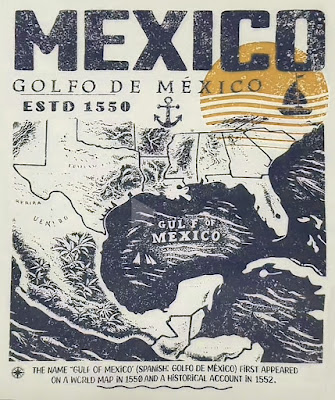
My country is in an uproar. Along with all the other crazy distractions, the new administration is trying to change the name of "The Gulf of Mexico" to "The Gulf of America."


Yet, simultaneously, something really cool happened to me the other day. These synchronicities always happen when there is an uproar in our country, seemingly to help me process the madness and I am so very grateful for these positive little messages from the Universe.

A piece of artwork that had been in my family since the 1960's made it's way back to me on January 12. But first I have to tell the story about this piece of art and the artist who painted it and why it has anything to do with the uproar in the United States. 

The Fajardo's Thanksgiving dinner
1970 with "The Wagon Boss" 
on the knotty pine wall.
1804 Magnolia, Amarillo, TX

I had written about it in January of 2022 when I was in St Louis for my annual winter trip. But now I 
actually have the piece of art and I've learned more about the artist and his family. They were very much a part of the western states becoming a part of the United States in the 1800's. Here's a link to the blog from January 17, 2022 if you want to read it later.

https://christinafajardo.blogspot.com/2022/01/the-wagon-boss-by-charles-marion-russell.html

I wrote the above blog on a typical snowy winter day in St Louis. As I sat sipping mint tea, deep in thought, hundreds of miles away from my Central Texas home, I imagined that my son, grandchildren and I had been sent on a mission by our ancestors to this midwestern outpost in St Louis. The purpose? To heal some of our generational trauma. Why would I feel that? Well, a few male characters in my family tree came from the St Louis area in the mid 1800's and married into my large Spanish settler family. There was a big land grab going on out west after the United States had taken more than half of northern Mexico. It's always felt a little more than coincidental that my son would end up living right back in St Louis.

I had begun that day reading about the marriage of my cousin Josefa Jaramillo and her husband, the frontier legend, Kit Carson. They seemed to have a storybook romance. On the other hand, Josefa's older sister, Maria Ignacia Jaramillo was the common law wife of Charles Bent. He was equally as well known as his brother-in-law, Kit Carson. He was an American businessman who owned the most important trading post on the Santa Fe Trail called Bent’s Fort. It was the only permanent settlement that was not under the jurisdiction and control of the Hispanic or Native Americans citizens in the west. Charles Bent and his younger brother, William Bent started out as fur traders. Their father, Silas Bent was a prominent land surveyor and Supreme Court Judge for the Missouri Territory. The Bent brothers could have lived lives of ease in St. Louis but they saw the potential wealth in fur trading in the western territories.


It was common for men to "go west" to find fortune in the uncharted lands out west. It was also a known fact that to be successful out west, the protocol was to convert to Catholicism and to marry into a large, prosperous, land owning Hispanic family who had been well established citizens since the 1500's. In the case of Kit Carson, he converted to Catholicism and married Josefa Jaramillo. Charles Bent didn't want to convert to Catholicism so Maria Ignacia Jaramillo merely became his common law wife. 

I just discovered a book called "Blood in the Borderlands: The Rise and Fall of Charles Bent, 1829-1847" by David C. Beyreis. The book says that Charles Bent knew that he needed to be “plugged into” local power networks and "marriage" into a landowning Hispanic family was the best way in. But he just barely tolerated the people of New Mexico. On the surface his plan seemed to be working for him. The United States appointed him as governor in 1846 and his possibilities seemed limitless. But there was trouble brewing. The powerful Hispanic families and Native Americans of New Mexico felt that the new U.S. governor didn’t treat them with due respect. They feared that their land titles would become null and void and they’d lose their land. Only 4 months after Charles Bent became governor, a group of Native Americans and Hispanics gathered in the Taos plaza demanding the release of some Native Americans who had been jailed by U.S. troops. The Taos Revolt broke out and it ended with Governor Charles Bent being scalped and murdered.

Needless to say the Bent family was both powerful and controversial, depending on who recorded the history. Charles Bent and his brother William had been disowned by the Bent and Russell family. The Bent brothers had a sister named Lucy. Her full married name was Lucy Bent Russell. I found her grave at a cemetery in St Louis. 

Grave of Lucy Bent Russell
St Louis, MO

Of course that lead me down another rabbit hole and I discovered her grandson was the famous American artist of the American Old West, Charles Marion Russell. Also known as C.M. Russell, Charlie Russell or Kid Russell. Here's where my story comes full circle. When I was a child, my father worked as a furniture repairman at "Heath Furniture Store" in Amarillo, Texas. Our home was always decorated with the most fashionable Early American Furniture, upholstered with the most plush earth toned velvet fabrics. A large framed print of a Charles M. Russell painting "The Wagon Boss" hung on the knotty pine paneled wall the living room above the couch. I never knew anything about the piece of art or the artist. To me it was just pretty piece of art from a nice furniture store. 

"The Wagon Boss"
Painted by Charles Marion Russell 
The original oil painting The Wagon Boss by Charles M. Russell
is owned by the Gilcrease Museum in Tulsa, Oklahoma.
The Thomas Gilcrease Foundation gifted the painting
to the museum in 1955

This masterpiece that I spent hours gazing at, was a print of a painting from 1909. The earth toned art matched the knotty pine paneling and the floral earth toned love seat, gold arm chair, polished end tables with gold lamps that were all perfectly arranged on the gold carpeted floors.

What a surprise to discovered as an adult that Charles M Russell was born in St Louis in 1864. He left home at the age of 16 and went west where he painted more than 2,000 paintings of cowboys, Native Americans and landscapes and created bronze sculptures set in the western United States.

Charles M Russell had been named after his Great Uncle Charles Bent but didn't follow in his footsteps. He was a gifted artist, storyteller, historian, writer and advocate for Native Americans. Totally opposite of his power and money hungry uncle.

This is where the story of the art by Charles M Russell and the uproar of the United States all come together. Earlier this month, I went to my step-daughter Sarah's birthday party. All of the women and kids were sitting around the dining room table talking and eating while the men were playing corn hole in the backyard. 

Ethridge Family
Dylan Ethridge, Adriane Ethridge, Davis Ethridge, Sherry Ethridge, Christina Fajardo, Sarah Ethridge, Jeanette Parr
and Emerson Ethridge

My ex-husband, Davis' wife Sherry casually says to me "I have a surprise for you." I said "What is it?" She proceeded to remind me that when Davis and I got divorced, I had left the 
Charles M Russell "Wagon Boss" painting in the closet and it was still there. I was in shock. She told me I could drop by their house and pick it up. So Dylan and I dropped by and picked it up. I brought it home with the intention of giving it to Dylan because he has asked for it. My parents had taken it out of the frame some time in the 70's and I am guessing I brought it home to Austin with me around that same time. It may have even hung over my fireplace at one time, I can't remember. 


At any rate it seemed magically synchronistic that the "Wagon Boss" would make its way back to me at this time when the political choices of our country's administration is mimicking the times when Charles M. Russell's power mongering Great Uncle Charles Bent had been appointed governor of New Mexico. A man with no moral compass, who had lived a life of privilege and lacked empathy towards people who didn't look like him or speak his language or practice his religion. Sound familiar? He was a lot like the man who bought his way into the White House earlier this month. 

It warms my heart that Charles M Russell went his own way and lived a life of empathy and compassion. This painting represents the kindness in Charles Russell's heart. He chose to spend his life helping the disenfranchised after his great-uncles had played such a huge part in doing just the opposite. Charles M. Russell, often called "the cowboy artist," is recognized for his significant contribution to portraying the positive Native American life and culture in his art. He used his platform as an artist to depict Native Americans as strong, dignified people. He also advocated for their rights through his paintings and writings, even going as far as supporting land rights for tribes by lobbying for the establishment of a reservation for them. 

Charles M Russell

In closing it warms my heart that my father chose a piece of art to hang in our home that was painted by someone who wasn't just a 
"cowboy artist." He was related to my family by marriage and a hero of mine. He was recognized for actively helping Native American tribes by deeply immersing himself in their culture and portraying their lives with respect and accuracy in his art, preserving their history accurately through his paintings. 

With love to you Charles M Russell. May your kind spirit live on forever.

Saturday, July 2, 2022

Canary Islands Descendant

For as long as I can remember I have dreamed of living on a tropical island. It's my happy place. Now I think I know why. It's in my DNA. I have 2 branches of my paternal family tree who were from the Canary Islands. My 8th great-grandfather, Juan Lujan was born in the Canary Islands in 1573 and another 8th great-grandfather, Miguel Fajardo was born in the Canary Islands in 1591. 


I now belong to a group on Facebook called "Canary Islands Descendants Association-San Antonio." A photo of this historical marker was posted yesterday because on July 2, 1731, the original 16 families began to lay out a village in San Antonio de Bexar.

Canary Islanders Historical Marker
San Antonio, Texas

In 1971 this historical marker was placed in Main Plaza in San Antonio. My history is so very different than the history I have celebrated my entire life. 

The Founders Monument
In front of the historic Bexar County Courthouse

On March 9, 2019. Bexar County, in partnership with the Canary Islands Descendants Association, unveiled the Founders Monument outside of the Historic Bexar County Courthouse. T
his commemorative project, by artist Armando Hinojosa, consists of five pieces. There is one Female and one male Canary Islander, one Native American, one Spanish friar, and one presidio soldier - representing the founders of our community.The Canary Islander on the right leaning on a cain is modeled after a distant cousin of mine named Paul Garcia.

Paul Garcia with statue modeled after him

The figures in the monument, created by Laredo artist Armando Hinojosa, represent the four founding communities of San Antonio - American Indians, Canary Islanders, Franciscan friars and Presidio soldiers. As early as 1691, Spanish explorers recorded insightful information on various American Indian tribes in the area, whom the Spanish collectively referred to as the Coahuiltecans. Later tribes included the Lipan Apaches, the Tonkawa, and the Comanches. Colonial settlement began in 1718, with the establishment of the Presidio San Antonio de Béxar and the Mission San Antonio de Valero (now called The Alamo).

In 1731, Spanish immigrants from the Canary Islands, (Spain) settled in the area and formed the first organized civil government in Texas, founding the village of San Fernando de Bexar adjacent to the presidio. The mission, presidio and villa communities worked hard to maintain their individual identities but eventually began the process of working together to achieve mutually beneficial outcomes. Through marriage and business ventures, the soldiers, mission natives and Canary Islanders joined together to form a solid foundation that would persevere through many tests and conflicts.

The monument located in front of the historic Bexar County Courthouse in the heart of San Antonio. This area is commonly referred to as Main Plaza but for hundreds of years it was known as Plaza de las Islas Canarias.

It just so happens that my cousin, Michael Padilla is in the Canary Islands and posted amazing photos yesterday. Happy Canary Islander Day!


Thursday, May 27, 2021

Maximilliano Mike "Max” Henderson


Maximilliano Mike Henderson 


This is Maximilliano Mike "Max” Henderson. He was my first cousin, the son of my mother's older sister, Maria Padilla Henderson and my Uncle Sam Henderson.

I love this photo of Mike because he reminds me of my brother, Phillip.

Mike was born June 10, 1937 in Puerto de Luna, New Mexico. Ten years later, his family moved to Tucumcari. The move was traumatic for Mike because he had been attending school in a one-room schoolhouse, surrounded by his family's Spanish language. His formative childhood experience was the complete opposite from mine. I  was born and went to elementary and middle school in Amarillo, Texas and then went to live in Puerto de Luna with my Spanish speaking grandma in the eleventh grade. I can honestly say it was in the top five best experiences of my life and it  changed the trajectory of my life.

April 19, 1954, the year before I was born, Mike married, Mary Esther Moya  in Amarillo, TX. He was 17. The couple moved to Los Angeles where they stayed for 10 years. They then moved to Albuquerque and eventually back to Tucumcari, where Mike made a living doing car paint and body work. By this time, the couple had eight children. Mike had began to create furniture and art for their house.

Later Mike started selling some of his art in Santa Fe. Then when an elderly man showed him a wooden figure of Christ that was broken and held together with duct tape, Mike volunteered to repair it, taking the opportunity to examine the design. He began studying the work of famous artists and books of saints and found encouragement from several famous santeros in northern New Mexico.
Santeros are artists who carve and paint santos, images of saints.

Mike was an International Artist with artwork in Wood Carving and Religious Statues. He was a member the New Mexico Spanish Colonial Art Society.

Mike was closer to my mother's age than he was to my age so I didn't know him very well. We would often stop at my Aunt Mary and Uncle Sam's house when we drove from Amarillo to Puerto de Luna to visit my grandma but Mike was rarely around so we usually only saw each other at weddings and funerals.

Maximilliano Mike Henderson passed away December 14, 2007 at the age of 70, at Dan C. Trigg Memorial Hospital in Tucumcari. He was survived by his wife Mary Esther Henderson; two daughters, Cynthia (Larry) Winn of Gallup, NM, and Judith (Phillip) Guttman of Rio Rancho, NM; six sons, Michael (Cris) Henderson of Pojoaque, NM, David Henderson Clovis, NM, Ronnie (Dawn) Henderson of Rio Rancho, NM, Ray Henderson of Tucumcari, NM, Jay (Louella) Henderson of Pecos, NM, and Tom Henderson of Altus, OK; two brothers, Gracien Henderson of Los Angeles, CA, and Walter (Bertha) Henderson Tucumcari, NM; and numerous grandchildren and great-grandchildren. He was preceded in death by his parents, one son, three brothers, and three sisters.

Maximilliano Mike Henderson


Friday, September 28, 2018

My Valdez Family of New Mexico from Oviedo, Asturias, Spain

Five years ago, in the early days of my ancestry research, I discovered that the Fajardo family originated in Andalucía, Spain. Simultaneously, I saw my favorite chef and world traveler, Anthony Bourdain, on an episode of "Parts Unknown" in Andalucía. I was moved by this episode more than any other. After watching the episode, more than once, I pondered the word "duende," used by the Spanish Flamenco musicians and dancers. It's said to be the hardest Spanish word to translate to English. Originally El Duende was a magical being akin to elves and leprechauns. Later its meaning translated loosely to spirit, passion, inspiration. You know that spontaneous feeling that arises in creativity, particularly relevant to the arts.The mojo that's born and dies perpetually during the performance of a dance, song or even cooking.

I was listening to Paco de Lucia's album, "El Duende Flamenco de Paco de Lucia" to see if I could gain insight into what the word "duende" meant to Paco, the most famous of Flamenco guitarists. It excited me because it was something I had always felt but didn't have a word for. I've known from a very young age that often words don't translate from Spanish to English, neither do customs and traditions. Most importantly, neither does the passion. There was always a passion that my mother had when she spoke that I didn't see in my friend's parents in Amarillo, Texas when I was growing up. I've been told on more than one occasion by ex-boyfriends that I was too sensitive. They didn't comprehend the fire in my soul and most often, it was scary to them.

In my research I found that Paco was from Algeciras, Andalucia, Spain. In my research, I traced my beginnings back to a castle in Andalucia originally called "Castillo de los Fajardo" now called "Castillo de Velez-Blanco built by Pedro Fajardo.

Much of the information was in Spanish but I felt like I was being guided by a spirit much larger than myself to dig deeper. I stayed up late and woke up early to read about Andalucia, the Fajardo castle, Paco de Lucia and the word "duende." I took a break to get more coffee and rest my brain. I opened the CNN website to read a little morning news and discovered that Paco de Lucia had died of a heart attack that morning. What are the chances that I would be listening to his music and researching the region of Spain where he was born on the morning of his death? I was really blown away by the synchronicity. As I read on, I realized Flamenco originated in Andalucia, as was bull fighting.

Album byPaco de Lucía
"El duende flamenco de Paco de Lucía"

For the past five years I have been overwhelmed and humbled by my family history and the information that seems to just appear out of nowhere. Because of this phenomenon, ancestry research has become somewhat of an obsession. I feel that it's my duty to record my family history. The information seems to fall in my lap from time to time and I don't think it is my chance.

So... fast forward five years... I took a trip to New Mexico this month. The airbnb we stayed in was north of Taos, a couple of miles from Valdez, NM. That was a sign to me that it's time to dig deeper into my Valdez lineage. My maternal grandmother was a Valdez and my mom was extremely proud of her Valdez family heritage. But the stories that I heard as a child only went back to the late 1800's when Billy the kid worked on my great-great uncle's ranches on the banks of the Pecos River in Puerto de Luna. My favorite story about Billy the Kid was that after the ranch work was done in the evenings, Billy taught my 7 year old Great Uncle Hilario Valdez to read and write in English. This tells me that Billy the Kid was not the cold blooded killer that you read about in the western novels, but someone with a kind heart who was a protector of the Hispanic families that had taken him in when he arrived in New Mexico as an orphan. When the cattle rustlers came to steal from his adopted family, he acted as a protector.

My research took me off into a hundred directions and it has taken me almost 5 years piece together the back story on the Valdez family. After my recent trip to New Mexico, took me within a couple of miles from Valdez, New Mexico, I discovered that my 7th great-grandfather, Jose Luis Ruiz de Valdez was the first Valdez to come to New Mexico from Spain. He was born in Oviedo, Asturias, Spain in 1664. I started writing this blog earlier this week and just like clockwork, tonight "Anthony Bourdain: Parts Unknown" 2nd episode of his final season was in Asturias, Spain. I was glued to my TV. His co-host is Chef Jose Andres. As it turns out the people of Asturias are sheep herders and musicians. Go figure.

Anthony mentioned that Chef Jose was sued by Trump in 2015 after he canceled plans for a restaurant in Trump’s hotel in Washington DC after Trump’s disparaging remarks about Mexican immigrants. In this episode, Chef Jose Andres was wearing a T-Shirt that says "We Are All Dreamers." 

Thanks Anthony and Jose. ❤️


I don't know why it surprises me but it's somewhat overwhelming to think I am a direct descendant of just about every Spanish settler of New Mexico.

I found a "Taos News" newspaper clipping written by Jerry A Padilla about the original Valdez family on Ancestry.com. It was attached to Jose Luis Ruiz de Valdez. I downloaded it, read it and was blown away. 

It states that "Among the oldest and most respected families in Springer, NM is the Valdez family. Springer is about 80 east of Taos. It's kind of sad that I never met the Valdez family of Springer or Taos and barely knew the Valdez family of Puerto de Luna. I really wish I had lived in New Mexico way more of my lifetime. There are so many unanswered questions. 

According to the Taos newspaper article, Jose Luis Ruiz de Valdez was the son of Francisco Ruiz de Valdez and Maria de Caso Valdez both born in Asturias, Spain. Jose Luis Ruiz de Valdez was the first Valdez to arrive in New Mexico. He of course had to make the trek across the ocean and through Mexico. He met the woman he would marry in Mexico City, Maria Medina de Cabrera. She was of Spanish decent but had been born in Mexico City. They moved to New Mexico in the colony of 1693, the reconquest after the Pueblo Revolt of 1680 with their two children. Jose was 4 and Ana 1 1/2. After arriving in New Mexico, they had 4 more children, Ignacio Luis, Catalina and Juan Lorenzo and Domingo, my 6th great-grandfather.

Unfortunately, Jose Luis Ruiz de Valdez was killed by the Zuni Indians in the Mission church of Zuni while he and two other Spanish soldiers were singing an alabado after Mass, on Sunday, March 4, 1703. Jose was only 39 and his wife, Maria only 30. A sad end for a promising soldier and family.

Of the Valdez girls, Ana married Lazaro Antonio Cordoba in 1710.
Catalina, nicknamed " La Prieta " was murdered by her husband, Miguel Lujan in 1713. Her mother was still living in this year and gave her age as forty. Maria Hernandez de Medina Cabrerra died in Santa Cruz de la Canada in 1731.


I decided to look up the writer, Jerry Padilla, who I figure is more than likely a distant cousin since I have Padilla's on both sides of my family. What I found, unfortunately was Jerry's obituary from 2012. He was born in 1952 and  a long time resident of Taos. Jerry was an avid historian, and was very involved in preserving and teaching the history and culture of Taos and Northern New Mexico, which earned him recognition from the Taos Country Historical Society. He was an artist who painted in acrylics. I think he and I would have become friends had we known each other.

I really appreciate other's research on ancestry because it makes mine easier. I was able to fill in the 7 generations between me and my 7th great-grandfather, Jose Luis Ruiz de Valdez.


I found this life story of my 7th great-grandfather, Jose Luis Ruiz de Valdez on Ancestry.com. Excerpt from Fray Angelico Chaves' book, "Origins of New Mexico Families, A Genealogy of the Spanish Colonial Period." Revised Edition, 1962 . Page 301.

Jose Luis Ruiz de Valdez a native of Oviedo, Spain, was thirty years old in 1694. Two years later he was a sergeant in Santa Cruz. His wife was Maria Medina de Cabrera, a native of Mexico City, who came with him in the colony of 1693 (The Reconquest) with their two children, Jose who was 4 and Ana, who was 1 1/2. After arriving in New Mexico, they had 4 more children, Ignacio Luis, Catalina, Juan Lorenzo and Domingo. Jose Luis Ruiz de Valdez was killed by the Zuni Indians in the Mission church of Zuni while he and two other Spanish soldiers were singing an alabado after Mass, on Sunday, March 4, 1703. Jose was only 39 and his wife, Maria just 30. A sad end for a promising soldier and family.

Of the Valdez girls, Ana married Lazaro Antonio Cordoba in 1710.
Catalina, nicknamed " La Prieta " was murdered by her husband, Miguel Lujan in 1713. Her mother was still living in this year and gave her age as forty.


Update on this blog July 2023
Genealogy is a fun game of connecting the dots. Jose Luis Ruiz de Valdez was the first Valdez to arrive in New Mexico. He of course had to make the trek across the ocean and through Mexico. He met the woman he would marry in Mexico City, Maria Medina de Cabrera. She was of Spanish decent but had been born in Mexico City. They moved to New Mexico in the colony of 1693, the reconquest after the Pueblo Revolt of 1680. Sometime before 1847 Buenaventura de Jesus Valdez and Maria Juana Catarina Lovato settled in the Taos area. I am assuming that "Valdez" the unincorporated community located in Taos County, is named for Buenaventura de Jesus Valdez. "Valdez" is located on New Mexico State Road 230, 8.8 miles north of Taos. 

I mentioned in another blog post that on January 19, 1847, the Taos Revolt began. While serving as territorial governor, Charles Bent a violent mob attacked the Bent home. He was assassinated, scalped and his mangled body was dragged through the streets of Taos. The mob called for a full-scale rebellion against the American occupation and by the end of the evening, 15 others had been killed including Kit Carson's brother-in-law (Josefa Jaramillo Carson's brother) Pablo Jaramillo and Lucien Maxwell's brother-in-law (Luz Beaubien's brother) Narcisco Beaubien. Both of them blood relatives of mine. Kit Carson was on a fur trapping trip, Charles Bent's wife Ignacia Jaramillo Bent, her sister Josefa Jaramillo Carson and the children escaped through a hole in the adobe wall. Ignacia and Josefa begged the blood thirsty mob for mercy. Luz Beaubien Maxwell's grandfather, Buenaventura De Jesus Valdez entered the Bent house and intervened, sparing the women’s lives. The attackers left, leaving the family in a state of shock. The ladies went to stayed with Luz Beaubien's grandparents, Maria Juana Catarina Lovato and Buenaventura De Jesus Valdez for three days until they could escaped to Santa Fe with their children. What I didn't know when I found this information is that Buenaventura De Jesus Valdez was my 2nd cousin 6 generations ago. Buenaventura and Maria Juana's son, Antonio Jose and his wife Maria Antonia Quintana lived in Taos until they purchased 100,000 acres from his brother-in-law, Carlos Beaubien. They then moved to Rayado where Antonio Jose Valdez became a prosperous rancher. Some time before 1850 Antonio Jose and his wife Maria Antonia adopted a young Native American boy in Taos and named him Francisco.