Showing posts with label Puerto de Luna. Show all posts

Sunday, June 28, 2026

1972 - Bless Me, Ultima

The school year of 1971-1972 was one of the most positive pivotal points in my life. I was 16 years old. I had lived on Magnolia Street in Amarillo my whole life. It was the perfect neighborhood for kids to go up in. I knew someone on almost every block. I spent my summers at Thompson Park swimming at the pool all day and hanging out at Wonderland at night. Weekends we would often visit the zoo. I had gone to school with the same kids since elementary school. 

My life drastically changed the last week of my freshman year at Horace Mann Junior High. I had the measles and will very ill for 2 weeks. When I returned to school, I was sitting Science class and had a seizure. Years later, I was told by a doctor that sometimes those who contract measles develop brain inflammation, which frequently leads to seizures and other serious neurological symptoms.There was nothing worse than a seizure to transform a social butterfly to a misunderstood teenager who sits in her room, listening to Bob Dylan records. I struggled through my sophomore year, going to school half a day and working half day. In the fall of 1971, I was not looking forward to go to my junior year at Palo Duro High. To make it even more stressful, the city of Amarillo closed the only all black high school in the Texas Panhandle and bused the students to the other schools. Desegregation was turbulent shift for most of the United States and Amarillo made it even more awkward by just closing the black school leaving them no gathering place in their part of town, just so that white kids didn't have to be bused. Students were acting out and rightfully so. My friend Regina's parents sent her to Alamo, the private Catholic high school. That would have been my preference so I started skipping school and going to school with her. Monsignor Matthiesen was the principal at Alamo High. He knew my family well because he was the founding pastor of St. Laurence Cathedral where we attended church and my dad was an active member of the Knights of Columbus. He was more than happy to have me in photography class. But instead of enrolling me at Alamo, my parents decided to take me to Puerto de Luna, New Mexico to live with my 88 year old blind, Spanish speaking grandmother, Rosita Valdez Padilla. She lived on the family farm with her 2 bachelor sons, Uncle Jose and Uncle Mac, who were both characters. Sounds like aa disaster waiting to happen doesn't it? My parents wanted to show me how difficult life really could be. Much to my their surprise, after 2 weeks, they drove 170 miles to bring me back to Texas. But I didn't budge. I'd become the social butterfly again and made life long friends. My teachers loved me and I loved the farm life in my parent's little home town. My Uncle Gilbert and Aunt Rita lived next door with their 8 lively children and life was a new adventure.  I can honestly say it was one of the best years of my life.


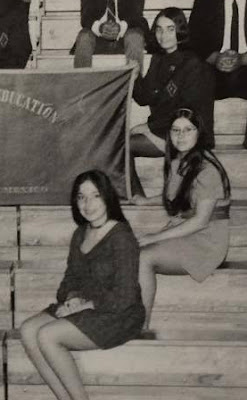
Christina in Distributive Education Class
Santa Rosa High School 1972

Santa Rosa High was a beautiful 12 mile drive down a winding road along the Pecos River in a school bus picking up kids who I now know to be cousins. The first day I went to the cafeteria for lunch, I was served pinto beans, potatoes, green chile and a tortilla. It was the first time in my life I had eaten a traditional New Mexican meal in public. My thought was "I Am Finally Home!" If I had only known then what I know now! It wasn't until about 2010 that I started doing ancestry research and discovered that many of my new friends were related to me, sometimes on both sides of the family because our ancestors had lived in that small community for many, many years. In fact I just discovered last year that my grandfather, Ascension Padilla had given land on either side of my grandparents farm to his female first cousins so they too could have farms in West Puerto de Luna. My mother really didn't like the idea of me living there because she was afraid I would unknowingly marry a cousin. HaHa and I would have! Yet, she never told me who my cousins were and how we were related.

Meanwhile, unbeknownst to me, that same year of 1972, Rudolfo Anaya published his landmark debut novel, Bless Me, Ultima. Rudy was 34 and had been born in Pastura, NM just about 20 miles from Puerto de Luna as the crow flies. It's widely regarded as the most widely read and critically acclaimed novel in the New Mexican Literature Canon. The cornerstone of contemporary New Mexican literature was a semi-autobiographical coming-of-age story written about Puerto de Luna, Santa Rosa and Pastura, New Mexico during WWII in the 1940s. I didn't read the book until after I saw the movie. The story is semi-autobiographical told from the point of view of 6 year old Antonio Márez y Luna as he navigates cultural, religious, and moral challenges with the mentorship of an old revered curandera (traditional spiritual healer) who comes to live with his family. She was known as Ultima. 


What were the chances that Bless Me Ultima would be published the same year I went to live with my grandma while learning the same lessons that he learned when Ultima came to live with his family. We were both learning from a whole community of people that we were very connected to. Rudolfo gave the main character Antonio the last name Marez y Luna honoring his mother, who had been born in Puerto de Luna. She had traditional Catholic beliefs and wanted Antonio to be a priest. His father was a cowboy who wanted to move to California. 
Without going deep into my family tree, I am related to Rudolfo Anaya and Ultima, AKA Anastacia Lucero Bonney. A dear friend of mine, Jasmine is Ultima's great great granddaughter. She's had a store in Santa Rosa, NM called "Casa de Ultima" for a few years but she is closing soon but she sells her homemade herbal remedies and soaps at farmer's markets in Las Vegas, New Mexico. She always takes the Ultima doll that I made for her and displays her with her goods.


Rudolfo was a huge inspiration to me. He passed away 6 years ago today on June 28, 2020 and I am so happy that he didn't leave this world with his stories still inside of him. I saw myself in his stories and it gave me permission to tell my story. I went to see him once at a bookstore in Austin having a book signing. I was to shy to tell him that my parents were from Puerto de Luna. 

I write my blog because I miss New Mexico. I want to keep my very unusually rich New Mexican family story alive. My son Christian and my deceased brother Phillip always being my biggest cheerleaders. Christian said to me once "Mom, you don't even know how many times a week I brag about the work you do, researching our family history and writing our story." It warms my heart to know that he understands how important it is. If I die without telling my stories, our history dies with me. Before my dear brother Phillip pasted away, he would remind me that I am the keeper of the stories and the family history. Before me, my mother was the keeper of  family history and her mother was the keeper of her generation. I feel honored that their Curanderismo was passed down to me. I realize now that is why my grandma Rosita always had a constant stream of people coming to her house to listen to her stories. 

My Mom and Grandma
Agnes Padilla Fajardo
and Rosita Valdez Padilla

Ultima, AKA Anastacia Lucero Bonney died August 15, 1954, 9 months before I was born. 
Frida Kahlo was died on July 13, 1954, 10 months before I was born. I find it very interesting that two of the women who had huge influences on me died the year before I was born. I don't believe energy dies and I have read that when someone who profoundly influenced you died the year before you were born, often symbolizes a spiritual, symbolic passing of the torch. My grandma Rosita died a year before Adriane was born so I named her Adriane Rose for the same reason.

---->  Click here to watch a really good YouTube video called "Meet Rudolfo Anaya"

My mother told me years ago that we were related to Rudolfo Anaya on my dad's side of the family. She made sure I knew it was on Daddy's side because she didn't like that Rudy wrote about his pagan beliefs. As it turns out, he is my 6th cousin 2x removed on his dad's side of the family and and he is the stepson of my second cousin 2x removed on his mom's side of the family. Both of those connections are through my dad's side of the family. 


Sunday, May 31, 2026

Happy Birthday Momma

Today, May 31, 2026 my mother would have been 105 years old. She passed away on April 12, 2005, exactly one month before my 50th birthday. My son, Christian wrote the following last year on the 20th anniversary of my mom's passing. 

Agnes Padilla Fajardo 1946

Agnes Padilla Fajardo
At the house where she raised her family
1804 Magnolia, Amarillo, Texas

Mom, Adriane and Christian in the 80's

Mom and Dylan in the 90's

Christmas 1955 on Magnolia Street, Amarillo Texas
Gilbert, Nita, Daddy, Phillip, Mom and Christina

Agnes Padilla Fajardo
Puerto de Luna, New Mexico


Agnes Padilla Fajardo
Puerto de Luna, New Mexico

Agnes Padilla Fajardo
Puerto de Luna, New Mexico


Agnes Padilla Fajardo
The Red Dirt Girl From Puerto de Luna

Agnes Padilla Fajardo
Puerto de Luna, New Mexico

I love all of the photos I have of my mom when she was young, sitting in the fields, on the mountain sides and near the Pecos River in Puerto de Luna, New Mexico. I always wonder who it was that took these beautifully artistic photos of her. 

Happy Birthday And Rest In Peace My Dear Momma

Friday, February 27, 2026

Healing Ancestral Trauma


For centuries people have been captivated by genealogy, tracing their ancestors through historical records for various reasons. In recent years, DNA tests have taken genealogy to a whole new level. This is a DNA chart of me, my sister Nita and my brother Gilbert. Siblings have different DNA, despite sharing the same parents. We each inherit a unique, random combination of 50% from each parent. Phillip isn't on this chart because he didn't take his DNA test with Ancestry.com.

About 16 years ago, my brother Phillip was the first in my family to take a DNA test. He was interested in finding out if we had Sephardic Jewish ancestry. Unfortunately, at the time the $99 DNA test he took only supplied information on our father’s side of the family. A year later I had a DNA test done by Ancestry.com. By that time the average DNA test provided both paternal and maternal DNA information. In the beginning my interest was in healing generational trauma because I saw a pattern repeating in my life which involved extremely unfair real estate deals that I couldn't logically explain. It became obvious that healing generational trauma would require disrupting established power structures within the family which would require me, the youngest female in a very traditional Hispanic family, to break inherited cycles of dysfunction. Through self-awareness and emotional processing, I could clear the trauma in my lineage. I realized that I went along with the status quo to keep peace in the family and it never worked in my favor. 

Previously, since my DNA is mostly Spanish, I was  taking on the responsibility of the misplaced Jews who lost their homes and all their belongs during the Spanish Inquisition and the misplaced Native Americans due to the Spanish Colonizers in the Americas. But then I realized I am 43% Spanish, 20% Native American, 10% Sephardic Jew and a 27% mixture of a whole bunch of other stuff. In other words, my ancestors experienced both victory and defeat. So, logically, how could I be responsible for the Spanish Inquisition? LOL

I then discovered the study of epigenetics and found that we can carry our ancestors' trauma through epigenetic inheritance. Stress impacts gene expression, turning genes "on" or "off" like a dimmer switch without changing the DNA sequence itself. This affects our descendants' stress responses, mental health and behaviors. That would explain why children born into the same family experience different levels of stress-related behaviors. Past traumatic experiences can leave biological marks, influencing the hormonal systems and brain function in future generations, leading to heightened anxiety or depression. While these marks exist, healing is possible through therapy, and acknowledging family history to prevent passing on these chains. So here I am, trying to heal my family.

Our family's DNA did have an impact that aligned with Phillip's interest in discovering his Sephardic Jewish ancestry, but maybe not the way he thought it did. He passed away September 4, 2025 and in our last personal conversation, he said he wanted to get an updated DNA test. I wish he could have for so many reasons. He seemed to be trying to come to terms with a few things in his last days. Phillip was the only immediate family member who had read my blog regularly over the years and I miss his commentary immensely. There were times when he and I had long phone conversations about spirituality and quantum physics, in the same conversation. He always had a way of taking the conversation to the next level. In the last few years of his life, he didn't get to spend time with the Fajardos. There were unspoken moments when I knew we didn't see eye to eye on religion & politics so we just left well enough alone. 

It seemed almost poetic that my research had taken me back to the 13th century Spain when the Fajardo Army of southern Spain, described as a prominent, elite lineage, had consolidated their forces with the Catholic Monarchs, Ferdinand and Isabella to take over all of Spain during the Spanish Inquisition. Tstatutes, they were among the primary enforcers of these discriminatory Spanish laws that required proof of Christian ancestry "pure blood." These laws were used to exclude Jews, Muslims, or non-Christians from public office and universities. Yet, on the flip side, the surname Fajardo is considered to be of Sephardic Jewish origin due to its historical connection to converso (forced convert) families who fled. Our lineage first went to the Canary Islands and then to New Mexico right after the Spanish Inquisition. It reminds me of the extremes in current day United States, especially Phillip's immediate family of "Born Again Christians" vs the rest of the Fajardo family. It's a perfect example of how all families throughout the ages have their differences. Some of the Fajardos during the Spanish Inquisition were on the side of the Catholic Monarchs and some were Sephardic Jews. We truly do carry our ancestors' trauma through epigenetic inheritance. 

Phillip was diagnosed with a brain tumor in May 2025. He was having seizures and suffered a severe brain bleed that his hospice nurse confirmed would ultimately take his life. Earlier today I opened facebook and this post appeared to remind me that he was diagnosed with a brain tumor and had it removed exactly 16 years ago today. At that time, 16 years ago, the neurologist said he only had 2 years which tell me that Phillip was misdiagnosed. 


But there I was in August, just a couple of weeks before he passed away, having our last private conversation. His wife was glaring at us across the room. It wasn't until then that I realized just what an oppressive relationship he had been in for all of these years. 
It had proven to be useless to bring up any topic his wife didn't approve of. My ongoing research into the "Common Hispanic Mutation" (CCM1 - Cerebral Cavernous Malformation)  and the fact that it is often misdiagnosed as a brain tumor was right at the top of the list of topics that weren't allowed to be discussed. Phillip's wife was treating him with a hand full of non prescribed drugs and he had signed Advance Directives saying he didn't want any more medical care. So there I sat with all my years of research about the genetic mutation that's highly prevalent in our New Mexican blood line on both our father and mother's side of the family. Yet his family ignored the fact that our genetic legacy came from a small group of early Spanish settlers, linked directly to the historical ideology of Limpieza de Sangre (purity of blood) that is scientifically known to cause brain bleeds.

During our conversation Phillip said to me "You and I were cut from the same cloth." I smiled and said proudly "Yes, we were." I felt that in the depths of my heart, yet in the back of my mind I was thinking "Yes, with the same genetic disease, caused by our ancestor's fixation on having pure Spanish blood. And sadly, the same mindset of the right-wing Christian nationalists government who want to keep 'America' white." 

I couldn't save my brother. I strongly believe he is in a better place. When I think of him, I see his healthy, brilliant face in a beautiful field of of mushrooms. 

Phillip Fajardo

The good news is that others have found my blog helpful and informative. I had a doctor from Dallas and one from El Paso who found my blog about 6 years ago. They were both impressed with my research and asked if I would be interested in taking part in their CCM1 studies. At the time, I was in my mid-sixties and I don't drive long distances, so I refrained, but my research was helpful in tracing some of my relatives with the CCM1 gene to the Santa Rosa, NM area. I have also been contacted by many distant cousins who have found my blog because they are on the same journey of self discovery through ancestry. When you do a Google search of Puerto de Luna, New Mexico, my blog is the first thing that comes up because it is literally a ghost town now. 

I discovered much more information than I bargained for when I signed up to become a member of Ancestry.com, thinking I would keep the membership for 3 months. Here it is 15 years later and I have been on a quest that has taken me on an amazing journey through my family's colorful past. Tracing the Fajardo surname back to Spain as far back as the 1200's has been a mind blowing, educational experience.

I started writing about my research for my children and grandchildren because after my parents passed away, I felt like I should have asked more questions. The next generation may be interested in it some day, but meanwhile I am connecting with cool cousins. At the bottom of this post you can click on "See More Posts" and it will take you to older posts.

The journey actually began when I was 16 years old, my junior year in high school, when my parents sent me to live with my Grandma Rosita Padilla in Puerto de Luna, New Mexico as a punishment for skipping school. I was having anxiety attacks at school. That all disappeared when I went to Santa Rosa High. I felt seen and heard. I loved my art teacher, Mr Lopez. I felt a deep connection to my ancestors who had been in New Mexico for over 400 years. In the quiet times, alone on the farm, in my grandma's adobe house, that my mother had helped to build and in the chile fields next to the acequia. Or on the weekends when my cousin Percy Padilla and I worked at the small store/gas station in Puerto de Luna  called "Mercado Coronado." The store was next door to what used to be the Grzelachowski General Store, which is is known for having the likes of Billy the Kid as a regular customer in the late 1800's. I felt that I was surrounded by the spirits of my ancestors and there was an underlying feeling that I had been there in the previous century. It all felt oddly familiar. I felt like I was finally home.

I didn't have time to do a deep dive into my past until years later, after my parents had passed away and my children were grown. Building my family tree has been a nightly activity. The historical discovery of my parents homeland of New Mexico and the journey of my ancestors from Spain has been truly fascinating.

I've learned that a well-researched family tree typically reaches back to the 17th or 18th century with good parish records. I've traced my mother's paternal Padilla lineage back to Anton Martin de Padilla who was born in Sevilla, Spain in 1536. I've traced my father's Fajardo lineage back to my 9th Great-Grandfather Jose Miguel Fajardo born in the Canary Islands in 1591. But I can't help but think his family was just traveling through when he was born because his son, my 8th Great-Grandfather Alonso Fajardo was born in Santa Fe, New Mexico in 1656. 

Fajardo Coat of Arms

I haven't found a connection but there was an Alonso Fajardo de Entenza, Governor-General of the Philippines (1618–1624), who was a Spanish nobleman born in Murcia, Spain and he was the son of Admiral Don Luis Fajardo. He was a Knight of the Order of Alcántara. The Fajardos had been sent out to conquer the world and it appears that some ended up in in the Philippines just before the first Fajardos came to New Mexico. They had to be related but I don't know exactly how.

The surname Fajardo originated in the northwestern region of Galicia, Spain. With roots traced to a nobleman, Pedro Anes Galego, Lord of Santa Marta de Ortigueira. He was the progenitor of the Fajardo surname. Fajardo is a Galician/Latin term for a beech wood or tree. Then the Fajardo family emigrated to Murcia in 1296 and became high-ranking officials of the Crown of Castile. 

You can't imagine the mixture of emotions I had when I discovered that the Fajardo family was the most powerful and prestigious noble lineage in the Kingdom of Murcia, Spain beginning in the 13th century. 

The prestigious Spanish noble title held by the Fajardos was Marqués de los Vélez. It was a title that held major influence in the region for centuries and was first granted to Pedro Fajardo y Chacon in 1507. He was a prominent military leader and politician. I just read a blog written in 2022 about  Pedro Fajardo y Chacon's iconic Castillo de Vélez-Blanco, also know as the Castillo de los Fajardo located in the town of Vélez-Blanco, Andalusia, Spain. It is said to be a remarkable example of a Spanish Renaissance Castle and it has been declared a historical-artistic monument belonging to the National Artistic Treasury since 1931.

Castillo de Vélez-Blanco,
also know as the
Castillo de los Fajardo

Read more about the castle here.

The importance of the Fajardo family in the history of the Crown of Castile didn't go unnoticed by great authors of Spanish literature. In the 16th-century, because the Fajardo family of the Kingdom of Murcia, held such immense power, they became natural subjects for Spain’s greatest writers. There were satirical plays written for them. Research into Spanish literature highlights connections between the poet Acevedo and members of the Fajardo family

With all of that being said, I have known from the start of my ancestry research that the Fajardo and Padilla lineages are only 2 of many of my lineages. Those are just the names I was assigned in our patriarchal naming system. I actually have more Chavez, Padilla and Baca DNA because they are on both sides of my family tree.

In closing, for years I had come across stories of my Spanish ancestors expelling Jews from Spain and conquering the Americas. Ancestral trauma healing involves identifying and releasing emotional, physical and spiritual wounds that have been passed down through the generations. These wounds manifest as unexplained fears and toxic patterns. Healing requires forgiveness. Forgive yourself above all and forgive others. Ancestral research empowers future generations. I've always felt there has to be a reckoning of accumulated damage done by our ancestors. Being a deep thinking, peace loving healer, I wondered if I had been chosen in my lineage to even up the score. Not as a punishment, but to heal the lineage for my family and future generations. Therefore, I have experienced genetic health issues and botched real estate deals to bring it all to my attention. This blog is just one layer of my personal healing process. Thank you for being a part of my journey.


Tuesday, September 19, 2023

He Built It With His Hands - My Tio Guillermo Padilla

Most of the time I write posts about ancestors, who I never had the pleasure of meeting because they lived long ago. Today I am writing about my Tio Guillermo Padilla. AKA Maquela, Maquel, Mac or Max McGee. He had so many nicknames because he was a character. I think Maquel liked flying under the radar, living in Puerto de Luna, however, he wasn't hard to miss. 

The other day I wrote a poem about Maquel, inspired by a conversation I had with my cousin, Tony Dodge while having lunch with him and his wife Sharon in San Antonio. He described how Maquel built his rock walls and as he told me, I could just see Maquel creating his magic. He would place a rock on top of the wall he was building and sit back, light a cigarette and look at the placement of the rock. Then he would ever so slightly move to rock and take another puff off of his cigarette. I as an artist truly understand that form of meditation.

Guillermo Padilla
AKA 
Maquela, Maquel, Mac or Max McGee

Guillermo Padilla was born June 8, 1913 in Puerto de Luna, New Mexico. He died March 10, 1985. He was an eccentric man with many talents. He was a musician, an artist and a rock mason. I didn't like him as a child because I didn't understand him. He was quiet and he snored and talked in his sleep. Now I understand. Now I think he probably would have been described as being neurodivergent because of his social preferences and the fact that he was very talented in certain creative areas. I recognize this because I too am neurodivergent. I am thinking there could be a genetic element. I am glad that in my lifetime society has finally concluded that people experience and interact with the world around them in many different ways; there is no one ‘right’ way of thinking, learning and behaving and differences are not viewed as deficiencies. 

This is a painting I did of the adobe house in Puerto de Luna
where Guillermo lived most of his life.

Maquel was my mom's older brother. He never married. He lived 12 miles from Santa Rosa in Puerto de Luna most of his life, except when he was in the army. He was stationed at Fort Bliss, Texas for basic training, then he went to Egypt and Italy, where he was honorably discharged due to medical issues. From what I understand, he came back from WWII with what is now known as post traumatic stress disorder. I have a feeling many returned from WWII with PTSD.

The other day after I wrote the poem about Mac, I posted it on Facebook and I was surprised at the response I got from cousins who had memories of him when they were young. My cousin, Patrick Padilla said that my post brought back fond memories. One summer Patrick's father, Floyd Padilla, forced him to help Tio Maquel build a rock wall around their yard. He said he'd never forget riding with Maquel to Puerto de Luna in his old flatbed truck to gather the rock for the job. Patrick said he was amazed at how Mac knew just where to hit the large sandstones near the river with his pickaxe to break off chunks of rock for the wall. Patrick also said he had always wished he could have learned more about masonry from Maquel but it was hard work and he was too young to care. I didn't know until then that Maquel actually quarried his one stones! He quarried sandstone, smooth river granite stones and even petrified wood. He was an amazing mason.Watching him piece together a wall was a beautiful thing. I remembered that we had a pile of petrified wood on the side of our house that my dad was sort of proud of. He would move the pile to mow the grass and carefully place it back in the middle of the side yard. To anyone else, it was just a pile of rocks.


This is my grandson Dylan standing in front of my
parents house in Amarillo, TX in 2010.
This is the only photo I could find of the
rock flower bed Maquel built in front of the porch.

This is one of Maquel's walls at the entrance of Park Lake
in Santa Rosa, New Mexico

Guillermo Padilla on the left playing accordion


Guillermo Padilla playing accordion in Puerto de Luna

My dad Felipe Fajardo and Guillermo Padilla

And the beauty of it all was that he wasn't just a rock mason. He was also an artist and a musician. I started painting horses in the early 1990's and it wasn't until my brother Phillip saw one of them and told me it looked like one of Uncle Mac's that I remembered his horsed that drew and mine look just like his.

My daughter Adriane wearing one of my
"Two Ladies on Horses" T-Shirt at an art show in 1993.


"Two Ladies on Horses" T-Shirt painted by Christina Fajardo 1993 

I've been told that the wait staff put a black ribbon around the booth where Mac used to sit and drink coffee at his favorite restaurant in Santa Rosa. I don't know that for a fact because I was living in Austin with 2 children in 1985. It's good to know that your DNA lives on Uncle Mac. My son's nick name was Big Mac for a little while and he wore it proudly and used to make Instagram posts of Mac that were pretty funny.


Monday, August 23, 2021

Mercado de Coronado - Puerto de Luna, New Mexico

Painting of My Grandma's House
by Christina Fajardo

In 2017 I wrote a blog reflecting back 45 years to 1972, when I was 16 years old. I was born and raised in Amarillo and had lived on Magnolia Street in the Hamlet neighborhood my whole life, up to that point.  I am sure when my parents moved there from Garfield Street, it felt like heaven. It was a new middle income neighborhood when I was born. North Amarillo was booming because of the airbase. We were in walking distance to the largest park in Amarillo. Thompson Park was my paradise. It had a Zoo, swimming pool and an amusement park called Wonderland. Life as I knew it, was pretty freaking good on Magnolia Street. We had a 4 bedroom house and my dad had a workshop in the backyard and we always had a beautiful yard due to the fact that one of my dad's favorite pass times was watering the grass, feeding birds and stray cats.

This is the house I grew up in at
1804 Magnolia, Amarillo, Texas

Both of my brothers and my sister had gone to the local north side high school, Palo Duro High. However the dynamics of the high school had changed considerably by the time I arrived there for my junior year. My best friend Regina's parents transferred her to Alamo private Catholic school. My parents decided to take me to Puerto de Luna, New Mexico to live with my 90 year old grandma on her farm. I realized later, this was simply to make a point, to show me how tough things really could be since I was seemly unhappy living in my perfect teenage bedroom with blacklight posters, walk-in closet and blue princess phone. 

Playing guitar in my bedroom

I had a cute boyfriend who lived down the street. We were either on the phone or hanging out at the swimming pool or Wonderland at Thompson Park.

Jay Spann and Christina Fajardo

Next thing I knew, I was, living with my grandma Rosita in Puerto de Luna, New Mexico. It made for a very interesting living situation since she was blind and she only spoke Spanish. My saving grace was that my Uncle Gilbert and Aunt Rita Padilla and their 8 kids lived next door. 

Me with my cousins who lived next door
 to my Grandmas Rosita, in Puerto de Luna, NM
From left to right: Percy Padilla, Christina Fajardo,
Mark Padilla, Rita Padilla and Michael 
Padilla

Distributive Education Class
Santa Rosa High
Bottom Row - Christina Fajardo
Middle Row - Connie Campos
Back Row - Percy Padilla

I wasn't really aware that my parents had taken me to Puerto de Luna to convence me of how good my life in Texas really was. Needless to say, they were extremely surprised when they returned a couple of weeks later to take me home and found that I had settled into my new dusty New Mexico farm life very well. I didn't mind sleeping on a roll away bed in my grandma's bedroom. I found it comforting to hear her pray the rosary at night in the dark with an owl hooting in the tree outside my window. The 12 mile school bus ride to Santa Rosa High wasn't so bad because the radio station seemed to play Jose Feliciano's "Ain't No Sunshine" every morning at the same time. I loved being the new girl in school and the teachers thought I was brilliant. Especially my art teacher, Mr. Lopez, who bought me canvas and oil paints while everyone else was painting on paper. I loved that the school cafeteria served rice, pinto beans, potatoes and tortillas for lunch. For the first time in my life, I felt like I was really at home. I found a group of friends who have remained lifelong friends, unlike the majority of the kids I had gone to school with for the previous 10 years. And the icing on the cake is that I have since learned that most of them are my cousins.

I didn't miss spending my weekends going out with the party animals of Amarillo. In fact, there was a small co-op grocery store/gas station in Puerto de Luna called "Mercado de Coronado." My first cousin Percy Padilla and I worked there on the weekends. It was located in an old, light green adobe building next to what used to be the Grzelachowski General Store, established 100 years earlier, around 1872. 

Photo of the "Mercado de Coronado" It has been closed for many years
Grzelachowski General Store, Puerto de Luna, NM

There were a couple of young men who were VISTA volunteers who helped organize "Mercado de Coronado." The other day I received an email from Sam, one of the VISTA volunteers. He said he had stumbled across my blog a couple of years ago while looking for news of Puerto de Luna. It was so cool to hear from him. I have such fond memories of that little store. The front room had a cash register, shelves of essentials like canned goods, bread, crackers and the not so essential candy and a refrigerator full of generic sodas. Then there was a pool table in the other room. The regulars would come by with money in hand to put their quarter on the pool table to take their turn at pool and another quarter for a soda. We also sold gasoline as you can see by the rusty old Conoco gas sign still standing out in front of the building in the photo.

The church where my parents were baptized and married was in walking distance and across the road was our family cemetery where my little brother, Larry was buried.

Nuestra Senora del Refugio Catholic Church

At the time, I had not a clue what historic events had taken place in that very location a century before. My paternal grandmother Josefita Labadie Fajardo's family lived in Puerto de Luna as well. My first cousin (3 generations back) Beatriz Labadie was married to Juan Patron. They had been living in Lincoln but the Lincoln County War had broken out so they moved to Puerto de Luna to live on the Labadie ranch. Upon their arrival, Juan raised money to have the church, Nuestra Senora del Refugio (Our Lady of Refuge) built in 1982. Unfortunately, the first mass held in the church was for Juan Patron's funeral. He was murdered at a salon in Puerto de Luna.
He is buried under the nave of the church. He could have very well become the governor of New Mexico but instead he was needlessly assassinated before the age of 30.

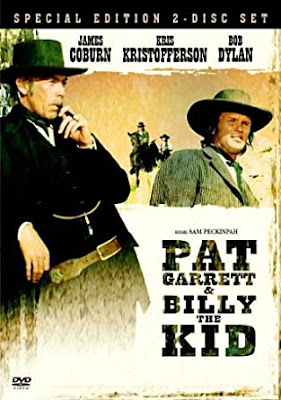
The following year one of my all time favorite movies, "Pat Garrett and Billy the Kid" was released. I never thought twice about why I felt so emotionally attached to the movie and the sound track. 

Movie poster for Pat Garrett and Billy the Kid

There were very few remnants left of what a bustling little community Puerto de Luna was 100 years before. It was the county seat, so there was a court house, post office and a beautiful Catholic church. 

Court House in Puerto de Luna, NM

My cousin Juan Patron, a young, up and coming politician had raised the money to build the church. He was murdered in a Puerto de Luna saloon on April 15, 1884, just 
as the church was being finished. His funeral was the first mass to be held in the new church and he is buried in the nave. He was the son-in-law of my Great-Great Uncle Lorenzo Labadie, who was one of the most impressive characters in my family history during the 1800's. He had been a Lieutenant Colonel, a sheriff and when he got older he had orchards and vineyards. He had a license to sell wine and was the he was a very accurate census taker. While doing my ancestry research, I always know that if the census was filled out by Lorenzo Labadie, it is complete and accurate. 

Now, reflecting back, I wish I would have asked a lot more questions of the local farmers who came in to buy gas at "Mercado de Coronado." I wish I had know a little more history of this dusty little ghost town when I lived there. Bobby Gerhardt (my  second cousin) was one of my favorites who often came into the store. He was a tall, blue eyed rancher with the a golden farmer's tan. He always wore a grin and joked with everyone he met. He spent evenings at my grandma's smoking cigarettes and drinking a cold one with my Uncle Jose Padilla out in the screened in porch by the light of the moon. 

This is when a healthy dose of time travel would come in handy. William Bonney AKA "Billy the Kid" spent a lot of time in Puerto de Luna at the Grzelachowski General Store in the late 1800's. I was beyond surprised when I found his name on census 1880 census when I was researching John Gerhardt. Interestingly enough, John Gerhardt was my Great Aunt Doloritas Padilla Gerhardt's father-in-law and he was also my Great Uncle Hilario Valdez's father-in-law. This is where one of the branches of my family tree gets a little tangled. My mom's Aunt Doloritas Padilla, on her dad's side was married to John Gerhardt's son, Henry Gerhardt. AND my mom's Uncle Hilario Valdez, on her mom's side was married to John Gerhardt's daughter, Katie Gerhardt. John was the only practicing doctor in the vicinity. I remembered stories of my Great Uncle Hilario being the Gerhardt Ranch foreman for many years prior to marrying Katie. Later Hilario and Katie had a ranch in Los Ojitos and Grandma Rosita Valdez Padilla and my Grandpa Ascencion Padilla had an adjoining ranch. I'd heard the old folks speak of all of these characters my whole life but didn't pay much attention to the Spanglish (half English and half Spanish) conversations and private jokes that they had shared for years. 

Oddly, when I started doing ancestry research I adopted a cat named Katie and then another named Rosita. It was purely serendipitous. It felt like it was a little private cosmic joke on me from the Universe that they came with the names of my grandma Rosita and her sister-in-law, Katie. Often, as I drank tea engrossed in my late night research, I imagined the sister-in-laws, Kate and Rosita, cooking posole together as they tended to fire in the wood burning stove and the children playing on the dusty wooden floors of their adobe houses while their husbands, Hilario and Ascencion worked the sheep ranches.

So my time in Puerto de Luna was short lived. My parents made me go back to Amarillo for my senior year. When I returned to Amarillo, I went to school half day and worked half day, saving my money to get back to New Mexico the summer after I graduated. I rented a little adobe house in Santa Rosa that summer with Yolanda Smith. I had big plans to attend Highlands University in the fall. My parents had other plans. They snatched me up and took me to Austin where I would remain most of my adult life. 

My house in Santa Rosa
My cousin Barbara Quintana Baca's children,
Timothy and Kris Baca
In front of my macrame and
mural on the living room wall
in my tiny house on the hill, in Santa Rosa

Moving back to New Mexico has always been in the back of my mind...but for now my heart and soul live there and I just go back to visit every couple of years.


One of my favorite photos of Puerto de Luna


My cousin Davy Delgado just told me that the Puerto de Luna area has been inhabited by descendants of indigenous Pueblanos and llaneros, Hispanos and Mexicanos since 1541. Manuel Chavez' familia was there before 1849 and Hacienda de Agua Negra Land Grant settlers were there by 1824. The first three "residents" of Puerto de Luna were Fray Juan Padilla and two others in 1541, according to documented history.