
The synchronicities in my life are sometimes so astonishing that I have to write down the events to reflect back on the events at a later date. As I understand it, synchronicities occur because the connection between our individual psyche and the collective unconscious creates a sense of meaningful connection between our internal and external experiences. If one pays attention, seemingly random events line up and can be interpreted as signs from the Universe. These synchronistic events are part of the reason I write this blog. This post is going to touch on what appears to be a couple of different subjects that you will see actually all come together in the end.
In case you are new to my blog, the topics are largely about my profound connection to my ancestors, the majority of whom were the original Spanish settlers of New Mexico. I'm a first generation Texan... barely... I was born at St Antony's Hospital on Route 66 in Amarillo, just 50 miles east of the Texas/New Mexico border. Before my generation, both sides of my family had been in what is now New Mexico since Spain colonized the New Mexico region in 1598. Then, for 27 years between 1821-1848, New Mexico became part of Mexico when Mexico won its freedom from Spain. Then in 1848, the United States claimed the top 55% of Mexico which is now the western part of the United States including New Mexico, California, Arizona, Nevada, Utah and portions of Colorado and Wyoming.

Mexico also gave up its claims to Texas, hence recognizing the Rio Grande as the border between the United States and Mexico. It seems appropriate to be writing about borders right now since the newly appointed administration of the United States is trying to deport Mexicans and even Native Americans. Why? "Because they're not Americans." WHAT? Here we are again. As of inauguration day, January 20, those at the top are fighting the same old war. Not actually trying to take land but deporting people out of the United States. Call me crazy but Native Americans are just that. Native. According to archaeological and genetic evidence, Native Americans have been in America for at least 20,000 years. And as for the Mexicans... the western half of the United States used to be Mexico. Logically they have every right to be here. As for me... my family immigrated from Spain to New Mexico 427 years ago. I think it's safe to say this is my home.
My country is in an uproar. Along with all the other crazy distractions, the new administration is trying to change the name of "The Gulf of Mexico" to "The Gulf of America."
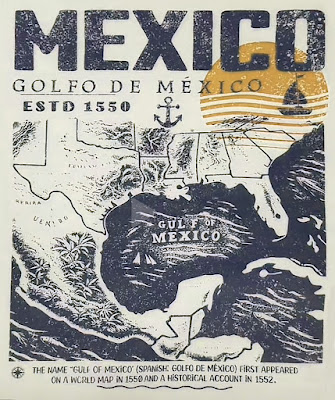
Yet, simultaneously, something really cool happened to me the other day. These synchronicities always happen when there is an uproar in our country, seemingly to help me process the madness and I am so very grateful for these positive little messages from the Universe.
A piece of artwork that had been in my family since the 1960's made it's way back to me on January 12. But first I have to tell the story about this piece of art and the artist who painted it and why it has anything to do with the uproar in the United States.
 |
| The Fajardo's Thanksgiving dinner 1970 with "The Wagon Boss" on the knotty pine wall. 1804 Magnolia, Amarillo, TX |
I had written about it in January of 2022 when I was in St Louis for my annual winter trip. But now I actually have the piece of art and I've learned more about the artist and his family. They were very much a part of the western states becoming a part of the United States in the 1800's. Here's a link to the blog from January 17, 2022 if you want to read it later.
https://christinafajardo.blogspot.com/2022/01/the-wagon-boss-by-charles-marion-russell.html
I wrote the above blog on a typical snowy winter day in St Louis. As I sat sipping mint tea, deep in thought, hundreds of miles away from my Central Texas home, I imagined that my son, grandchildren and I had been sent on a mission by our ancestors to this midwestern outpost in St Louis. The purpose? To heal some of our generational trauma. Why would I feel that? Well, a few male characters in my family tree came from the St Louis area in the mid 1800's and married into my large Spanish settler family. There was a big land grab going on out west after the United States had taken more than half of northern Mexico. It's always felt a little more than coincidental that my son would end up living right back in St Louis.
I had begun that day reading about the marriage of my cousin Josefa Jaramillo and her husband, the frontier legend, Kit Carson. They seemed to have a storybook romance. On the other hand, Josefa's older sister, Maria Ignacia Jaramillo was the common law wife of Charles Bent. He was equally as well known as his brother-in-law, Kit Carson. He was an American businessman who owned the most important trading post on the Santa Fe Trail called Bent’s Fort. It was the only permanent settlement that was not under the jurisdiction and control of the Hispanic or Native Americans citizens in the west. Charles Bent and his younger brother, William Bent started out as fur traders. Their father, Silas Bent was a prominent land surveyor and Supreme Court Judge for the Missouri Territory. The Bent brothers could have lived lives of ease in St. Louis but they saw the potential wealth in fur trading in the western territories.


It was common for men to "go west" to find fortune in the uncharted lands out west. It was also a known fact that to be successful out west, the protocol was to convert to Catholicism and to marry into a large, prosperous, land owning Hispanic family who had been well established citizens since the 1500's. In the case of Kit Carson, he converted to Catholicism and married Josefa Jaramillo. Charles Bent didn't want to convert to Catholicism so Maria Ignacia Jaramillo merely became his common law wife.
I just discovered a book called "Blood in the Borderlands: The Rise and Fall of Charles Bent, 1829-1847" by David C. Beyreis. The book says that Charles Bent knew that he needed to be “plugged into” local power networks and "marriage" into a landowning Hispanic family was the best way in. But he just barely tolerated the people of New Mexico. On the surface his plan seemed to be working for him. The United States appointed him as governor in 1846 and his possibilities seemed limitless. But there was trouble brewing. The powerful Hispanic families and Native Americans of New Mexico felt that the new U.S. governor didn’t treat them with due respect. They feared that their land titles would become null and void and they’d lose their land. Only 4 months after Charles Bent became governor, a group of Native Americans and Hispanics gathered in the Taos plaza demanding the release of some Native Americans who had been jailed by U.S. troops. The Taos Revolt broke out and it ended with Governor Charles Bent being scalped and murdered.
Needless to say the Bent family was both powerful and controversial, depending on who recorded the history. Charles Bent and his brother William had been disowned by the Bent and Russell family. The Bent brothers had a sister named Lucy. Her full married name was Lucy Bent Russell. I found her grave at a cemetery in St Louis.
 |
| Grave of Lucy Bent Russell St Louis, MO |
Of course that lead me down another rabbit hole and I discovered her grandson was the famous American artist of the American Old West, Charles Marion Russell. Also known as C.M. Russell, Charlie Russell or Kid Russell. Here's where my story comes full circle. When I was a child, my father worked as a furniture repairman at "Heath Furniture Store" in Amarillo, Texas. Our home was always decorated with the most fashionable Early American Furniture, upholstered with the most plush earth toned velvet fabrics. A large framed print of a Charles M. Russell painting "The Wagon Boss" hung on the knotty pine paneled wall the living room above the couch. I never knew anything about the piece of art or the artist. To me it was just pretty piece of art from a nice furniture store.
 |
| "The Wagon Boss" Painted by Charles Marion Russell The original oil painting The Wagon Boss by Charles M. Russell is owned by the Gilcrease Museum in Tulsa, Oklahoma. The Thomas Gilcrease Foundation gifted the painting to the museum in 1955 |
This masterpiece that I spent hours gazing at, was a print of a painting from 1909. The earth toned art matched the knotty pine paneling and the floral earth toned love seat, gold arm chair, polished end tables with gold lamps that were all perfectly arranged on the gold carpeted floors.
What a surprise to discovered as an adult that Charles M Russell was born in St Louis in 1864. He left home at the age of 16 and went west where he painted more than 2,000 paintings of cowboys, Native Americans and landscapes and created bronze sculptures set in the western United States.
Charles M Russell had been named after his Great Uncle Charles Bent but didn't follow in his footsteps. He was a gifted artist, storyteller, historian, writer and advocate for Native Americans. Totally opposite of his power and money hungry uncle.
This is where the story of the art by Charles M Russell and the uproar of the United States all come together. Earlier this month, I went to my step-daughter Sarah's birthday party. All of the women and kids were sitting around the dining room table talking and eating while the men were playing corn hole in the backyard.
 |
| Ethridge Family Dylan Ethridge, Adriane Ethridge, Davis Ethridge, Sherry Ethridge, Christina Fajardo, Sarah Ethridge, Jeanette Parr and Emerson Ethridge |
My ex-husband, Davis' wife Sherry casually says to me "I have a surprise for you." I said "What is it?" She proceeded to remind me that when Davis and I got divorced, I had left the Charles M Russell "Wagon Boss" painting in the closet and it was still there. I was in shock. She told me I could drop by their house and pick it up. So Dylan and I dropped by and picked it up. I brought it home with the intention of giving it to Dylan because he has asked for it. My parents had taken it out of the frame some time in the 70's and I am guessing I brought it home to Austin with me around that same time. It may have even hung over my fireplace at one time, I can't remember.

At any rate it seemed magically synchronistic that the "Wagon Boss" would make its way back to me at this time when the political choices of our country's administration is mimicking the times when Charles M. Russell's power mongering Great Uncle Charles Bent had been appointed governor of New Mexico. A man with no moral compass, who had lived a life of privilege and lacked empathy towards people who didn't look like him or speak his language or practice his religion. Sound familiar? He was a lot like the man who bought his way into the White House earlier this month.
It warms my heart that Charles M Russell went his own way and lived a life of empathy and compassion. This painting represents the kindness in Charles Russell's heart. He chose to spend his life helping the disenfranchised after his great-uncles had played such a huge part in doing just the opposite. Charles M. Russell, often called "the cowboy artist," is recognized for his significant contribution to portraying the positive Native American life and culture in his art. He used his platform as an artist to depict Native Americans as strong, dignified people. He also advocated for their rights through his paintings and writings, even going as far as supporting land rights for tribes by lobbying for the establishment of a reservation for them.
 |
| Charles M Russell |
In closing it warms my heart that my father chose a piece of art to hang in our home that was painted by someone who wasn't just a "cowboy artist." He was related to my family by marriage and a hero of mine. He was recognized for actively helping Native American tribes by deeply immersing himself in their culture and portraying their lives with respect and accuracy in his art, preserving their history accurately through his paintings.
With love to you Charles M Russell. May your kind spirit live on forever.


